
It was learned from the National Astronomical Observatories of the Chinese Academy of Sciences on the 20th that China's Tianwen-1 Mars probe recently sent back exciting news: it successfully captured clear images of an "interstellar visitor" that entered the solar system from Mars orbit, obtaining unique information on its dust activity. The related research findings were published in *The Astrophysical Journal Letters*.
This "interstellar visitor," named 3I/ATLAS, is the third interstellar object confirmed by astronomers. Discovered by astronomers in July 2025, its orbit indicates it was born billions of years ago in distant space outside the solar system. From late September to early October 2025, it happened to have a close encounter with Mars, providing an excellent observation opportunity for Tianwen-1, which is operating in Mars orbit.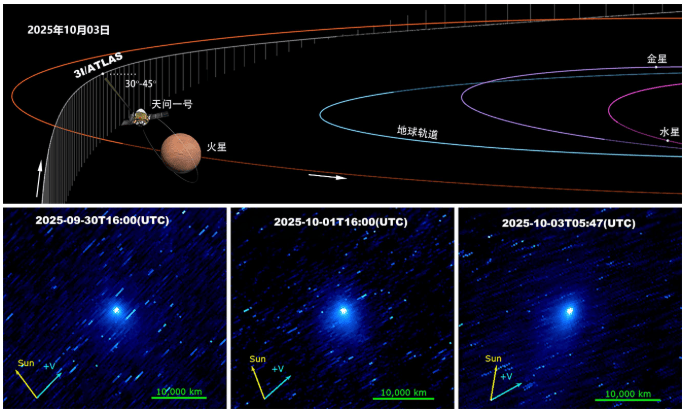
Researchers from the National Astronomical Observatories of the Chinese Academy of Sciences and other institutions used the high-resolution camera onboard Tianwen-1 to photograph 3I/ATLAS three times from September 30 to October 3, 2025. The images show that the morphology of this "interstellar visitor's" dust tail changed significantly: evolving from a fan shape into a curved, narrow tail.
The research team's analysis found that the dust ejected by this "interstellar visitor" is mainly dominated by larger particles of several hundred micrometers, much larger than the micrometer-scale dust commonly seen in typical solar system comets; the dust ejection velocity is about 3 to 10 meters per second. Notably, although the overall appearance of this "interstellar visitor" changed due to viewing angle variations, its brightness remained surprisingly stable.
Based on observational data estimates, this interstellar object ejects about 1 ton of dust material per second on average. "By comparing it with the second confirmed interstellar object, we speculate that the main gas driving its ejection is likely water ice, and the size of the object itself directly determines the rate of its 'weight loss,'" said Ren Xin, the first author of the paper and a researcher at the National Astronomical Observatories of the Chinese Academy of Sciences.
It is worth mentioning that previous studies suggested seeing multiple jets on it, but the images taken by Tianwen-1 from different viewing angles did not find such structures, indicating that the previous view needs further scrutiny.
Ren Xin stated that this successful observation is an important extended application of the Tianwen-1 mission. It not only demonstrates that the orbiter is operating stably and in good condition but also validates the capability of deep-space probes to conduct flexible observations of sudden "targets of opportunity," accumulating valuable experience for subsequent deep-space exploration missions.