
On May 21, a research team jointly led by Academician Xue Qikun, Professor He Junfeng from the University of Science and Technology of China, and Associate Professor Chen Zhuoyu from the Southern University of Science and Technology directly observed a nodeless superconducting gap in a nickel oxide high-temperature superconducting thin film for the first time, and discovered the phenomenon of electron-boson coupling. The related research findings were published in Science on the same day.
It is reported that this discovery provides important experimental evidence for the two core issues of high-temperature superconductivity: "superconducting gap symmetry" and "superconducting pairing mechanism." It holds significant scientific importance for deeply understanding the mechanism of high-temperature superconductivity and also serves as a foundation for promoting broader applications of superconducting technology.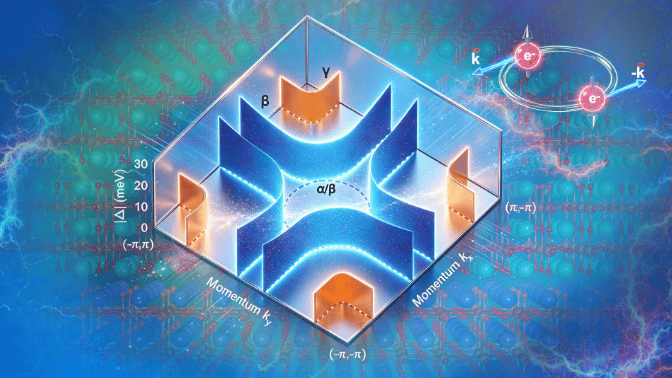
In superconductors, electrons "pair up" and travel together. This "pairing" behavior is fundamental to the phenomenon of superconductivity. However, in high-temperature superconductors, why electrons pair up and in what manner they pair remain among the biggest mysteries in physics.
"In superconductors, electrons save energy by pairing up, and this saved energy is the superconducting gap," introduced Chen Zhuoyu. "We can imagine electron pairing as a pair dance, and the symmetry of the gap is their 'dance posture'."
According to the introduction, the gap in conventional superconductors is fully open with no nodes where the gap is zero, belonging to s-wave symmetry, while copper-based high-temperature superconductors have long been considered to have nodes, belonging to d-wave symmetry.
"Therefore, whether the gap has nodes is a key indicator for distinguishing the physical origin of high-temperature superconductivity," Chen Zhuoyu introduced. This study provides a clear answer for the first time in RP bilayer nickel-based high-temperature superconducting thin films: their superconducting gap has no nodes and is more consistent with s-wave (or s± wave) symmetry.
It is reported that although both are high-temperature superconductors, the pairing mechanisms of nickel-based and copper-based superconductors may not be entirely identical.
How electrons pair is another key to unlocking the mystery of high-temperature superconductivity. Theoretically, electron pairing mechanisms fall into two categories: one requires no mediator, while the other requires a mediator for transmission.
"We captured a typical 'band kink' spectroscopic signal about 70 meV below the Fermi level, which is precisely the 'fingerprint' left by the coupling interaction between electrons and some kind of boson," introduced Chen Zhuoyu. "This confirms the existence of electron-boson coupling in nickel-based high-temperature superconductors, suggesting that their electron pairing is likely facilitated by some kind of mediator."
It is also learned that this discovery provides important experimental evidence for answering how electrons pair. Currently, the research team has found traces left by the mediator through these "fingerprints." The next step, confirming exactly what boson acts as the pairing mediator, may become the key to ultimately elucidating the physical mechanism of high-temperature superconductivity.