
In the field of construction robotics, whether humans and machines can achieve true "collaborative operation" on unpredictable construction sites has long been the ceiling of automation research. Recently, the Princeton University Architectural Structures and Design Lab team published a landmark achievement at the 43rd International Symposium on Automation and Robotics in Construction (ISARC 2026), a top-tier international conference in automation and robotic construction. They proposed, for the first time, a closed-loop feedback-driven adaptive human-robot collaborative masonry process, fundamentally solving the world-class problem of precision loss in multi-process collaborative operations on construction sites (and extended scenarios).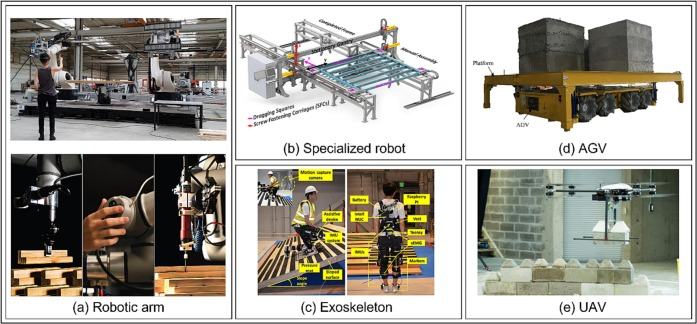
Breaking Through the "Execution Silos" in Construction and Mining
Both building construction and mining/tunneling operations are highly integrated systems engineering. Traditionally, construction sites involve numerous processes and rely heavily on human-machine cooperation. However, faced with the "uncertainties" of material supply, dimensional tolerances, and accumulated on-site disturbances, robots under open-loop command control often "appear clumsy." In the mining industry, similar problems are particularly prominent: processes like underground coal mine roadway support, concrete or cement slurry spraying, and rock bolting with shotcrete still heavily rely on manual labor or semi-automated heavy equipment. The error accumulation caused by remote control and the information lag from complex working conditions make it difficult to achieve both operational precision and large-scale safe construction. How to enable robots to adapt to the physical feedback of highly dynamic environments, achieving human-like "perceptiveness," and guide manual processes with precision through real-time visual means has become a key strategic pivot for the deep integration of intelligent construction and intelligent mining.
Adaptive Collaborative Process: From "Open-Loop Execution" to "Real-Time Correction"
The research team proposed an adaptive human-robot collaborative workflow for construction. The core tools of this process are a real-time feedback loop based on laser scanning and an end-effector projection guidance system:
Laser Scan-Driven Closed-Loop Correction: Through an intelligent laser scanner, the robotic system continuously collects the actual dimensions and placement positions of bricks. When misalignment caused by raw material tolerances or accumulated deviations from previous processes is detected, the robot no longer mechanically executes pre-programmed instructions. Instead, it uses laser scanning feedback to dynamically correct its grasping posture and placement pose. This closed-loop adaptive mechanism directly resolves the industry bottleneck of "material and assembly uncertainty."
End-Effector Real-Time Projection Guidance: The research team innovatively added a high-precision projector to the end of the robotic arm. After the robot precisely places a brick, the system calculates in real-time through algorithms and immediately projects the adhesive application area required for the next brick onto the manual work surface in a visualized manner. This means workers no longer need to interpret drawings or judge by eye; they simply operate along the "glowing blue outline" on the floor or wall.
The paper indicates that through this series of "perception-calculation-correction-projection" closed-loop interactions, the system significantly improves the precision and robustness of collaborative operations, successfully avoiding large-scale engineering rework and safety accidents caused by open-loop execution.
Technological Grafting: From Building Walls to Underground Three-Dimensional Spaces
Although the paper uses bricklaying as its entry point, the technical architecture it constructs—"3D scan-based closed-loop adaptive control" and "end-effector real-scene guidance"—possesses strong universality for basic equipment, especially showing broad application prospects in complex mining engineering operations:
1. Underground Coal Mine Roadway Masonry and Sealing Wall Construction
Underground sealing construction conditions in coal mines are more complex, arduous, and dangerous than those on the surface, with long operation times, high construction difficulty, and high costs. Traditional pneumatic shotcreting equipment or manual masonry often lags in adapting to the variable rock contours and support strength underground. Drawing on this technology, future intelligent underground masonry/shotcreting robots could use high-precision laser scanners attached to the robotic arm to perceive the three-dimensional surrounding rock contour of the roadway in real-time, precisely adjusting the placement posture of support components. Simultaneously, a projection system mounted on the arm's end could accurately guide auxiliary underground personnel in applying base anchoring grout or plugging materials. This technology can significantly improve the support quality of shafts and chambers and the precision of surrounding rock control, effectively eliminating hazards like roof falls and rib spalling caused by roadway deformation.
2. Surface/Deep Underground Hard Rock Drilling and Rock Bolt Installation in Mines
Under the current mining trend of turning "overlying resources" into "rich ores," drilling precision and control of bolt hole formation angles have become key factors restricting mineral resource recovery rates and the quality of single-pass roadway completion. The dynamic visual perception mechanism in this technology can effectively empower intelligent mining drilling robots: enabling them to detect minute displacements of the drill bit caused by lithological changes during cutting. Through real-time adaptive adjustment of the end effector, it can avoid bolt failure and support density waste caused by drilling deviation. Furthermore, the real-time adhesive dispensing guidance concept based on 3D imaging can be expanded to "anchoring agent position guidance" or "drilling depth indication," achieving a fully unmanned or minimally manned drill-anchor-support process.
3. Collaborative Operations on Subsea/Deep Mine Extraction Faces
In confined underground spaces, the cross-operation of large extraction equipment and manual work crews has always been a difficulty for mine safety. The "human-robot communication" closed-loop method proposed by the Princeton team provides a highly stable engineering implementation solution for multi-equipment collaboration in underground mines. Its underlying control strategy can be directly transformed into a collaborative scheduling hub for coal mine robot clusters, ensuring that the operational precision and safety boundaries of the entire heading face are fundamentally guaranteed in extremely harsh environments.
The emergence of this technology is not only a significant indicator of the Construction 4.0 era but also a key cornerstone for the mining sector's move towards truly unmanned factories. As this "adaptive collaboration" concept extends to heavy-duty robots specialized for mining, mining operations will accelerate from "mechanization replacing humans" into a new era of "adaptive robots replacing manual labor." This will bring a revolutionary leap in intrinsic safety levels and comprehensive resource utilization efficiency for mines worldwide.