
Narrow tunnels, dim lighting, no GPS signal, rugged terrain—these are the formidable barriers that underground mines pose to inspection work. Now, a multinational research team led by Zhejiang University is turning quadruped robots into "exploration pioneers" capable of independently traversing these extreme environments. The newly developed autonomous inspection framework, QRIVAS (Quadruped Robot Intelligent Visual Acquisition System), has overcome numerous key technical bottlenecks in autonomous navigation within complex underground settings. It achieved a 100% navigation success rate in simulation tests and 96.7% in scaled bridge column tests. This breakthrough not only provides a brand-new solution for the intelligent perception of transportation infrastructure like bridges but also opens up vast prospects for unmanned inspection operations in China's underground mines.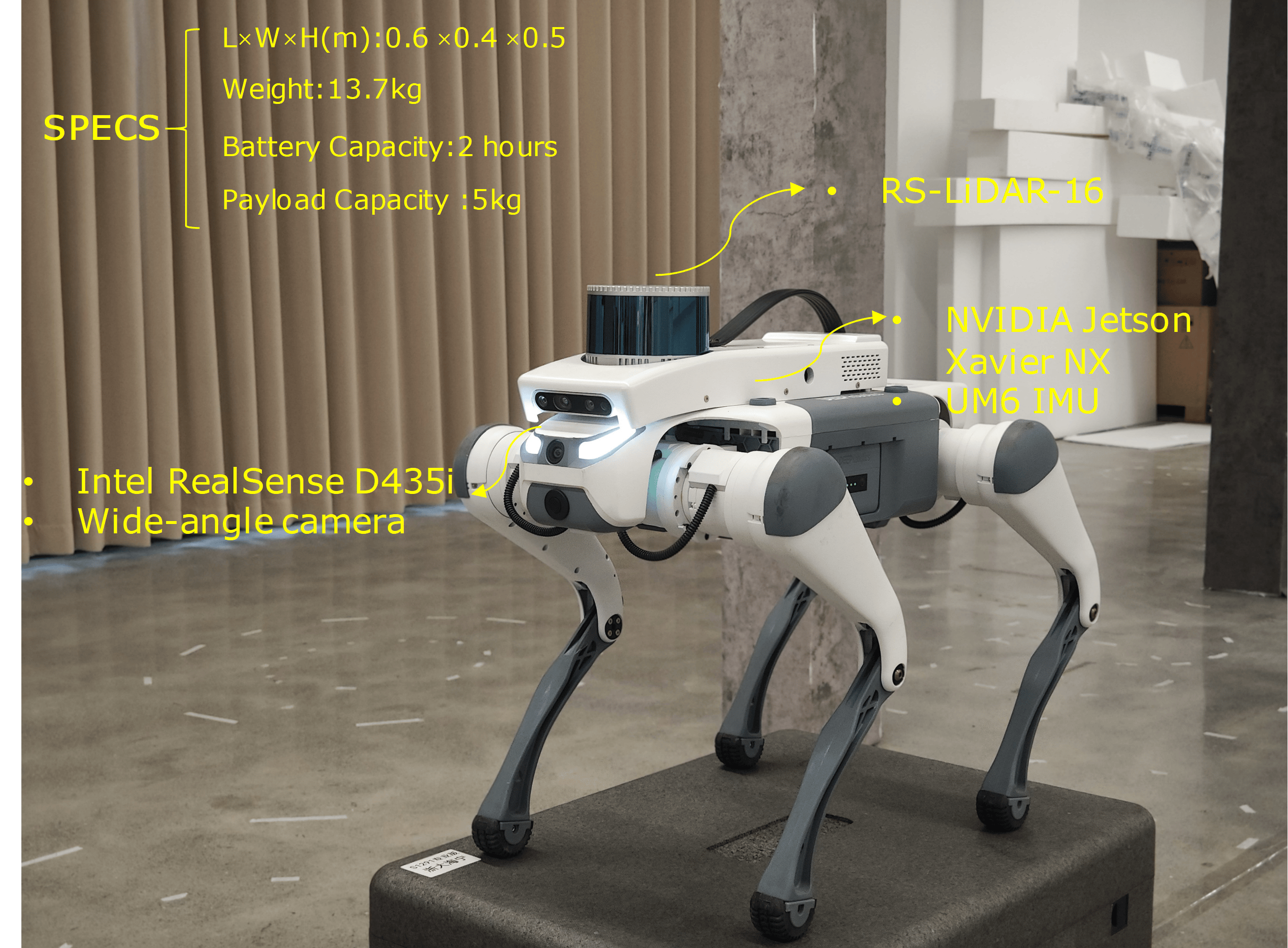
Equipping Robots with a "Perception Hub" for Extreme Environments
The shaded sides of bridge piers, confined spaces within steel structures, the dark tunnels of underground mines—in these areas, traditional camera vision is limited, GNSS signals are completely lost, and wall textures are sparse. Conventional inspection robots easily lose their way or collide with obstacles. Existing robotic solutions generally face navigation difficulties in GNSS-denied and low-light environments.
The core innovation of QRIVAS lies in the first deep integration of 3D LiDAR SLAM (Simultaneous Localization and Mapping) with real-time semantic segmentation technology. LiDAR SLAM is responsible for constructing a 3D spatial model of the surrounding environment and locating its own position in real-time without relying on GNSS; real-time semantic segmentation endows the robot with the visual reasoning ability to "identify key targets"—it can judge in real-time from the massive information acquired by LiDAR and visual sensors which are bridge piers, which are maintenance access ways, and which are structural surfaces requiring focused inspection. The deep coupling of these two technologies enables the quadruped robot to navigate autonomously and precisely lock onto target structures even under GNSS-denied and low-light conditions.
Another feature of QRIVAS is "mapless operation"—it does not rely on pre-built maps. This means the robot can, like a human, explore and plan simultaneously in unfamiliar mine tunnels, rather than being locked onto a preset route.
Proving Technological Maturity with "Hard Metrics"
The research team conducted systematic validation on a simulated concrete railway viaduct and a 1:3 scale model. In the simulation environment, the navigation success rate reached 100%—meaning no single trial experienced route deviation, target loss, or collision interruption; the average mission navigation success rate across six bridge columns in the physical scale model also reached 96.7%. More critically, even under complex terrain conditions vastly different from ideal flat surfaces, such as rough artificial turf and high curbs, QRIVAS maintained robust autonomous operation capability.
The technical significance behind these data deserves in-depth examination: The ground conditions in underground tunnels are far more complex than ordinary factory floors. Potholed surfaces full of gravel, continuous undulations from cables and track beds, and step-like obstacles formed by rail facilities can all cause conventional navigation algorithms to fail. The 96.7% navigation success rate on uneven terrain validated by QRIVAS highly corresponds to the actual terrain conditions of underground mines, providing the most important technical endorsement for its "seamless transition" from experimental environments to real-world operational scenarios in underground mines.
Quadruped Robots Become "Intelligent Rangers" of Underground Mines
Over 90% of China's metallic and non-metallic mines use underground mining, with tunnels totaling tens of thousands of kilometers. The underground environment features heavy moisture, high dust levels, and poor lighting. Many areas are partitioned into confined spaces by explosion-proof walls, air doors, and fire barriers, making manual entry extremely inconvenient and posing high safety risks. This is widely recognized as a "tough nut to crack" for inspections.
The three core technologies mastered by QRIVAS correspond precisely to the rigid demands of underground mine inspection:
① Reliable positioning under GNSS denial—Mine positioning systems cannot penetrate thick rock layers, making the underground itself a massive GNSS-free space. QRIVAS's positioning method, centered on 3D LiDAR SLAM, is tailor-made for this.
② Recognition in low-light and texture-poor environments—Under poor lighting conditions and dim wall surfaces, traditional binocular vision solutions are highly prone to failure. QRIVAS combines LiDAR point clouds with semantic segmentation to form "multimodal perception redundancy" that does not rely on good lighting.
③ Autonomous obstacle negotiation and navigation on complex terrain—Slopes, gravel, tracks, drainage ditches; every underground tunnel is a terrain challenge. QRIVAS's robust performance on high curbs and rough turf has strong terrain analogy with underground gravel track beds, validating its obstacle negotiation and terrain adaptation capabilities.
The technical architecture of QRIVAS provides a directly reusable paradigm for the development of mine underground inspection robots. By decoupling yet integrating SLAM positioning with semantic target recognition, and strengthening mapless autonomous navigation capabilities, it can offer a complete technical framework from "perception closed-loop" to "decision-making and execution" for the customized development of mine inspection robots.
The Industrial Wave of Unmanned Mine Inspection is Surging
The breakthrough of QRIVAS coincides with a critical window period for intelligent mine construction. In early 2026, several listed companies including Meian Sen had completed the overall design scheme demonstration for mine explosion-proof quadruped robot dogs, with core components like explosion-proof motors and specialized explosion-proof batteries passing specialized test verification; in May 2026, at the 6th China Guizhou International Energy Industry Expo held in Guiyang, Yunnan Coal Times Artificial Intelligence Technology Company exhibited a prototype explosion-proof quadruped inspection robot. Integrated with multiple perception systems including LiDAR, thermal imaging, and gas sensors, it can monitor parameters like gas, temperature, and smoke in real-time, marking the accelerated launch of the industrialization process for quadruped inspection robots from the laboratory to the mines.
The mapless autonomous navigation, multimodal perception, and complex terrain inspection framework validated by QRIVAS are precisely the common foundational technologies most urgently needed for the current industrialization of mine inspection robots. Zhejiang New Leading Navigation Intelligent Technology Co., Ltd., listed among the paper's co-authors, has already provided industrial support for the engineering implementation of the QRIVAS framework on quadruped robots—from prototype validation in university labs to industrial product development in enterprises, the path for technology transfer is being cleared.
Opening a New Path for Cost Reduction and Efficiency Gains from a "Dilemma"
The dilemma currently faced by mines—"no inspection leads to significant safety hazards" versus "high inspection frequency leads to soaring labor costs"—is intensifying. Once the large-scale deployment of quadruped intelligent inspection robots is realized, it will generate multiple systemic benefits:
Safety aspect—Replacing humans entering high-risk areas such as confined spaces, toxic and harmful gas zones, and goafs, fundamentally reducing the probability of personnel safety accidents.
Efficiency aspect—All-weather, full-time inspection, replacing fatigued manual inspection with highly consistent data collection, enabling the transition of hazard events from "post-event recording" to "real-time discovery—instant warning."
Cost aspect—Liberating high-level inspection personnel from frontline high-risk environments to remote control centers. Once one-person-multiple-machine operation is achieved, total personnel working hours and comprehensive costs will drop significantly.
Standing on the strategic foresight proposed by the QRIVAS research results that "AI-driven robotic systems change traditional infrastructure maintenance practices," underground mines may become the key industry track where this technical route first achieves large-scale application implementation.