
On May 20, a Chinese research team once again published innovative sensor research findings in the top academic journal Nature.
This research, based on the principles of cusp singularity physics, establishes a cube-root scaling relationship for the frequency and phase modulation induced by the Coriolis effect, effectively optimizing the core performance indicators of chip-scale Coriolis vibratory gyroscopes. Verified through multiple sets of experiments, this innovative optimization scheme does not increase the device's structural size nor generate additional power consumption, yet it can significantly improve the system's signal-to-noise ratio and greatly enhance the gyroscope's motion detection and attitude measurement accuracy—paper data shows a three-order-of-magnitude enhancement of the Coriolis factor, a 253-fold improvement in the signal-to-noise ratio, and a 297-fold improvement in precision.
The achievement was published in Nature under the title "Cusp-singularity-enhanced Coriolis effect for sensitive chip-scale gyroscopes".
According to the information, Professor Xin Zhou (National University of Defense Technology & Southern University of Science and Technology), Professor Hui Jing (National University of Defense Technology & Hunan Normal University), Professor Franco Nori (RIKEN), and Professor Fei Wang (Southern University of Science and Technology) are the co-corresponding authors of the paper; Master's student Sen Zhang from Zhou Xin's research group is the first author of the paper, who conducted the experiments under the guidance of Professor Xin Zhou; Professor Xin Zhou led the theoretical analysis, Professors Hui Jing and Nori provided important guidance, and Dr. Ran Huang, jointly supervised by Professors Hui Jing and Nori, also contributed to the theoretical analysis. The research work was funded and supported by the National Key Research and Development Program and the National Natural Science Foundation of China.
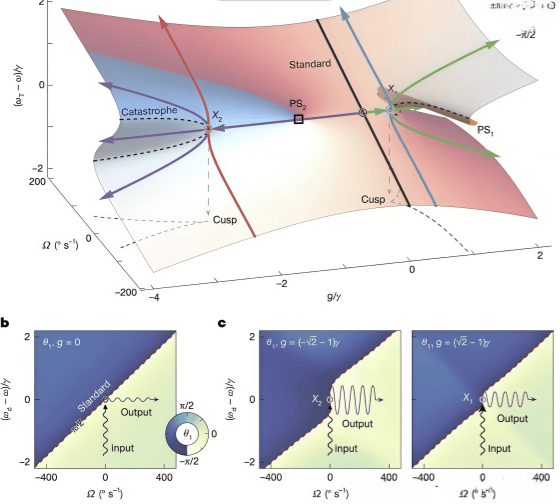
Gyroscopes, as fundamental inertial sensors, are crucial for rotation measurement in industries such as consumer electronics, automotive, and aerospace, with the most widely used type being based on the Coriolis effect. Chip-scale Coriolis vibratory gyroscopes (CVGs) offer advantages in size, weight, and cost, but their performance is far inferior to traditional macroscopic CVGs. This is because the inherently weak Coriolis factor in microchips limits sensitivity improvements, and Brownian noise in microchips is much greater than in macroscopic ones. To overcome this physical limitation, we propose and experimentally verify the use of the third-order singularity within the cusp catastrophe in on-chip CVG phase-tracking oscillations to achieve cube-root scaling of the frequency modulation induced by the Coriolis effect. Utilizing this effect, we achieved a three-order-of-magnitude enhancement of the Coriolis factor, a 253-fold improvement in the signal-to-noise ratio, and a 297-fold improvement in precision. Furthermore, the cusp singularity enables previously unattainable sublinear measurement of ultra-sensitive phase modulation, thereby achieving record-breaking signal-to-noise ratio performance in silicon chip gyroscopes. These findings not only fill the gap in observing and controlling singularity-enhanced Coriolis effects, bringing revolutionary advances to gyroscope technology, but also provide new ideas for other ultra-sensitive sensing applications.