
On the 24th, the intelligent transmission electron microscope system (hereinafter referred to as the "Intelligent TEM System") developed by the team of Researcher Deng Dehui and Researcher Liu Wei from the Dalian Institute of Chemical Physics (DICP), Chinese Academy of Sciences, passed the scientific and technological achievement appraisal organized by the China Petroleum and Chemical Industry Federation in Beijing. The appraisal committee experts unanimously agreed that this technology is highly innovative, and the developed Intelligent TEM System is a global first, reaching an internationally leading level.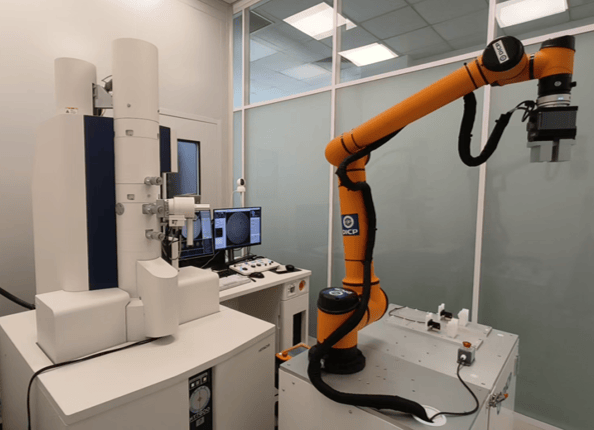
This system is like a wise eye that perceives the atomic world, realizing the unmanned and intelligent operation of the entire process of "sample transfer—imaging—analysis," allowing humans to explore the extremely microscopic world more accurately and intuitively.
As scientific research delves deeper into the extremely microscopic, the transmission electron microscope (hereinafter referred to as "TEM") is a cutting-edge tool for exploring the microscopic world and a core piece of equipment in fields such as advanced materials, energy and chemical engineering, and life sciences. However, for nearly a century, TEM has relied on manual operation, facing bottlenecks such as low efficiency, strong subjectivity, and difficulty in statistical quantification.
To solve this challenge and achieve a "curve overtaking" in the independent research and development of intelligent electron microscopes, the team has long been committed to the intelligent and integrated research of TEM software and hardware. Collaborating with the team of Researcher Han Zhi from the Shenyang Institute of Automation, Chinese Academy of Sciences, they developed the "Fully Autonomous Perception-Analysis-Manipulation General Intelligent TEM System" algorithm. On this basis, they overcame five key technologies: embodied intelligent high-vacuum sample transfer, autonomous adjustment of electron optical imaging, nanoscale intelligent sample positioning, autonomous image acquisition and real-time analysis, and full-system state perception and scheduling collaboration. They successfully developed the world's first Intelligent TEM System—"Yuanyan-1."
This achievement marks the first leap of TEM from "manual operation" to "AI-driven fully autonomous process operation," providing a powerful reference for the intelligent application of high-end scientific research instruments. It is expected to continuously provide large-scale, high-quality structural data for the development of fields such as energy and chemical engineering, materials genome, and life sciences, supporting the paradigm shift in AI-driven scientific research.