
On May 25, 2026, Beijing time, the Shenzhou-23 crewed spacecraft successfully completed a radial rendezvous and docking with the China Space Station. The entire rendezvous and docking process was smooth, orderly, precise, and efficient. This marks the first time a Chinese crewed spacecraft has executed a radial rendezvous and docking mission under the 3.5-hour express rendezvous and docking mode. Throughout the process, the Guidance, Navigation, and Control system operated stably and performed excellently, precisely controlling the spacecraft to complete every critical maneuver.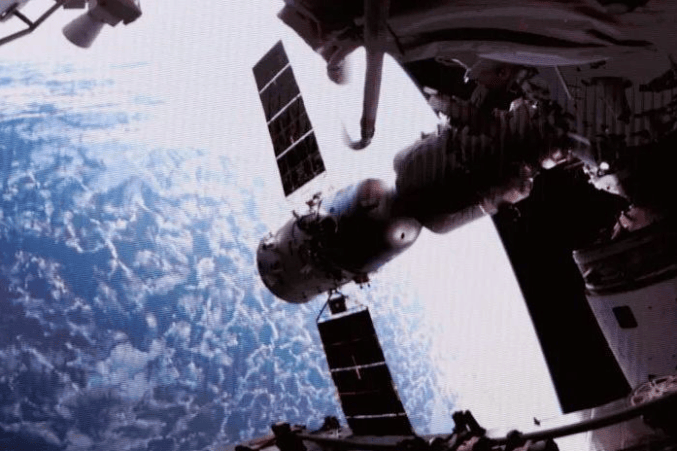
What breakthroughs lie behind the combination of "express rendezvous technology" and "radial rendezvous and docking"? What new leaps in China's space rendezvous and docking technology does the 3.5-hour express "arrival" witness?
Space rendezvous and docking is hailed as "threading a needle across thousands of miles in space" and is recognized globally as one of the most complex core technologies in the field of crewed spaceflight. The GNC system, which stands for Guidance, Navigation, and Control system, acts as the "helmsman" piloting the Shenzhou spacecraft and is the key to completing rendezvous and docking missions. The GNC system undertakes the entire process control tasks, from launch and orbit insertion, attitude and orbit control, to fully autonomous rendezvous and docking with the target vehicle, and finally to departure and return. Its performance directly determines the safety and precision of the rendezvous and docking.
After decades of technological accumulation and iteration, the GNC system of China's Shenzhou spacecraft has achieved leapfrog development. From the initial verification of Shenzhou-8, which took over 40 hours, to the routine application of the 6.5-hour express rendezvous and docking from Shenzhou-12 to Shenzhou-20, and further to the 3.5-hour intelligent autonomous express mode for Shenzhou-21 to Shenzhou-23, covering forward, backward, and radial directions, a technical system characterized by high reliability, high precision, and high efficiency has been established, achieving a leap from usable to highly effective.
This radial rendezvous and docking between Shenzhou-23 and the China Space Station is the first time a Chinese crewed spacecraft has achieved radial docking under the 3.5-hour express rendezvous and docking mode.
Diao Weihe from the Fifth Academy of the China Aerospace Science and Technology Corporation introduced, "The GNC capability onboard the spacecraft is becoming increasingly powerful. Previously, the entire orbit control process was calculated on the ground, but now it is calculated autonomously onboard the spacecraft in space. This is its biggest highlight and also one of its characteristics."
Although the previous Shenzhou-13 and Shenzhou-14 missions verified radial rendezvous and docking technology, they were both under the 6.5-hour rendezvous and docking mode; Shenzhou-21 and Shenzhou-22 initiated the 3.5-hour express rendezvous and docking mode, but both were forward dockings.
Zhang Yi from the Fifth Academy of the China Aerospace Science and Technology Corporation told reporters: This mission, for the first time, deeply integrated the 3.5-hour express rendezvous technology with the radial docking mode, achieving the first "combined application" of the two modes. From a technical verification perspective, in this mission, the express rendezvous-related procedures before the mid-course aiming point had been fully validated in the Shenzhou-21 and Shenzhou-22 missions, and the radial docking-related technologies after the mid-course aiming point had also been tested in past missions. However, integrating these two parts of technology together in a 3.5-hour express mission is of groundbreaking significance.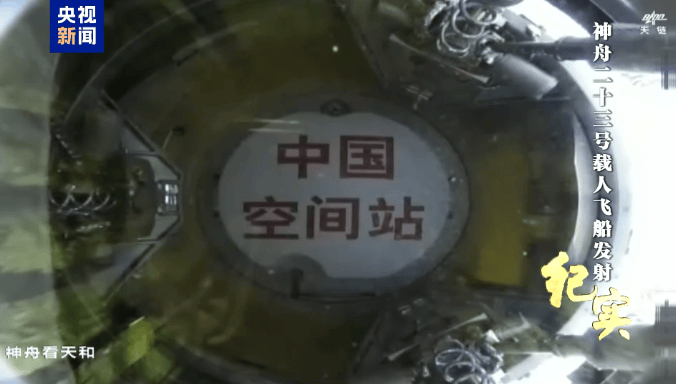
From the perspective of the GNC system, radial rendezvous and docking differs significantly from forward and backward rendezvous and docking. Its technical difficulty far exceeds the latter, placing higher demands on the precise control capability of the GNC system.
Zhang Yi: Forward and backward rendezvous and docking have stable mid-course aiming points. Even if the spacecraft's engines stop working, it can maintain attitude and orbit stability for a relatively long time, resulting in relatively less control pressure on the GNC system. In contrast, radial rendezvous and docking has no stable parking point; the spacecraft needs to continuously adjust its attitude and orbit, remaining in a state of dynamic control throughout the entire process. This not only requires real-time consideration of propellant consumption but also imposes stringent requirements on the real-time response and control precision of the GNC system. Simultaneously, during the radial rendezvous and docking process, the spacecraft needs to complete a large-scale attitude maneuver from horizontal flight to vertical flight, which places higher demands on the GNC system's sensors, requiring them to accurately capture the position information of the target vehicle and achieve precise positioning without Earth reference benchmarks.
It is worth mentioning that the manual control operation for radial rendezvous and docking is more difficult, and the tracking and telemetry conditions are relatively poorer, making it more dependent on the fully autonomous control capability of the GNC system, further highlighting the system's reliability and safety. Zhang Yi explained that China has previously achieved multiple radial rendezvous and dockings, but this mission achieved the deep integration of this technology with the express rendezvous mode on a crewed spacecraft.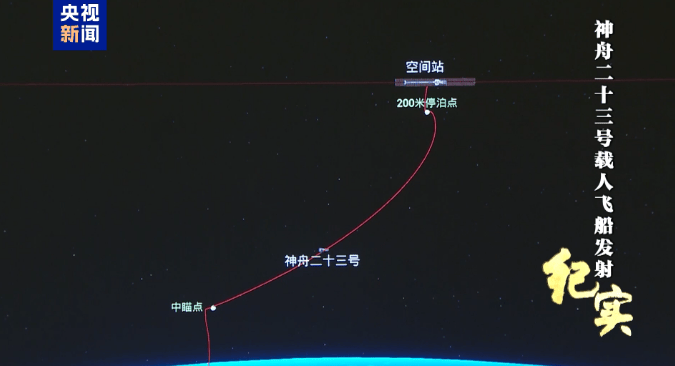
Zhang Yi: The mid-course aiming point is a distinctive design feature of China's space rendezvous and docking technology. Located behind and below the space station, the mid-course aiming point is the soul of the close-range fully autonomous rendezvous scheme, acting like a "transfer station" for rendezvous and docking. Through this point, the spacecraft can conveniently switch docking directions, significantly saving time and propellant consumption. In this mission, the GNC system precisely controlled the spacecraft to pass through the mid-course aiming point, successfully completing the seamless connection of technical procedures before and after the point. This fully validated the scientific nature and practicality of this design and also demonstrated the high-level control capability of China's GNC system.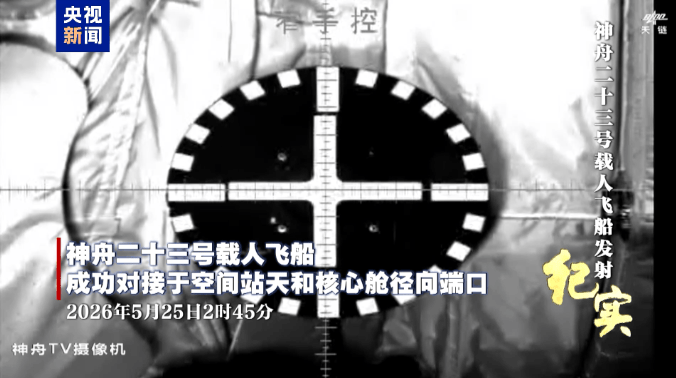
The success of this mission further validated the stability, reliability, and advancement of the GNC system, perfected China's express rendezvous and docking technology system, and provided greater flexibility for subsequent space station mission planning.
Zhang Yi: It has enhanced China's aerospace emergency response capability, laid a solid foundation for the long-term orbital operation of the China Space Station and the conduct of space science experiments and technology tests, and also provided valuable technical accumulation for China's subsequent major aerospace missions such as deep space exploration and crewed lunar landing. This embodies the firm belief of China's aerospace industry in self-reliance and independent innovation, marking another solid step towards the goal of building a space power.