
In the hundred-meter-high sea breeze, a maintenance worker grips a bridge cable tightly, searching inch by inch for millimeter-level cracks with binoculars—this scene is becoming history. As cable-climbing robots deeply integrate with AI, the global safety and maintenance of critical infrastructure is undergoing a fundamental transformation from "human climbing" to "intelligent climbing," and from "post-event repair" to "preventive maintenance."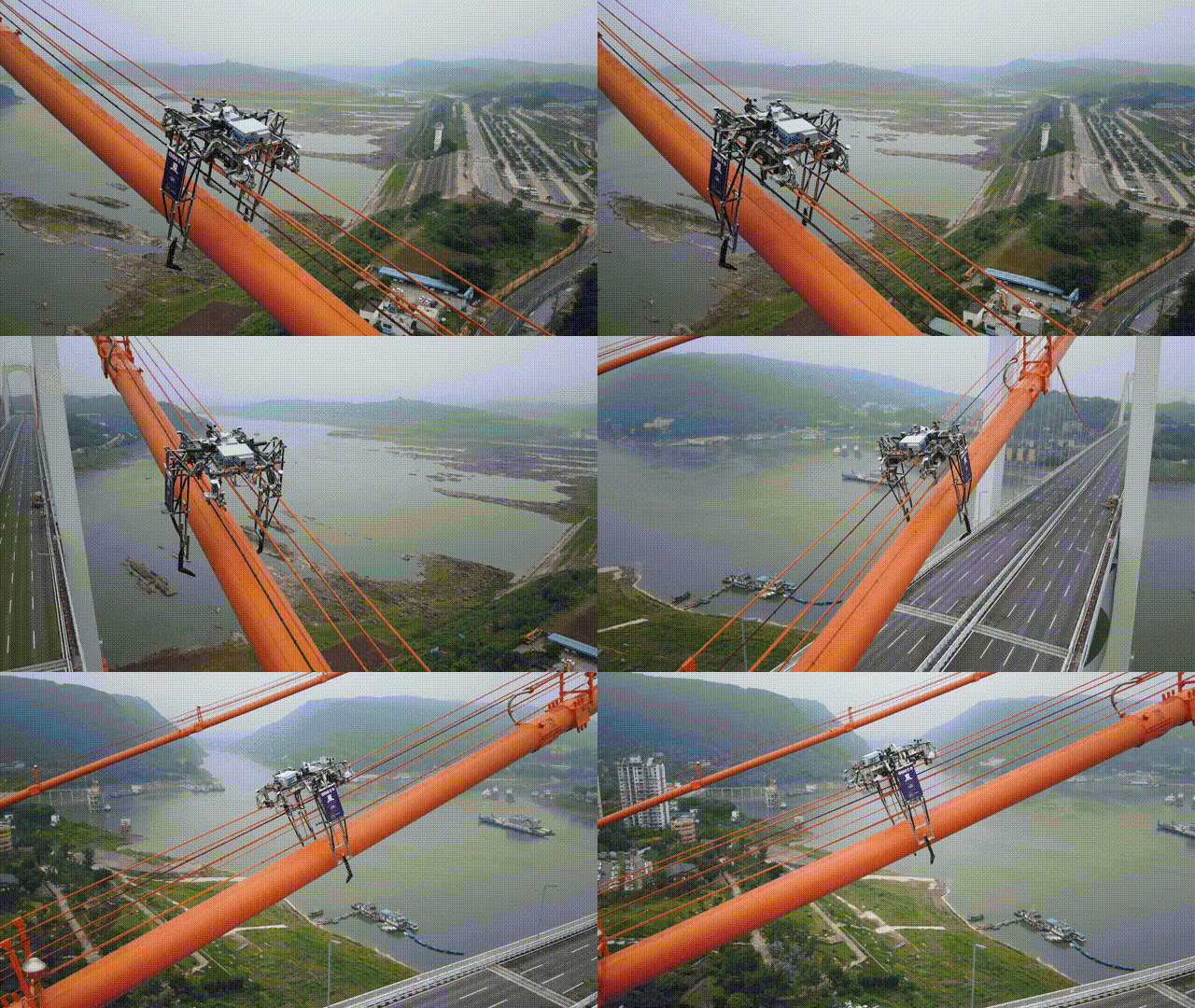
The "Chronic Problem" and "Dawn" of High-Altitude High-Risk Operations
Bridge cables are the most critical structural components supporting long-span bridges. The main cables and stay cables bear the tensile forces of the entire bridge, and their health directly determines the operational safety and lifespan of the bridge. However, as cables are often hundreds of meters long and located at heights of a hundred meters, they are long-term exposed to harsh environments such as wind, rain, salt spray, and strong ultraviolet radiation, leading to frequent issues like sheath aging and cracking, and steel strand corrosion and water seepage.
Traditional inspection methods heavily rely on manual high-altitude work, requiring the setup of large hanging baskets, scaffolding, aerial work platforms, and other heavy auxiliary facilities. The cost for a single inspection of one bridge can easily reach millions of yuan. This model of "massive manpower + heavy equipment" not only poses extremely high safety risks—maintenance personnel must work suspended on cables at heights of a hundred meters—but also suffers from low operational efficiency. Limited by field of view and accessibility, it is difficult to achieve full cable section and full circumferential detection without blind spots.
The global bridge safety accidents and economic losses caused by undetected cable diseases each year are staggering. The urgent industry need for a safer, more efficient, and more accurate new type of cable inspection method has spurred the rapid development of cable-climbing robots.
Cable-Climbing Robot + AI Inspection + Metaverse Digital Twin
In January 2026, a joint team from the Korea Electronics Technology Institute (KETI) and the Fraunhofer Institute for Ceramic Technologies and Systems (Fraunhofer IKTS) proposed a landmark cable health monitoring technology system at the 2nd Latin American Workshop on Structural Health Monitoring (LATAM-SHM 2026). This solution, with its core architecture of "Cable-Climbing Robot + AI Inspection + Metaverse Digital Twin," establishes a full-process closed loop encompassing data collection, intelligent analysis, and visual decision-making, marking the entry of cable structure health monitoring into a truly digital and intelligent new phase.
Highlight 1: Cable-Climbing Robot—Full Cable Section, No Blind Spot Data Collection
The core execution device of this solution is a cable-climbing robot specifically designed for the cable service environment. This robot can travel smoothly along components like stay cables and main cables. It uses onboard high-definition industrial cameras to capture images of the entire cable surface, covering every inch of the cable sheath, eliminating the blind spots inherent in manual high-altitude work.
Significant breakthroughs have been made by multiple teams in climbing mechanisms. The bridge cable intelligent inspection robot developed by Shenyang Jianzhu University supports remote control and autonomous navigation. Operators can complete all tasks from the ground, achieving a fundamental shift from manual high-altitude work to remote intelligent control, completely eliminating the risk of falls. This robot reduces the inspection cycle by approximately 80% and lowers operational energy consumption by about 90%. The cable-climbing robot used on the Taoyaomen Bridge of the Zhoushan Cross-Sea Bridge, part of the Yongzhou Expressway, achieved stable travel on the stay cables, with an intelligent recognition accuracy rate reaching 95%.
In terms of adaptability to extreme working conditions, the collaborative cable-climbing robot squad (CCRobot-S) developed by Dr. Ding Ning's team innovatively proposed a "reconfigurable parallel cable-driven multi-robot collaborative climbing strategy," successfully overcoming the three core bottlenecks of balancing "efficient movement, heavy-load operation, and flexible cross-cable capability." This system adopts a "wheel-palm-cable" composite drive scheme, using controllable adhesion instead of friction to interact with the cable surface. Combined with multi-robot collaborative load-bearing, it decouples adhesion from load, effectively solving the problem of insufficient friction between the robot and the cable surface under high loads, achieving an amplification effect on the system's load capacity. Furthermore, the robot features a zero-stop climbing gait for cable inspection and a spider-like climbing gait for cable repair, adapting to different operational requirements.
Highlight 2: AI-Driven Intelligent Inspection—Pixel-Level Disease Identification
At the visual inspection level, the research team introduced deep learning-based AI recognition algorithms. The raw image data collected by the robot is fed into the AI inspection module, where algorithms perform pixel-level intelligent identification and precise localization of apparent diseases such as cracks, spalling, exposed rebar, water seepage, and sheath damage. In practical application on the Zhoushan Cross-Sea Bridge, the cable-climbing robot captured images of the entire cable sheath surface on the stay cables. Relying on intelligent algorithms, it accurately identified subtle diseases like sheath damage and water seepage, achieving a recognition accuracy of 95%.
AI algorithms solve the problems of missed detections and misjudgments inherent in traditional manual visual inspection due to fatigue, lighting variations, and subjective experience differences. Combined with the continuous iteration of deep learning models, this recognition system can also improve its performance as inspection data accumulates, demonstrating excellent adaptability in large-scale projects like cross-sea bridges.
Highlight 3: Metaverse Digital Twin Platform—"Reading" Cable Health at a Glance
The most forward-looking innovation of this solution lies in introducing the metaverse platform into the field of cable structure health monitoring. Information on disease location, type, and severity output by the AI inspection module is mapped in real-time to the metaverse digital twin space, constructing a "virtual-real fusion" visual operation and maintenance platform.
On this platform, the location and morphology of each cable and each crack are reconstructed into high-precision 3D digital models. Relying on this platform, maintenance personnel can view the overall structural health status of the bridge at any time through extended reality (XR) terminals and dynamically compare the trends of inspection data from different periods. A maintenance worker from the Zhoushan Management Center of Zhejiang Communications Investment Group stated: "We rely on digital inspection data to create exclusive 'disease archives' for each cable component, dynamically compare and analyze historical inspection data, and promote the transformation of bridge maintenance from traditional 'post-event repair' to scientific, precise 'preventive maintenance'."
Highlight 4: Multi-Sensor Fusion High-Precision Positioning
To address the challenges of GPS signal obstruction and difficulty in accurately capturing robot posture during high-altitude cable inspection, this solution integrates multi-source sensor information fusion positioning technology combining differential GPS and visual-inertial odometry. By capturing the robot's 3D spatial coordinates and attitude orientation at heights of a hundred meters in real-time, it achieves high-precision spatial calibration of detected defects. In enclosed special areas like anchor chambers without GPS signals, drones achieve centimeter-level autonomous navigation and obstacle avoidance using SLAM indoor positioning technology, precisely capturing hidden defects difficult for humans to find. This fusion positioning mechanism ensures that every disease identified by AI can be accurately located on the physical bridge, providing a spatial basis for subsequent precise repair decisions.
From "Human Climbing Cables" to "Intelligent Climbing Cables": Four-Dimensional Capabilities
The technical integration and interaction of this solution can be summarized in four key dimensions:
Deep Perception Dimension: The cable-climbing robot, equipped with high-resolution visual sensors, captures sub-millimeter-level surface texture details of the cable at heights of a hundred meters, overcoming the resolution limits of human long-distance observation.
Intelligent Analysis Dimension: Trained on massive datasets of disease images, the AI model achieves quantitative grading and detection of disease features such as crack width, sheath water seepage degree, and corrosion level, providing a scientific basis for structural safety ratings.
Positioning and Calibration Dimension: Through the combination of RTK GPS and VIO, the location of each identified disease is precisely positioned within the bridge's 3D spatial coordinate system. This allows maintenance personnel to carry small repair equipment and accurately reach the disease point, significantly saving the inspection cost of secondary searching.
Digital Mapping Dimension: After AI processing, the inspection data generates a 3D health archive of the bridge body that can be directly browsed on the metaverse twin platform. This achieves a leap from maintenance personnel "entering the site" to find problems to "entering the digital space" for simulation and assessment, laying the foundation for scientific maintenance management throughout the bridge's entire lifecycle.
From Cross-Sea Bridges to Intelligent Operation and Maintenance Transformation of Global Infrastructure
1. Promoting Bridge Infrastructure from "Post-Event Repair" to "Preventive Maintenance"
The "Cable-Climbing Robot + Intelligent Drone" three-dimensional intelligent inspection system of the Zhoushan Cross-Sea Bridge, relying on digital inspection data, has established exclusive "disease archives" for each cable component. By dynamically comparing and analyzing historical inspection data, it has achieved a transformation from "post-event repair" to "preventive maintenance."
2. Reducing Maintenance Costs and Carbon Footprint
Research data from the Shenyang Jianzhu University team shows that the cable intelligent inspection robot shortens the inspection cycle by approximately 80% and reduces operational energy consumption by about 90%. The cost for a single inspection of one bridge can be significantly reduced from millions of yuan. In the context of intensive infrastructure maintenance, large-scale promotion and application could not only save substantial financial expenditure for maintenance departments but also significantly reduce the overall carbon emissions of bridge maintenance, precisely aligning with the concept of green and low-carbon development.
3. Standardized Maintenance Solutions for Global Cross-Sea/Cross-River Major Corridors
China currently operates over a hundred cross-sea and Yangtze River bridges, and the next decade will see them enter an intensive high-maintenance period. A unified, standardized "Cable-Climbing Robot + AI Inspection" technical system will provide key guarantees for the safe and long-term operation of these major national projects. Furthermore, this solution is highly applicable to the maintenance of large suspension and cable-stayed bridges in Europe, America, and Southeast Asia, offering a replicable intelligent management template for global bridge operators.
4. Expanding to More Large-Scale Infrastructure Operation and Maintenance Scenarios
The overall framework of "digital integrated inspection + AI recognition + twin visualization" carried by the cable-climbing robot can be transferred to similar confined, high-risk, and human-inaccessible scenarios such as main cable anchor chambers, cable tower interiors, high piers and columns, and underwater inspection. It also holds strong cross-industry application potential for high-rise steel structures like wind turbine towers, tall communication towers, and cable car haul ropes.
5. Building a Standardized Cable Digital Health Archive System
Through digital storage and AI trend analysis of historical inspection data, each major bridge will possess a digital health archive spanning the entire lifecycle of design, construction, operation, and maintenance in the future. Relying on the accumulation of large amounts of data, predictive models for the evolution of cable diseases can be established, upgrading maintenance decisions from "how much damage currently exists" to "when damage will occur in the future." This represents a crucial step for lifecycle management of structural facilities moving from experience-based decisions to scientific quantification.
When "Spider-Man" Gives Way to "Machine Replacing Man"
As over 1.14 million bridges nationwide enter a concentrated maintenance period, the emergence of cable-climbing robots is no longer just a technological option but an institutional change concerning industry human resources, operational safety, and sustainable maintenance. Bridge cable inspection, a typical high-risk operation scenario, is comprehensively transitioning from the historical model of "humans climbing up" to the intelligent model of "machines replacing humans." The "Cable-Climbing Robot + AI + Metaverse" technical system supporting this transformation not only takes responsibility for the safety of countless frontline maintenance workers but also provides a solid technical foundation for ensuring the long-term safe operation of major national projects and advancing infrastructure digital construction and data asset management.