
Concrete 3D printing technology is revolutionizing traditional construction methods, but it has long faced an almost paradoxical engineering challenge: how to embed a continuous steel reinforcement cage within concrete components as they are built up layer by layer? Traditional prefabricated steel cages cannot adapt to the layered process of 3D printing, while on-site manual insertion severely slows down construction efficiency. This bottleneck, which has plagued the industry for years, has now been broken by a research team seeking answers from the principles of geometric folding.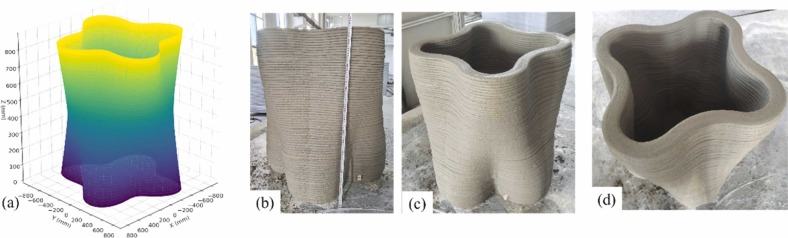
The "Steel Reinforcement Dilemma" in 3D Concrete Printing
Concrete 3D printing technology, with its advantages of formwork-free construction, high design freedom, and rapid prototyping, is recognized as one of the most disruptive innovations in the construction industry. From the world's first 3D-printed houses to the "European Bridge" in the Netherlands, this technology is moving from laboratories to construction sites.
However, a fundamental technical bottleneck has remained unresolved: steel reinforcement.
Concrete naturally excels in compressive strength, but its tensile and shear capacities rely heavily on steel reinforcement. Whether a building withstands wind loads, seismic forces, or a floor slab or bridge bears bending stress, steel and concrete are inseparable. In 3D concrete printing, the layer-by-layer deposition process makes it difficult to place steel reinforcement within a mold before printing, as is done in traditional casting. Existing solutions have significant drawbacks: post-printing vertical insertion is limited in direction and cannot meet complex stress requirements; robot-assisted placement of longitudinal or short rebars during printing faces poor bond quality at the steel-concrete interface; and fully manual insertion is inefficient, costly, and difficult to scale.
The 3D-printed concrete industry urgently needs a new solution that maintains the efficiency of the layer-by-layer printing process while enabling the integrated embedding of a continuous steel reinforcement cage.
The Geometric Ingenuity of Foldable Deployable Steel Reinforcement
On May 29, 2026, researchers from Gannan Normal University and other institutions published their latest findings in the international authoritative journal Construction and Building Materials, creatively proposing a Foldable Deployable Steel Reinforcement solution. Drawing inspiration from the logic of geometric folding and packaging, this research offers a novel pathway to solve the long-standing engineering bottleneck of integrating steel reinforcement with 3D concrete printing.
Prefabrication – Folding – On-site Deployment: Reshaping the Construction Process
The core innovation lies in overturning the traditional construction logic of "on-site tying of individual rebars." The central concept of the research is: the steel reinforcement cage is prefabricated in the factory, transported to the site in a compact folded state, and then rapidly deployed and embedded between the concrete printing layers during the 3D printing process. This design fundamentally changes the production and installation method of the steel cage, achieving "factory prefabrication + rapid on-site deployment," and solving the long-standing problem of incompatibility between prefabricated traditional steel cages and the 3D printing process.
Geometric Folding Principles Empowering Smart Construction
The design of the foldable deployable structure is inspired by geometric folding and packaging principles. Through ingenious mechanical design, the steel cage occupies only a fraction of its final volume when folded, facilitating transport and storage. Upon arrival at the construction site, the cage is triggered mechanically or manually to rapidly deploy into its target geometric shape at predetermined nodes, precisely synchronized with the 3D printing pace. This design allows the deployment process of the steel cage to keep pace with the layering rhythm of concrete printing, ensuring continuous and smooth embedding of the reinforcement between concrete layers.
Addressing the Core Challenge of Interface Integration between Steel and Printed Layers
The research further focuses on the interface integration between the steel and the 3D-printed concrete. In traditional methods, voids and defects often occur at the contact surface between the steel and the printed concrete, severely impacting bond strength and structural integrity. By leveraging the shape controllability of the foldable steel cage, this solution optimizes the geometric arrangement and mechanical load transfer path of the reinforcement within the concrete layers. It promises to fundamentally improve the interface bond issues caused by delayed insertion or misalignment of rebars. This will significantly enhance the flexural and shear performance of 3D-printed steel-reinforced concrete components, bringing them to a structural level comparable to traditional cast-in-place reinforced concrete.
A Paradigm Shift from "On-site Construction" to "Factory Prefabrication + On-site Assembly"
The deeper significance of this research lies in its representation of a more thorough extension of the "prefabrication-assembly" construction philosophy. In traditional reinforced concrete structures, rebars are cut and tied on-site. 3D-printed construction aims for a highly integrated process of "printing equals forming, forming equals strengthening."
The foldable deployable steel reinforcement technology precisely fills a critical gap in this integration chain:
Controllable Factory Prefabrication Quality: The steel cage is welded and quality-inspected in a factory environment, avoiding the impact of weather and human errors on-site, significantly improving the quality of steel fabrication.
Cost-Effective and Efficient Folded Transport: The folded state drastically reduces the cage's volume, lowering transport and storage costs, and providing an efficient logistics solution for standardized steel cage components.
Synchronized Rapid Deployment and Printing: On-site deployment seamlessly integrates with the 3D printing operation, eliminating the need for frequent printing interruptions. This makes the construction rhythm of 3D-printed reinforced concrete more continuous, propelling 3D-printed construction from "proof of concept" towards "large-scale production."
From Technical Prototype to Engineering Application
Complex Geometric Building Components
The high flexibility of the foldable steel cage allows 3D-printed buildings to break free from the constraints of conventional rectangular beams and columns. It enables the printing of load-bearing components with complex geometries, such as curved walls and topologically optimized irregular columns, offering unique advantages in public buildings like museums and art galleries.
Factory Production of Prefabricated Building Modules
In the field of prefabricated construction, this technology can help establish "one-stop" production lines for reinforced concrete prefabricated components: completing the prefabrication and folding of the steel cage and the 3D concrete printing of the component within the factory, directly outputting finished building modules. This realizes the vision of "building houses like manufacturing cars."
Rapid Construction in Areas with Low Transport Accessibility
The size advantage of the foldable cage during transport makes it unparalleled in scenarios with low transport accessibility, such as remote areas, islands, and polar research stations. A compact folded package means more steel cages can be transported in a single trip, reducing supply frequency and shortening construction timelines.
Rapid Setup for Post-Disaster Emergency and Field Camps
The rapid on-site deployment characteristic of the foldable prefabricated steel cage shows great potential for temporary structures with high time sensitivity, such as emergency shelters and field camps. By combining the folded cage with mobile 3D concrete printing equipment, structurally sound safe havens and material storage facilities can be rapidly constructed under extreme conditions.
Responding to the National Strategy for Building Industrialization
This achievement also aligns closely with China's national strategies for building industrialization, smart construction, and green, low-carbon development. By reducing on-site wet work and minimizing material waste, the construction industry can significantly cut carbon emissions during its transformation, contributing technological strength to the national "dual carbon" goals in the urban and rural construction sector.
Paving the Way for Large-Scale Application of 3D-Printed Buildings
For 3D-printed buildings to truly transition from "experimental prototypes" to "engineering products," the steel reinforcement issue must be fundamentally resolved. The research results from the team at Gannan Normal University, through the design of the foldable deployable steel cage, offer a solution with high engineering feasibility and potential for widespread adoption.
Starting from the geometric wisdom of a folded paper structure to opening the door to large-scale application of 3D-printed steel-reinforced concrete buildings – this is perhaps a vivid illustration of how fundamental research drives engineering innovation. As the integration solution for steel cages and concrete 3D printing technology continues to mature, 3D-printed concrete structures are expected to truly bear the weight of buildings in the near future, becoming a mainstream force in the smart construction industry.