
The size of rocket fairings limits the scale of facilities humans can deploy into space—a hundred-meter-class space solar power station or a kilometer-class deep-space detection antenna cannot fit entirely into any existing launch vehicle. The solution proposed by the Shenyang Institute of Automation, Chinese Academy of Sciences, goes straight to the core: not manufacturing before launch, but "on-site production" in orbit. Recently, the institute successfully developed an integrated technology for pultrusion and laser transmission welding of carbon fiber/polyether ether ketone (CF/PEEK) composite tubular units, with the relevant results published in the international authoritative journal Space: Science & Technology, providing a lightweight, high-strength, and highly reliable technical foundation for the automated on-orbit construction of kilometer-class ultra-large space facilities.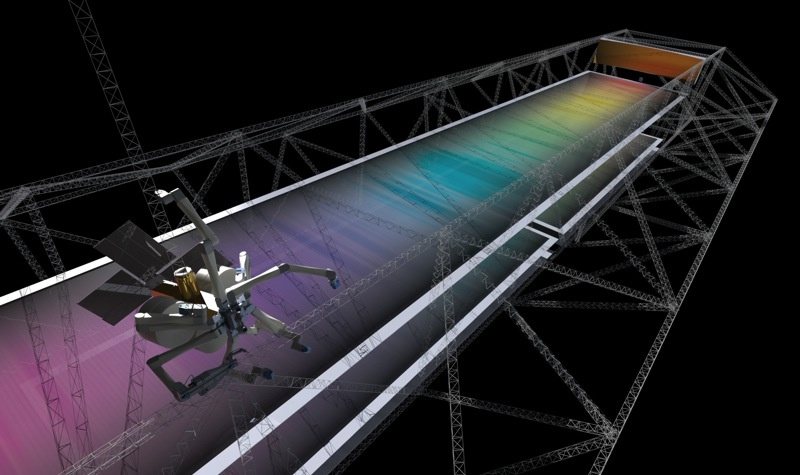
Folding Launch Has Reached Physical Limits
Currently, large-scale space facilities adopt the traditional model of "ground manufacturing + folding storage + rocket launch + space deployment," which, constrained by rocket fairing dimensions and launch overload environments, can no longer meet the deployment needs of ultra-large space facilities exceeding a hundred meters. On-orbit construction technology—directly fabricating components and assembling them in the space environment—has become the core focus for next-generation high-end spacecraft.
On-orbit construction faces two major technical challenges: first, how to efficiently prepare high-performance structural units in the space environment, and second, how to achieve stable and reliable connections between components. The team from the Shenyang Institute of Automation, CAS, proposed an "integrated CF/PEEK composite material preparation and connection technology solution," precisely targeting these two bottlenecks and providing a complete solution from materials to processes.
Integrated CF/PEEK Pultrusion and Laser Transmission Welding
Structural Unit Preparation: A "Space Pipe Factory" via Continuous Pultrusion
The team selected carbon fiber/polyether ether ketone (CF/PEEK) thermoplastic prepreg tape as the base raw material, fabricating hollow tubular components through a continuous pultrusion process. CF/PEEK is a high-performance thermoplastic composite, where carbon fiber provides ultra-high specific strength and stiffness, while the PEEK matrix imparts excellent resistance to radiation, high temperatures, and vacuum outgassing, adapting to extreme space environments.
Researchers systematically studied the effects of molding temperature and pultrusion speed on the mechanical properties of the finished product, ultimately determining the optimal process parameters. Composite tubes produced via this process combine ultra-high specific strength, high structural stiffness, and outstanding tolerance to extreme space environments, fully meeting the stringent standards for long-term stable service of spacecraft in orbit.
Reliable Component Connection: 3D-Printed Joints + Laser Transmission Welding
In terms of connection technology, the team broke away from traditional thinking and innovatively adopted 3D-printed highly transparent PEEK-specific joints, combined with mature laser transmission welding processes, to achieve high-precision, high-strength integrated connections between tubes and joints.
Laser transmission welding is a non-contact process, resulting in uniform stress distribution across the weld seam and high operational efficiency. Compared to previously common methods in the aerospace field, such as adhesive bonding (prone to aging and failure in long-term space environments) and mechanical fasteners (excessive self-weight and insufficient overall structural stability), the new technology completely eliminates these drawbacks. The weld structure is robust and stable, with all performance indicators meeting the long-term load-bearing requirements of large space structures.
Parabolic Antenna Truss Prototype Validates Full-Process Feasibility
To verify the engineering applicability of the entire technology, the team successfully completed the full-scale integrated manufacturing of a scaled-down parabolic antenna truss prototype. From the preparation of basic composite raw materials and integrated component molding to precise welding assembly and overall structural assembly, the entire process was smoothly executed, practically confirming that the technology is fully suitable for automated on-orbit construction in space applications.
Space Manufacturing Resources and Terrestrial Rare Metals
The breakthrough in this on-orbit construction technology has a clear underlying connection with the deep logic of the geological and metallurgical industries—the key raw materials for high-performance composites are terrestrial rare metals, while on-orbit manufacturing capabilities will open the door to in-situ utilization of extraterrestrial mineral resources.
The carbon fiber in CF/PEEK composites has its core raw material, polyacrylonitrile (PAN), derived from the petrochemical industry chain; while PEEK resin production relies on aromatic compounds such as diphenyl ether, and its synthesis catalysts—nickel, cobalt, palladium, and other platinum group metals—all come from geological mining, smelting, and processing systems. This means that every upgrade in space on-orbit manufacturing capabilities will impose higher demands on the purification levels and composite processing capabilities of high-end functional materials on Earth, driving continuous breakthroughs in related metal material preparation technologies.
More profoundly, the validation logic of this technology for on-orbit manufacturing can be seamlessly extended to the in-situ resource utilization of deep-space mineral resources. Extraterrestrial bodies such as the Moon and asteroids are rich in resources like titanium, iron, silicon, and platinum group metals. In the future, the integrated CF/PEEK pultrusion and laser transmission welding manufacturing technology is expected to deeply couple with extraterrestrial mineral extraction and processing systems—that is, completing mineral beneficiation and extraction on the lunar or asteroid surface, and using CF/PEEK printed nodes and pultruded rods to manufacture key facilities such as truss supports and communication antennas for deep-space bases on-site. This will achieve a deep synergy of "manufacturing in space, sourcing materials beyond Earth" in physical space, completely breaking free from reliance on Earth's supply chains and ushering in a new era of industrial utilization of extraterrestrial resources.
From Space Solar Power Stations to Deep-Space Exploration
The core application directions of CF/PEEK on-orbit construction integration technology cover three major scenarios:
Space Solar Power Stations: Kilometer-class space solar power stations represent the ultimate clean energy solution for the carbon-neutral era, and their massive truss support structures urgently require integrated on-orbit manufacturing and assembly capabilities.
Ultra-Large Aperture Deep-Space Detection Antennas: The demand for antenna aperture in deep-space exploration continues to rise, but constrained by launch vehicle dimensions, traditional technologies have hit a ceiling, making on-orbit manufacturing a key pathway to achieving this goal.
On-Orbit Service Platforms and Space Station Expansion: Long-term human spaceflight and commercial on-orbit services require flexible construction capabilities to support the on-orbit upgrade and expansion of modules, robotic arms, and solar arrays.
On May 22, 2026, the Chinese Academy of Sciences and the Shenyang Institute of Automation simultaneously announced that this technological achievement has been published in an academic journal and that a ground verification prototype has been completed. As the integrated CF/PEEK composite material preparation and connection technology continues to mature and optimize, it will break down the technical barriers to on-orbit construction of ultra-large space facilities, laying a solid technical foundation for cutting-edge aerospace endeavors such as deep-space exploration and space energy development.