
Perovskite solar cells are one of the most promising photovoltaic technologies for the future, with broad application prospects in ground-mounted power stations, building-integrated photovoltaics, and space energy supply. High-efficiency large-area devices are a crucial step toward the commercialization of perovskite solar cells. Currently, the photoelectric conversion efficiency of small-area laboratory cells has exceeded 27%, but there is a sharp efficiency drop when the device area is scaled up. The main challenge lies in the fact that, to improve the uniformity of perovskite films during large-area device fabrication, low-concentration solutions are often used to reduce solution viscosity. This method leads to a shortened crystallization window and localized rapid crystallization, resulting in poor film crystal quality and low module efficiency. Therefore, achieving both "large-area uniform coating" and "high-quality crystallization" is key to fabricating high-efficiency large-area modules.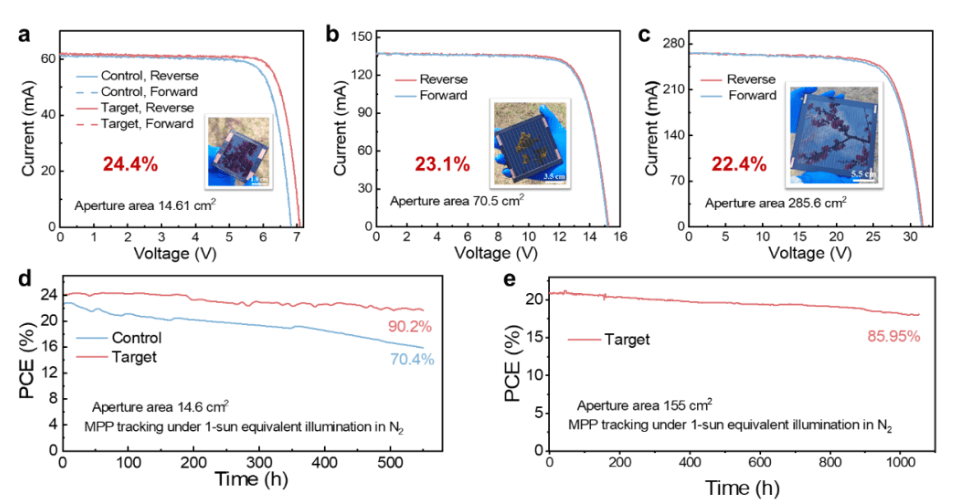
Recently, the research team led by Professor You Jingbi from the Institute of Semiconductors, Chinese Academy of Sciences, proposed a "stable intermediate phase regulation" strategy. By innovatively introducing a bifunctional additive, they successfully fabricated large-area perovskite films with high crystal quality and excellent uniformity, reducing the efficiency loss of large-area battery modules from 2.0% per order of magnitude increase in area to 1.3%, approaching the industry benchmark of 0.8% for commercial cadmium telluride thin-film solar cells.
The core innovation of this strategy lies in the research team's discovery that the N-crotonylglycine molecule contains both amide and carboxyl groups, which can form strong coordination bonds with lead iodide. During the film formation process from a low-concentration precursor, the additive molecules act as a "solute buffer reservoir," effectively stabilizing the typically unstable δ-FAPbI3 intermediate phase and significantly increasing the transformation energy barrier to the photoactive α-FAPbI3 phase from 0.21 electron volts to 0.84 electron volts, thereby slowing down the nucleation and growth process of the perovskite material.
Based on this strategy, the research team fabricated perovskite solar modules of different sizes, achieving internationally leading device performance: a 14.6 cm² module achieved a steady-state certified efficiency of 24.4%, the highest certified efficiency record reported for battery modules of 10 cm² and above; a 70.5 cm² module achieved an efficiency of 23.1%; and a 285.6 cm² module achieved an efficiency of 22.4%. Under one standard sun illumination, a module with an effective area of 155 cm² retained 86% of its initial efficiency after 1053 hours of aging at the maximum power point.
This work innovatively proposes a growth regulation scheme for large-area perovskite materials, providing important insights for the transition of perovskite photovoltaic technology from the laboratory to large-scale manufacturing.
The research results were published in the Journal of Semiconductors under the title "Stable intermediate phase regulation for high-performance and scalable perovskite solar cells." Cai Kai, a doctoral student at the Institute of Semiconductors, is the first author, and Dr. Zhou Haitao, a postdoctoral fellow at the Institute of Semiconductors, and Professor You Jingbi are the co-corresponding authors.
This work was supported by the National Key Research and Development Program of China, the Pilot Project of the Chinese Academy of Sciences, the Stable Support Basic Research Team of the Chinese Academy of Sciences, and Xiamen Fengyu Optoelectronics Technology Co., Ltd.