
On June 15, as the steel sleeve end cover slowly opened, the shield machine equipped with a specially designed "conical cutterhead" successfully emerged from the tunnel. This marked the smooth completion of the right line between Xiaomian Road Station and Jinji Road Station on Hangzhou Metro Line 15. This project is China's first case of using a shield machine to directly cut through an underground diaphragm wall with H-shaped steel joints and safely underpass an existing operational metro station.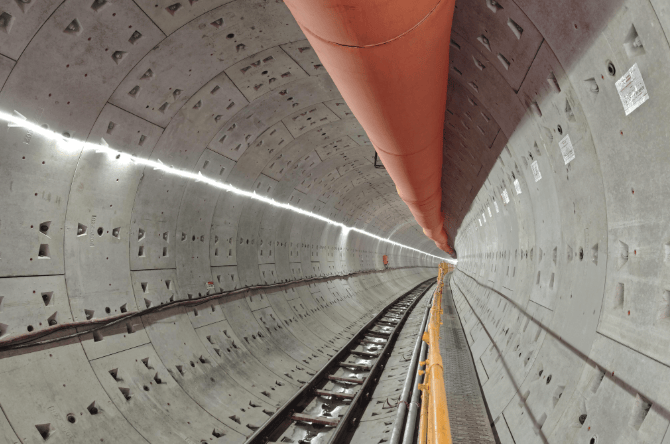
The shield tunneling section between Xiaomian Road Station and Jinji Road Station on Hangzhou Metro Line 15 required crossing two underground diaphragm walls and several bored piles of Metro Line 5's Jinji Road Station. These walls used 8 mm thick H-shaped steel as joints, forming a formidable "steel wall." According to the original plan, the project team needed to excavate a clearing shaft next to Jinji Road Station to remove the H-shaped steel joints before the shield machine could pass. However, due to the station's location in a bustling urban area, traffic diversion on the main road was challenging, and pipeline relocations were complex, affecting a wide area.
How could a more efficient and optimized construction plan be found while ensuring safety? The Hangzhou Metro Group and the China Railway First Group construction team innovated techniques and methods, allowing the shield machine to directly "chew through" the H-shaped steel.
To fully verify the scientific feasibility of the plan, the construction team established a research and development group, collaborating with shield machine manufacturers, a research team from Zhejiang University, and the National Key Laboratory of Shield and Tunneling Technology. After months of technical breakthroughs, including four rounds of indoor simulated cutting experiments that replicated the dynamic process of the shield machine cutting through steel, the plan for the shield machine to directly cut through the H-shaped steel was deemed feasible.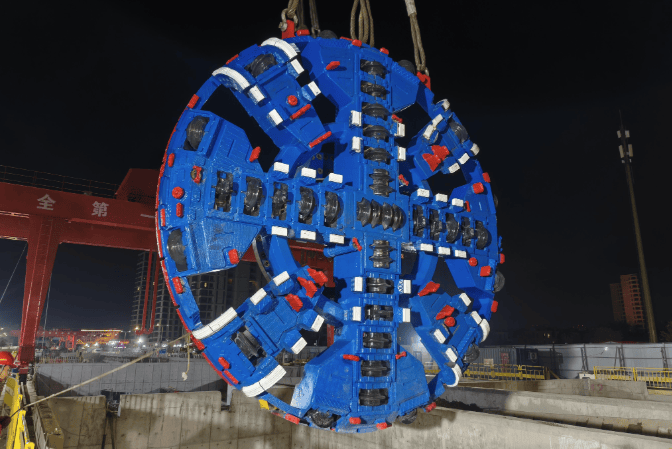
However, to enable the shield machine to actually "chew through" the steel, it required a comprehensive upgrade "from the inside out." The technical team fitted the cutterhead with custom-made "steel teeth," using a specially designed "conical cutterhead." Additionally, by upgrading the cutterhead drive system, adaptively modifying the screw conveyor, and strictly controlling tunneling parameters, the shield machine gained the capability to directly tackle the "steel wall." The successful application of this innovative method effectively reduced the impact of metro construction on traffic and residents' lives in the main urban area.
Phase I of Hangzhou Metro Line 15, a north-south backbone line, spans approximately 41 kilometers and includes 30 stations. This line connects core areas such as Qianjiang New City and Qianjiang Century City, extends south to connect with Old Xiaoshan City, and radiates north to Linping Chongxian. Upon completion, the project will directly shorten the spatial and temporal distance between north and south Hangzhou, creating a "half-hour commuting circle," which is of great significance for the urban development of both the northern and southern wings of Hangzhou.