
On June 17, Harbin Dongan Automotive Engine Co., Ltd. (hereinafter referred to as "Dongan Power") successfully completed the ignition test of its R10TE dual-rotor supercharged engine, a milestone that fills a technological gap in China's high-power rotary engine sector. This 1.0-liter dual-rotor supercharged engine, evolved from a mature single-rotor model, is lightweight yet powerful, addressing issues such as insufficient endurance in low-altitude aircraft and the bulkiness and energy inefficiency of traditional automotive range extenders. It marks a shining milestone in the development of domestically produced autonomous power, with a market launch expected in 2028.
Compared to single-rotor engines, it achieves comprehensive upgrades in four areas: lightweighting, power performance, internal structure, and reliability assurance.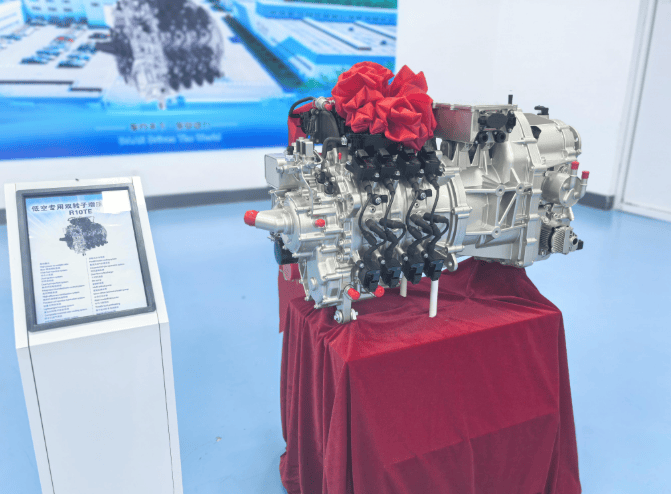
The most noticeable change is weight reduction. Xia Te, Deputy Director of the Engine Technology Center and Head of the Component Development Department at the corporate research institute, explained that the engine's initial design weight was 87 kilograms, but after rounds of meticulous optimization, it was reduced to 69.9 kilograms. The R&D team analyzed stress principles and used simulation calculations to streamline redundant structures, ensuring "the best steel is used for the blade." In terms of housing material selection, the team made a bold breakthrough: traditional engines commonly use cast iron housings, which are sturdy and robust, capable of withstanding the immense pressure from internal combustion, but they are too heavy.
To achieve lightweight goals, the R&D team switched entirely to aluminum alloy for the housing. Aluminum alloy is lightweight, effectively reducing the engine's burden, but its hardness and compressive strength are inferior to cast iron. To address this, technicians applied high-strength protective materials such as supersonic flame coatings and electroplated alloy coatings to the aluminum alloy housing surface, akin to equipping the engine with a special armor. This retains the lightweight advantage of aluminum alloy while compensating for its material strength shortcomings.
Despite the engine's smaller size, its "power" has significantly increased. The new engine is equipped with a supercharging system, ensuring stable and robust power output even at altitudes of 3,000 meters, without any "loss of power." Mou Hongyu, Head of the Advanced Technology Department at the corporate research institute, likened it: "Traditional piston engines are like burly strongmen, needing to exert all their strength to complete tasks; our dual-rotor engine is like a lightweight weightlifting champion—compact, consuming less, yet with explosive power that is no less impressive."
According to reports, the dual-rotor engine R10TE achieves a power-to-weight ratio of 1.8, a significant improvement over the single-rotor model. At rated speed, it delivers an output power exceeding 120 kilowatts, suitable for low-altitude and mid-to-high-altitude applications.
For a long time, rotary engines have faced numerous challenges, including ensuring good sealing, strong power, durability, and stability, while also addressing heat dissipation issues under extremely high power-to-weight ratios. To overcome these hurdles, the R&D team conducted thousands of simulation tests. On one hand, they used new sealing components to tightly seal the engine's interior, preventing power loss and enhancing overall wear resistance. On the other hand, they selected high-strength special materials for the core rotor, paired with an intelligent cooling system, akin to installing a "constant-temperature air conditioner" for the high-speed rotating machine, achieving a perfect balance among sealing, power, durability, and heat dissipation. Even when the aircraft hovers or turns in the air, power output remains stable.
With its robust capabilities, this engine has broad application prospects. Cao Xianhua, Deputy General Manager of Dongan Power, explained that in the low-altitude field, it can serve as a high-quality range extender, extending aircraft endurance from 250 kilometers to 500–1,500 kilometers, eliminating the hassle of frequent battery swaps or recharging. In the new energy vehicle sector, its lightweight design makes it far more practical than heavy traditional range extenders. It can be directly installed in vehicles or configured as a detachable "mobile power pack," and many mainstream automakers have already extended collaboration offers.