
Under the scorching summer sun, a building roof baked by sunlight consumes astonishing amounts of energy to keep the interior cool. Now, the answer to this challenge may lie hidden in a tiny insect that flits through the forests of Southeast Asia. A research team from the Hong Kong Polytechnic University (PolyU), inspired by the scales of the world's whitest beetle—the Cyphochilus beetle—has successfully developed a new passive radiative cooling ceramic material with a solar reflectivity of up to 99.6%, approaching a theoretically "perfect" level. This groundbreaking research has been published in the internationally renowned academic journal Science.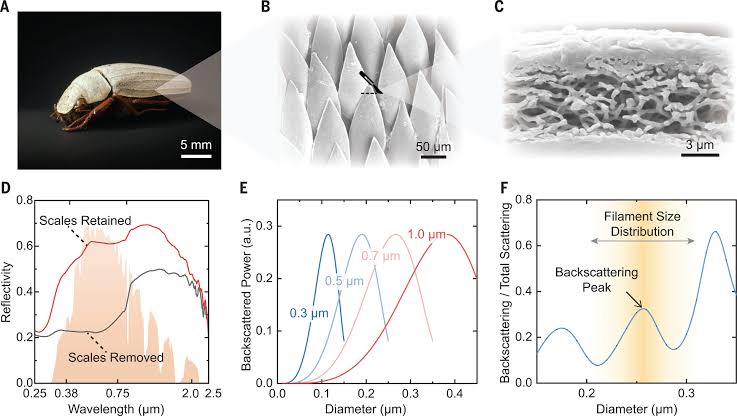
Learning from Nature's Whitest White
The bright white color of the Cyphochilus beetle does not come from pigments but from the unique hierarchical porous structure within its scales. This structure scatters light with extreme efficiency, even surpassing many man-made white surfaces. Led by Professor Wang Zuankai, Associate Vice President (Research and Innovation) at PolyU, the research team delved into the mysteries of this biological scattering system.
Their core innovation lies not in simply replicating the beetle's chemical composition, but in "translating" the geometric logic of its light scattering into a ceramic material. Through biomimetic design, the team successfully constructed a hierarchical porous structure similar to that of the beetle's scales, achieving highly efficient scattering across the full solar spectrum. Professor Wang stated: "Our cooling ceramic research exemplifies the immense power of learning from nature, filling a research gap in the field of passive radiative cooling regarding high solar reflectivity."
Near-Perfect Reflectivity and Breakthrough Leidenfrost Effect Suppression
The performance data of this biomimetic cooling ceramic is remarkable:
Record-breaking 99.6% solar reflectivity: In comparison, standard white roof coatings typically reflect only about 80-90% of sunlight. This seemingly small percentage difference represents a huge gap in energy consumption—higher reflectivity means less solar heat is absorbed by the building, directly reducing reliance on air conditioning systems.
Ability to suppress the Leidenfrost effect: This is another major technical highlight of the study. When a liquid contacts an extremely hot surface far above its boiling point, it forms an insulating vapor layer that hinders heat transfer. This new ceramic is superhydrophilic, causing water droplets to spread immediately and rapidly penetrate its porous structure. Research confirms that during evaporative cooling, the ceramic can suppress the Leidenfrost effect at temperatures exceeding 800°C, marking the first in-depth study of this effect in the field of passive radiative cooling materials.
A "All-Round" Material for a Sustainable Future
Beyond its exceptional optical and thermal properties, this cooling ceramic also offers high practical value:
Excellent weather resistance and mechanical strength: It can withstand sun exposure, rain, and significant temperature fluctuations, making it suitable for long-term outdoor applications.
Self-cleaning properties: Helps maintain its efficient cooling performance.
Simple manufacturing process: With recyclability and color tunability, it becomes a cost-effective, durable, and versatile solution.
Reshaping Urban Thermal Environments and Energy Landscapes
The application prospects of this biomimetic technology are extremely broad, with the potential to have a profound impact in multiple fields:
Green buildings and urban cooling: As a new material for building exteriors or roofs, it can significantly lower indoor temperatures, reduce air conditioning energy consumption, and contribute to building carbon neutrality. Its efficient passive cooling properties are also significant for mitigating the urban heat island effect.
Outdoor power and communication facilities: Can be used for passive thermal management of critical outdoor facilities such as substations, communication base stations, and data centers, improving equipment operational efficiency and lifespan.
Cold chain transportation and storage: Applied to refrigerated trucks, containers, or temporary storage facilities to reduce cooling energy consumption by minimizing external heat load.
Thermal management in extreme environments: Its ability to suppress the Leidenfrost effect gives it potential applications in industrial high-temperature environments and even spacecraft thermal control systems.