
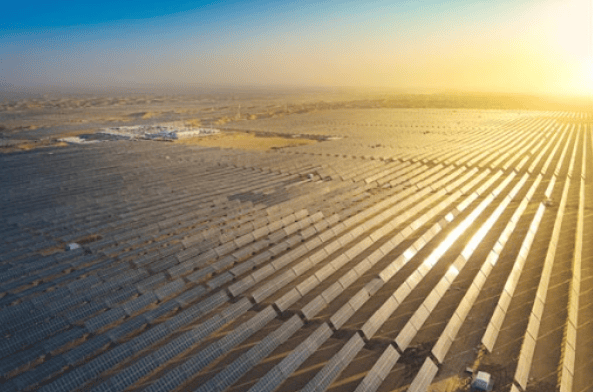
As a major clean energy base in China, Xinjiang's installed photovoltaic (PV) capacity continues to rank among the highest nationwide, with vast Gobi and desert areas providing ample space for new energy development. However, harsh natural conditions such as strong wind and sandstorms, stubborn salt-alkali deposits, and water scarcity lead to annual power generation losses of 5% to 15% for PV modules. Traditional manual cleaning is inefficient and poses significant safety risks, while general-purpose automated equipment often suffers from "maladaptation," failing to meet the demands of high-quality industrial development.
Recently, the "Xinjiang Smart Clean" team from Shihezi Vocational and Technical College spent three years conducting research and tackling challenges across major PV bases in Xinjiang. They successfully developed a prototype smart cleaning machine tailored for extreme Gobi and desert conditions, offering a viable technical solution to address the industry's pain points of severe dust-induced losses and high maintenance costs in local PV power stations.
Since 2023, the team has adhered to a principle of conducting research and validation on the front line. They have visited and studied seven typical PV clusters: the 142nd Regiment PV Station in Shihezi, the supporting PV area of Changji Zhundong Power Plant, the Hami State-owned Investment PV Power Plant, the Xiayedi PV Base in Shihezi, Zhongdian Hutubi Energy Co., Ltd., the Midong District PV Industrial Park, and Tianfu Lvneng PV Power Co., Ltd. The team participated in daily cleaning operations alongside frontline maintenance personnel, systematically recording the types and adhesion patterns of stains across different regions and seasons, and collecting extensive first-hand environmental data and maintenance requirements. In response to key issues identified during research—such as inaccurate recognition under strong light, difficulty in removing salt-alkali crystals, and high failure rates under extreme temperature differences—the team conducted multiple rounds of technical iteration and field testing, ultimately completing the development of the PV smart cleaning prototype.
This prototype incorporates several optimizations for Xinjiang's special working conditions, equipped with universal technology modules such as intelligent perception, multi-mode composite cleaning, and remote maintenance. It can automatically adjust its operation strategy based on the characteristics of different stains, significantly reducing water consumption while ensuring cleaning effectiveness. After continuous field testing, the prototype has operated for over 2,000 hours without failure, achieving a cleaning coverage rate of 98.7%, which positively impacts improving PV module power generation efficiency and reducing overall maintenance costs.
Currently, the team has completed core technology validation and prototype optimization. They are engaging in technical exchanges with several PV enterprises in Xinjiang and steadily advancing demonstration and application efforts.