
On a nonferrous metallurgy production line stretching several kilometers, AI is no longer just a "text assistant" that can chat—it can read industrial language, possess metallurgical thinking, and precisely regulate the entire production process. In September 2025, at the 2025 National Industrial Software Conference hosted by the Chinese Association of Automation, China's first "ZhiYe Large Model" specifically for the nonferrous metal smelting industry was officially unveiled. This marks the formal implementation of a new paradigm for embodied intelligent control industrial applications of large model technology, transitioning from "being able to chat" to "being able to act."
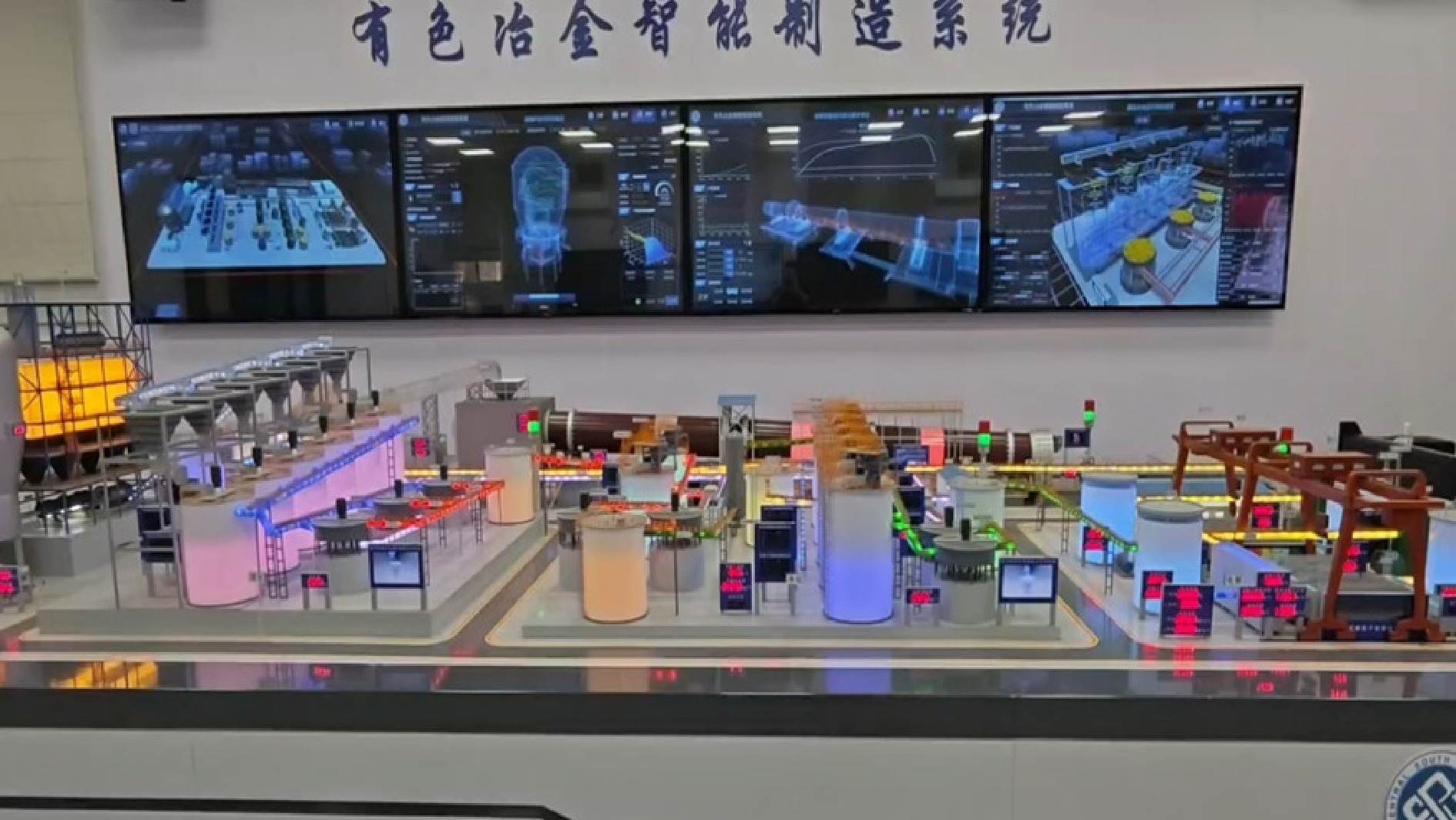
The Dilemma of "Experience Dependence" in a Century-Old Metallurgy Industry
The nonferrous metallurgy process is lengthy and complex, with every stage—from ore mining, screening, and purification to smelting, processing, and final product inspection—fraught with challenges. Taking copper smelting as an example, a single production line can stretch for several kilometers, involving multiple processes such as roasting, smelting, converting, and refining, where parameters like temperature, pressure, and material ratios change rapidly.
In the traditional model, the regulation of these parameters heavily relies on the empirical judgment and manual operation of engineers. The "feel" and "eye" of experienced workers become key guarantees of production quality, but this also brings significant limitations: experience is difficult to replicate, response speed lags, and multi-variable collaborative optimization is challenging. Especially in core equipment like roasting furnaces, even a slight deviation in temperature control can be problematic—insufficient temperature leads to incomplete roasting and reduced metal recovery rates; excessive temperature causes material sintering and melting, increasing energy consumption and damaging the furnace body.
How to enable AI to truly understand the physical and chemical laws of industrial production, rather than just staying at the "dialogue" level, has become a core issue for the industry's intelligent transformation.
Four-Layer Closed-Loop Architecture Enables AI to "Understand Processes and Control Operations"
Professor Yang Chunhua's team from Central South University underwent three generations of iteration during the development of the ZhiYe Large Model—from initial single-point optimization, to process-level control, and finally, the third generation achieved full-process optimization.
Four-Layer Closed-Loop Architecture: From Vertical Domain Adaptation to Embodied Feedback
In their paper "Exploration of a New Paradigm for Building Industrial Vertical Domain Embodied Intelligent Control Large Models" published in the journal Acta Automatica Sinica, the research team systematically elaborated on the model's technical architecture. The model constructs a four-layer closed-loop architecture integrating vertical domain adaptation, embodied control, credible verification, and embodied feedback.
The core innovation of this architecture lies in enabling the large model not only to "understand" industrial language but also to "master" metallurgical thinking. Unlike traditional general-purpose large models, the ZhiYe Large Model initially masters the professional terminology and knowledge system of the nonferrous metallurgy field through vertical domain supervised fine-tuning. More importantly, in the post-training phase, it introduces a reinforcement learning fine-tuning strategy combined with a chain-of-thought reasoning mechanism, enabling the model to handle complex dynamic scenarios and unexpected problems.
Embedding Physical and Chemical Laws: Solving the "Hallucination" Problem of Large Models
General-purpose large models have long faced a fatal flaw in industrial applications—the "hallucination" phenomenon: the model may generate solutions that conform to linguistic logic but violate physical and chemical laws, which is unacceptable in industrial production.
The research team innovatively proposed a hybrid reward model with embedded physical and chemical laws: by embedding a knowledge graph into the large model, using a contrastive enhancement strategy during chain-of-thought reinforcement learning training, sampling and generating chain-structured positive and negative data pairs to train the reinforcement learning reward model. Through repeated learning iterations, it ensures that the solutions output by the large model gradually satisfy the hard constraints of physical and chemical laws.
This means that every control command given by AI has been "reviewed" against physical and chemical laws, possessing industrial practical value.
Hardware Deployment: 8 High-Performance Nodes Supporting Real-Time Control
The model is deployed on 8 high-performance computing nodes, each configured with an Intel Xeon Platinum 8470Q CPU, 512GB of memory, and an NVIDIA A100 GPU. The generated industrial control code is tested on a virtual-physical interactive verification platform for nonferrous metallurgy, achieving closed-loop control from problem identification and solution generation to code execution.
Measured Data: Heating Time Reduced by Nearly 200 Seconds, Average Overshoot Reduced by 40%
The research team used the temperature control of a roasting furnace as a case study, systematically comparing the embodied intelligent control large model with classic PID control algorithms and general-purpose large models such as Llama3.1, DeepSeek-R1, and Qwen3.
The experimental results were remarkable:
Dynamic Response: The embodied intelligent control large model achieved rapid heating in approximately 250 seconds, nearly 200 seconds faster than the slowest heating model, Qwen3;
Control Stability: The maximum overshoot was only 1.36%, an average reduction of about 40% compared to classic PID control and other large models;
Steady-State Accuracy: The steady-state error remained stable within ±8.0°C, with a settling time of approximately 335 seconds, while classic PID control, despite a comparable steady-state error, had a settling time of up to 634 seconds.
In terms of completeness, logical consistency, and detail richness of chain-of-thought reasoning, the embodied intelligent control large model also significantly outperformed general-purpose large models such as DeepSeek-R1, ChatGPT-01, and Gemini-2.5-Pro.
From "Single-Point Breakthrough" to "Full-Chain Intelligent Control"
Full-Process Optimization: The "Intelligent Brain" for a Several-Kilometer Production Line
Professor Yang Chunhua pointed out that the third-generation ZhiYe Large Model achieves full-process optimization—"it can read and analyze data from the entire production process, a production line several kilometers long, identify where the problems are, and then regulate them one by one." This means AI is no longer limited to optimizing a single process but possesses a global perspective and systematic decision-making capability.
Accelerated Implementation of Smart Factories
Industry applications are rapidly following suit. In June 2026, the smart centralized control center of the Minmetals Copper Industry Smart Factory, constructed by MCC Jingcheng, was officially put into operation. This center integrates industry large models and AI technology to create a smart centralized control center combining remote operation, intelligent analysis and scheduling, and AI-assisted decision-making, with 14 intelligent AI application scenarios implemented. Previously, Chinalco had released the "Kun'an" AI large model for the nonferrous metal industry, covering the entire business chain from geological exploration and mineral mining to smelting, processing, and recycling. In April 2026, China Ruilin and Huawei jointly established a Copper Metallurgy AI Co-Innovation Center, focusing on implementing AI applications in key copper metallurgy processes.
From Nonferrous to Steel: A Replicable Industry Paradigm
The technical paradigm of the ZhiYe Large Model is extending to the steel industry. In June 2026, the "Baosteel ZhiYe" intelligent steelmaking large model was successfully deployed on the No. 1 converter of Baotou Steel Co., Ltd., deeply integrating multi-source heterogeneous data such as visual recognition of furnace mouth flames, flue gas analysis, and audio detection. It achieved three core functions: real-time accurate identification of converter blowing status, high-precision prediction of endpoint carbon and temperature, and intelligent collaborative regulation of oxygen supply and lance position. Baotou's traditional steelmaking is completely bidding farewell to the old "experience-driven" model.
National-Level Platform Support
On June 15, 2026, the first national-level AI pilot testing platform in the metallurgical field was inaugurated in Nanjing, Jiangsu Province, marking a new stage in the industrialization verification of AI technology in China's metallurgical field.
Redefining the Boundaries of "Smart Manufacturing"
The deeper value of this achievement lies in reconstructing the application paradigm of large models in the industrial field. In the past, the application of AI large models in industry was mostly confined to the "can chat" level, such as knowledge Q&A and document generation; the ZhiYe Large Model has achieved a leap from "can chat" to "can act" for the first time—AI can not only answer "what temperature should be set," but also directly generate industrial control code, precisely regulate equipment, and achieve closed-loop production optimization.
As the research team pointed out in their paper, this paradigm "builds a bridge from technology to implementation for large models moving from the laboratory to the industrial site." As AI truly "enters" high-temperature workshops, the century-old nonferrous metallurgy industry is undergoing a profound transformation from "experience-driven" to "data + algorithm-driven."