
On the 22nd, it was learned from the Institute of Process Engineering (IPE) of the Chinese Academy of Sciences that a joint team from IPE and Shenzhen University proposed a polymer "locking" mechanism, successfully weaving nanoparticles into three-dimensional photothermal evaporation materials. This significantly enhances the solar seawater evaporation rate, and through outdoor experimental devices, achieved preliminary exploration from seawater desalination to agricultural irrigation. The relevant results were published in the international academic journal Advanced Materials.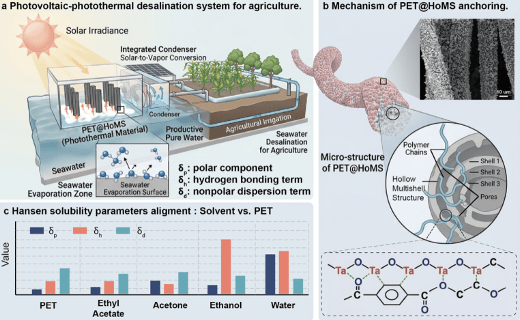
Interfacial solar water evaporation technology is regarded as a new pathway for green water extraction, but its core bottleneck lies in the fact that when high-performance nano photothermal powders are made into macroscopic devices, the nanoparticles tend to "agglomerate" easily, the three-dimensional structure has poor strength, and light exposure gradually leads to material aging and failure.
The joint team adopted a new strategy: first, they prepared multi-layered hollow-structured nano shells, using them as "buttons." Then, based on the principle of polymer-solvent compatibility, they allowed polyester molecular chains to precisely pass through the pores of the shells like sewing threads, firmly stitching the particles together to form a robust three-dimensional network resembling a "nano forest." This is akin to stringing nano spheres together with polymer threads, preventing agglomeration while constructing efficient water transport channels.
Experimental data show that this structure achieves a solar absorption rate of 90.2%, reducing the energy required to evaporate the same amount of water by 45.7%. During 30 consecutive days of accelerated seawater aging, no nanoparticles detached, and the material did not generate active free radicals under light exposure, solving the problem of organic substrate degradation.
The team built a 0.75-square-meter outdoor experimental device at the Langfang Engineering Pilot Base of the Institute of Process Engineering, Chinese Academy of Sciences. Under natural sunlight, the device produces 20.16 liters of fresh water daily, meeting the basic drinking water needs of about 10 people, with water quality reaching World Health Organization drinking water standards. The produced fresh water has successfully irrigated 5 square meters of farmland for an entire year, with crops such as spinach, corn, and Chinese cabbage completing full growth cycles, verifying the feasibility of agricultural irrigation.