
On June 24, it was learned from Xiamen University that a team led by Academician Sun Shigang and Professor Liao Honggang from the university, in collaboration with a team led by Professor Huang Yunhui from Huazhong University of Science and Technology, used a self-developed electrochemical in-situ liquid-phase transmission electron microscopy device to observe for the first time the concentration-driven phase separation phenomenon at the electrode/electrolyte interface. They also revealed the formation and evolution patterns of the high-concentration lithium polysulfide interfacial layer in lithium-sulfur batteries, providing a new theoretical foundation for designing and developing high-energy-density, fast-charging lithium-sulfur battery systems. The relevant findings were recently published in the journal Nature.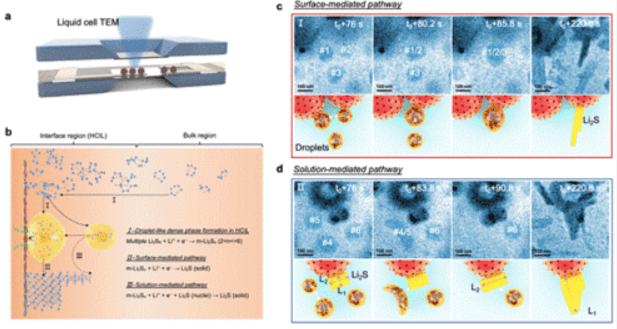
Lithium-sulfur batteries are an important system for next-generation high-specific-energy storage batteries. However, under conditions close to practical applications, such as high sulfur loading and lean electrolyte, the microscopic reaction mechanisms inside the battery are difficult to observe and explain, which has long limited improvements in energy density, fast-charging performance, and cycle stability. This study breaks through the limitations of traditional observation methods, using electrochemical in-situ liquid-phase transmission electron microscopy to achieve high-resolution real-time dynamic imaging of nanoscale interfacial reactions in lithium-sulfur batteries.
The study found that during the discharge process, lithium polysulfide continuously enriches at the electrode interface and undergoes phase separation, forming a high-concentration interfacial layer rich in ion clusters. This establishes two pathways for lithium sulfide deposition: one involves charge transfer reactions and deposition on the electrode surface, and the other involves charge transfer and deposition growth in the electrolyte. These two pathways together determine the efficiency and stability of the sulfur conversion reaction in lithium-sulfur batteries.
Based on these findings, the team proposed an optimization strategy for the material design and interface regulation of high-energy-density, fast-charging lithium-sulfur batteries. This involves rationally controlling the concentration of lithium polysulfide, sulfur content, and electrode interface structure to establish a balance between surface-mediated nucleation and solution-mediated growth, thereby achieving efficient sulfur conversion and enhancing the performance of lithium-sulfur batteries.
This study reveals the mystery of the formation of micron-thick lithium sulfide deposition layers in lithium-sulfur batteries, providing a new scientific basis for the design of next-generation high-energy-density, fast-charging, and long-life energy storage devices.