
On June 22, the first grid-forming energy storage "black start" test in East China was successfully completed in Quzhou, Zhejiang Province. During the test, the grid-forming energy storage module gradually established system voltage through a "zero-voltage start-up" method, successfully restoring power supply to the 110 kV Weida Substation and driving the resumption of operations for diverse loads, including enterprise production loads, charging piles, and distributed photovoltaics.
This marks that under extreme conditions, grid-forming energy storage facilities can serve as the "first spark" for the grid to participate in regional power system restart, providing a new pathway for building a "self-healing" regional power grid. The test was led by State Grid Quzhou Power Supply Company, with technical support from State Grid Zhejiang Electric Power Research Institute.
The so-called "black start" refers to an emergency plan in which, under extreme circumstances such as a large-scale blackout or even a complete grid-wide power outage, the power system relies solely on its internal self-starting power sources to gradually restore power supply without assistance from external grids.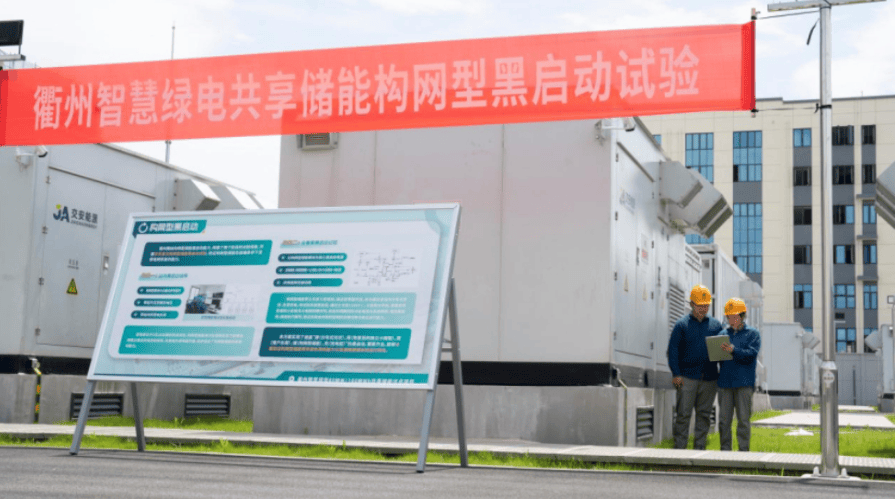
Zheng Keke, a technical expert from State Grid Zhejiang Electric Power Research Institute, explained that while traditional energy storage equipment merely functions as a "power bank" for storing and discharging electricity, grid-forming energy storage has been upgraded to a "support equipment" for the power grid. It can not only quickly balance fluctuations in wind and photovoltaic power generation to maintain grid stability, but also autonomously establish voltage and frequency to drive grid operation under conditions such as weak grids, islanding power outages, or complete blackouts. This technology solves the instability issue of integrating new energy sources into the grid, transforming photovoltaic and wind power from supplementary energy sources that coordinate with grid operation into primary energy sources capable of independently supporting the grid.
Compared to traditional "black start" methods relying on large hydropower units, grid-forming energy storage offers significant advantages: response times can reach tens of seconds, site selection is flexible without constraints from geographical or hydrological conditions, and it is more economically viable.
"Under extreme full-shutdown conditions of 'complete darkness,' how to coordinate the five key elements of 'generation, grid, load, storage, and charging' to achieve zero-voltage start-up, stable island operation, and ultimately synchronized grid connection was the greatest technical challenge of this test," said Wu Junfei, the test leader from State Grid Quzhou Power Supply Company. He noted that the test successfully established a complete real-world scenario for restoring diverse loads, completing key technical validations such as zero-voltage start-up and voltage building, stable island operation, synchronized grid connection and paralleling, and seamless switching from grid-connected to island mode.
As one of the first batch of pilot projects under the National Energy Administration's initiative to enhance the construction capacity of new power systems, this technological breakthrough at the Quzhou Smart Green Power Shared Energy Storage Demonstration Project provides a fast-response emergency self-healing solution for regional power grids with a high proportion of new energy integration.