
At the construction site of the Huandao Road Tunnel of the Xiamen-Jinmen Bridge (Xiamen Section) in China, a "steel arm" with eleven degrees of freedom is operating flexibly inside a 16.15-meter-class super-large-diameter shield machine. No longer requiring workers to enter the pressurized chamber and manually handle heavy disc cutters weighing over 200 kilograms in muddy, stuffy conditions, the robot autonomously performs cutter identification, path planning, and precise replacement under the command of a digital twin system. On June 25, China's first heavy-duty intelligent shield cutter-change robot, developed by China Railway 14th Bureau Group over six years, was officially released and successfully applied, marking a new stage of "unmanned cutter change" in large-diameter shield tunnel construction.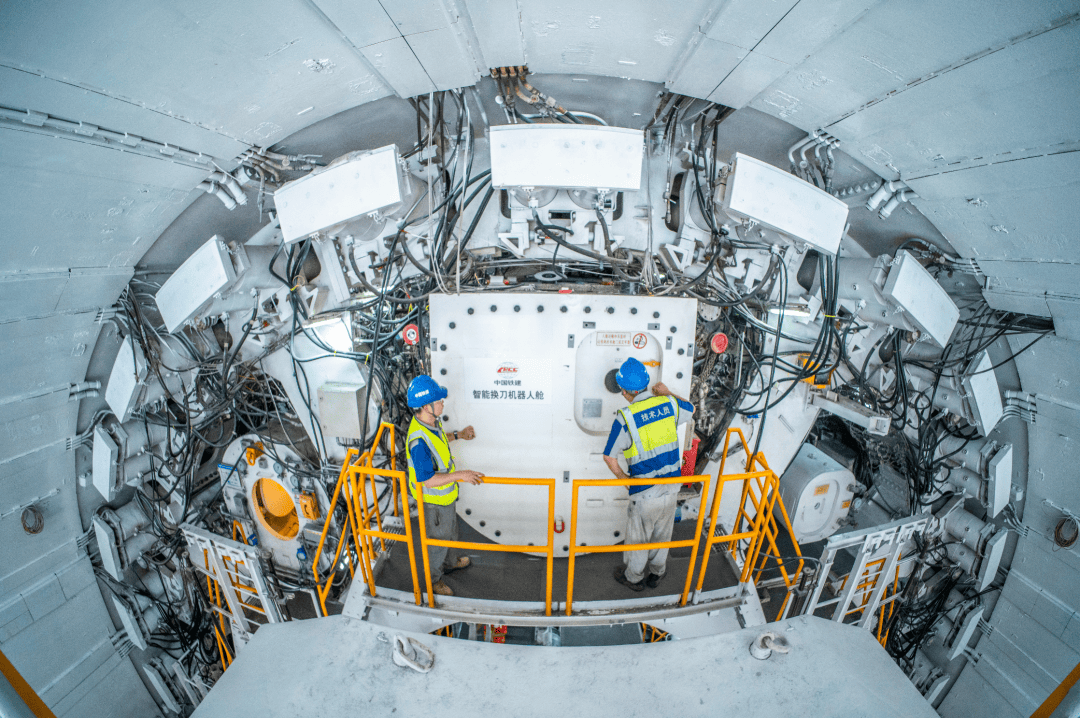
Shield Machine "Teeth" Wear Out, Cutter Change Like "Underground Mine Clearance"
The shield machine is a national heavy equipment for tunneling through mountains and seas. The cutters on the cutterhead act like "teeth" to cut through rock and soil, wearing down continuously during excavation. Efficient and safe cutter change is key to maintaining the shield machine's combat effectiveness.
However, the traditional pressurized cutter-change environment is extremely harsh. In slurry balance shield construction, workers must enter the pressurized chamber, facing not only mobility difficulties but also multiple risks such as face instability, harmful gases, and decompression sickness. The cutter-change chamber is cramped, dimly lit, hot, humid, and filled with turbid air. Traditional cutter change requires three workers and takes over four hours, resulting in low efficiency and high costs.
"Difficult detection and dangerous cutter change" have become recognized industry challenges. Especially in super-large-diameter shield tunnel construction, the large number of cutters and high wear risks multiply the frequency and difficulty of cutter-change operations. The shield section of the Huandao Road Tunnel of the Xiamen-Jinmen Bridge (Xiamen Section) uses a super-large shield machine with an excavation diameter of 16.15 meters, making it the largest-diameter shield tunnel in Fujian Province. The tunnel passes beneath core bustling areas, featuring long-distance composite strata with soft upper and hard lower layers, with the shallowest overburden only 8.1 meters, highlighting the risk of cutter wear. Traditional manual cutter change can no longer meet the dual requirements of safety and efficiency.
Four Core Technological Breakthroughs: From "Manual Operation" to "Intelligent Unmanned"
The R&D team of China Railway 14th Bureau Group started from mechanization, unmanned operation, and intelligence, spending six years to create this intelligent shield cutter-change robot with fully independent intellectual property rights. The robot's entire hardware and software are 100% domestically produced, and it has applied for 38 invention patents, 5 utility model patents, and registered 7 software copyrights.
Highlight 1: Eleven-Degree-of-Freedom Hybrid Manipulator – The manipulator with the highest degree of freedom in the industry
Pressurized cutter-change operations on a shield machine take place behind the cutterhead, in an extremely confined space. To maneuver within this limited area, the team developed an eleven-degree-of-freedom hybrid manipulator, the highest degree of freedom in the industry. With a flexible telescopic configuration and multi-source obstacle avoidance sensors, this manipulator can cover the entire cutterhead of 10-meter to 18-meter-class super-large-diameter shield machines.
Highlight 2: 500 kg Heavy-Duty Gripping Capacity – Easily Handles Heavy Disc Cutters Over 200 kg
Shield cutters are made of alloy, with many disc cutters exceeding 200 kg. The team paired this with a multi-stage telescopic heavy-duty manipulator, overcoming the stability challenges of large cantilever operations. Through algorithm optimization, the equipment's load capacity was increased to 500 kg, allowing it to easily grip heavy disc cutters and perform precise replacements.
Highlight 3: 3D Infrared Machine Vision Positioning – Accuracy Within 1 Millimeter
During slurry balance shield construction, large amounts of slurry fill the chamber, making traditional visual recognition insufficient for automation needs. The team developed 3D infrared machine vision positioning technology, equipping the robot with high-precision "stereoscopic eyes" that can quickly scan and identify the exact position and wear status of each cutter under complex conditions, with positioning accuracy controlled within 1 millimeter.
Highlight 4: Digital Twin Intelligent Management and Control System – Pre-operation Simulation, Real-time Intervention, Post-operation Traceability
In complex underground environments, relying solely on manual control still poses numerous risks. The team built a digital twin intelligent management and control system that receives real-time data and automatically plans the optimal cutter-change sequence and manipulator motion path, achieving full-process intelligent management and control including pre-operation simulation, real-time intervention, and post-operation traceability.
Efficiency Improved by Over 50%, Truly Achieving "No Personnel Entering the Chamber"
With the above technologies, the intelligent cutter-change robot's real-world performance is impressive:
| Indicator | Traditional Manual Cutter Change | Intelligent Cutter-Change Robot |
|---|---|---|
| Time to Replace a Single Disc Cutter | Over 4 hours | 25 to 40 minutes |
| Workers Required | 3 workers entering pressurized chamber | No personnel required inside chamber |
| Efficiency Improvement | — | Over 50% |
| Domestication Rate | — | 100% |
Using the intelligent cutter-change robot, combined with the project's digital twin intelligent management and control system, the time to replace a single disc cutter is only 25 to 40 minutes, improving efficiency by over 50%. The entire process requires no personnel inside the chamber, truly achieving reduced-manning and unmanned operations, effectively enhancing the intrinsic safety of shield construction.
Academician Evaluation: "Overall Reaching International Leading Level"
At the key technology achievement evaluation meeting for large-diameter shield intelligent cutter-change robots organized by the China Highway and Transportation Society that afternoon, an evaluation panel composed of academicians from the Chinese Academy of Engineering, including Qian Qihu, Liang Wenhao, He Chuan, and Xiao Mingqing, unanimously determined: "This research achievement represents the highest technical level in this field in China, overall reaching the international leading level."
Academician Qian Qihu highly praised the equipment development, stating that choosing the cutter-change robot as a research direction was "well-selected and well-chosen," aligning with the trends of autonomous, unmanned, and intelligent transportation equipment, opening a new path in safety, efficiency, and cost.
From the Xiamen-Jinmen Bridge to China's Super-Large Shield Projects
The first battlefield for the intelligent shield cutter-change robot is the Huandao Road Tunnel of the Xiamen-Jinmen Bridge (Xiamen Section). This tunnel has a total length of 3,291 meters, with the shield tunnel section constructed using a super-large shield machine with an excavation diameter of 16.15 meters, making it the largest-diameter shield tunnel in Fujian Province. The robot has been successfully applied on the 16-meter-class "Xiamen-Jinmen" shield machine, helping to drive safe and efficient tunnel excavation.
In the future, this technology has broad application prospects:
For super-large shield projects in complex geology: As China's tunnel engineering moves toward "ultra-deep, ultra-long, ultra-complex geology," the risk of cutter wear continues to increase. The intelligent cutter-change robot provides a safe and efficient solution for high-risk, high-frequency cutter-change operations.
Promoting "machines replacing humans" in shield tunnels: Experts at the meeting conducted in-depth discussions on future-oriented shield tunnel construction scenarios, focusing on directions such as "machines replacing humans," reduced-manning, and unmanned intelligent construction. The successful application of the intelligent cutter-change robot marks a step toward full-process unmanned shield tunnel construction.
Driving the upgrade of the domestic high-end equipment industry chain: The robot's entire hardware and software are 100% domestically produced, with fully independent intellectual property rights. This not only breaks foreign technological monopolies but also lays a solid foundation for the industrialization of China's intelligent shield tunnel construction equipment.
From relying on workers entering pressurized chambers to manually handle disc cutters over 200 kg in muddy, stuffy conditions, to an eleven-degree-of-freedom manipulator autonomously performing cutter identification and precise replacement under the command of a digital twin system—the successful application of China's first heavy-duty intelligent shield cutter-change robot frees people from the most dangerous underground environments, truly ushering large-diameter shield tunnel construction into a new era of "unmanned cutter change."
This is a historic leap from "human-wave tactics" to "intelligent unmanned operation," and another important milestone in the autonomous and intelligent development of China's underground engineering construction equipment.