
Microsoft, a US technology company, officially launched the cloud-based enterprise AI platform Microsoft Discovery at the 2026 Build Conference. Designed for data-intensive R&D scenarios such as chemistry, materials science, life sciences, semiconductors, and quantum computing, the platform leverages multi-agent collaboration, knowledge graphs, simulation tool integration, and experimental workflow orchestration to help research teams compress the cycle from hypothesis formation and experimental design to result validation. Initially introduced as a private preview at the 2025 Build Conference, Microsoft Discovery is now generally available.
Microsoft Discovery's core positioning is not as a general-purpose office assistant, but as an intelligent agent platform tailored for scientific research and engineering R&D workflows. Research institutions and corporate R&D departments often grapple with disparate datasets, internal documents, experimental records, simulation tools, instrument systems, and specialized models. In traditional R&D processes, researchers must constantly switch between different software, databases, and experimental platforms, with significant time spent on data cleaning, hypothesis screening, parameter comparison, and experimental review. Microsoft Discovery aims to integrate these steps into a unified cloud-based R&D workflow, allowing multiple AI agents to handle tasks such as literature retrieval, data organization, simulation invocation, hypothesis generation, experimental planning, and result analysis.
The key underlying module of the platform is the Discovery Engine. It organizes internal institutional knowledge bases, public scientific data, experimental data, model tools, and simulation results using a knowledge graph, enabling AI agents to perform cross-tool reasoning around a single research objective. When researchers propose tasks such as material screening, molecular design, semiconductor process optimization, or drug candidate validation, the system can invoke different agents to decompose the problem and integrate computation, retrieval, simulation, and experimental feedback into a single R&D pipeline. This design is closer to a "digital laboratory assistant" rather than a simple conversational Q&A system.
Microsoft Discovery supports multi-agent orchestration. Different agents can assume distinct roles, such as retrieving existing research findings, generating new hypotheses, invoking high-performance computing resources, running simulation tasks, comparing experimental data, and checking result consistency. Scientific research tasks are typically not completed in a single Q&A session but require multiple rounds of hypothesis refinement, parameter adjustment, experimental feedback, and result verification. The value of the multi-agent structure lies in breaking down complex R&D tasks into multiple executable nodes and then aggregating the results into a workflow that researchers can review.
Microsoft has particularly emphasized Discovery's application in quantum computing R&D. During the development of the company's next-generation topological quantum chip, Majorana 2, Microsoft Discovery was involved in material stack optimization, chip configuration, and experimental path compression. After adopting a new material stack, the Majorana 2 chip achieved approximately a 1000-fold improvement in qubit reliability compared to the previous generation, with an average qubit lifetime of 20 seconds, and some instances approaching 1 minute. For quantum computing, coherence time directly impacts the ability to maintain quantum states, error correction windows, and subsequent scalable computing capabilities; a lifetime of 20 seconds is a significant performance milestone for this technological pathway.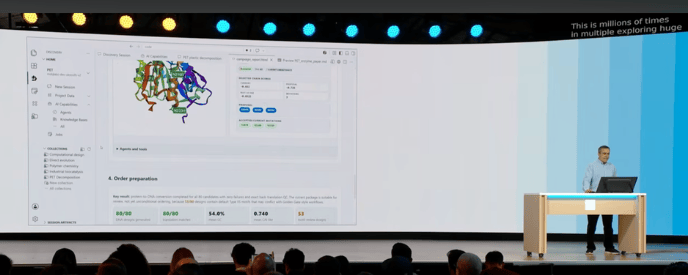
The challenge in quantum chip R&D lies in the highly coupled nature of materials, device structures, cryogenic environments, noise control, and measurement schemes. A change in one parameter can affect the band structure, interface quality, defect density, and quantum state stability. Microsoft Discovery's role in such problems is to integrate experimental data, simulation models, and candidate material combinations into an iterative workflow, reducing manual trial-and-error. AI agents cannot replace physical experiments, but they can help research teams more quickly screen candidate pathways, identify anomalous results, and transform fragmented data into testable hypotheses.
The platform also targets semiconductor R&D scenarios. Research into semiconductor materials, process routes, packaging structures, and device reliability requires extensive simulation and experimental data. Discovery can centrally manage process data, material properties, defect analysis, simulation models, and experimental records, allowing R&D teams to perform problem decomposition, variable screening, and result verification on a single platform. For advanced process nodes, compound semiconductors, optoelectronic devices, and AI chip material R&D, data organization and cross-tool coordination directly impact R&D efficiency.
Life sciences and chemical research are also target scenarios for Microsoft Discovery. Drug discovery, protein structure analysis, molecular screening, battery materials, electrolyte formulations, and catalyst design all involve high-throughput data and multi-variable experimental problems. Discovery can connect an institution's existing data, public databases, specialized models, and experimental systems, helping researchers shorten candidate screening time. Research teams still lead experimental judgment and result confirmation, with the AI platform handling information integration, task decomposition, simulation invocation, and automation of repetitive tasks.
The official release of Microsoft Discovery reflects that scientific AI is transitioning from "point tools" to "R&D workflow platforms." In the past, AI was more commonly used for literature summarization, code generation, or single-model prediction. Now, it is entering the chain of hypothesis generation, experimental planning, tool invocation, and result validation. For corporate R&D departments, the competitive edge of such platforms lies not only in model capabilities but also in data governance, permission management, knowledge graph quality, integration with specialized tools, and traceability of the experimental process.
Microsoft has also launched a preview version of the Microsoft Discovery application to lower the barrier for research teams and students. The enterprise-level platform is deployed on Azure Cloud, suitable for large institutions to integrate internal knowledge bases and high-performance computing resources; the local application is geared towards lighter-weight scientific exploration and early-stage experiments. As AI agents gradually enter the research workflow, the core value of R&D platforms will shift from "generating answers" to "organizing the research process." Whether Microsoft Discovery can establish stable applications in materials, semiconductors, quantum computing, and life sciences will depend on real-world experimental validation, the depth of industry data integration, and the long-term usage effectiveness of research teams.