
A team led by scientists at the University of California, Los Angeles (UCLA) has developed a new zinc-ion hybrid energy storage device, with electrodes fabricated using 3D printing technology, achieving an energy density seven times that of similar devices. The related paper was published in the latest issue of Small magazine.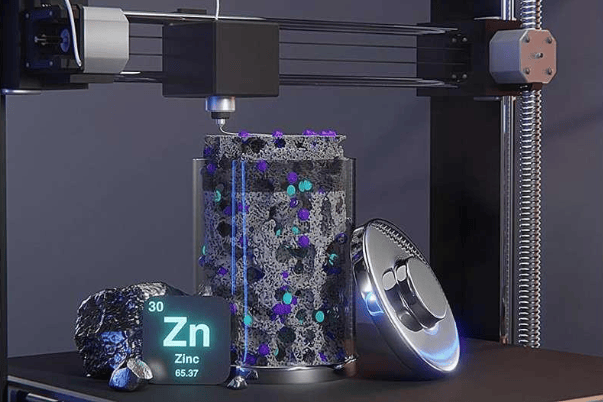
One end of the new device stores energy like a traditional lithium-ion battery, while the other end uses a carbon electrode similar to a supercapacitor. Using zinc instead of lithium to manufacture energy storage devices will be cheaper and more sustainable. This is because zinc is a hundred times more abundant in the Earth's crust than lithium, making it not only easier to mine but also simpler to recycle. Although supercapacitors store less energy, they charge and discharge extremely quickly and can have an expected lifespan of decades.
The bottleneck of supercapacitors is that energy can only remain on the electrode surface. In the latest study, the team significantly enhanced energy density through two approaches: first, by greatly increasing the surface area of the carbon electrode, and second, by filling these surfaces with the energy storage material vanadium oxide.
To increase the surface area of the carbon electrode, the team designed the electrode to be honeycomb-like or sponge-like, filled with tiny cavities inside. The electrode is constructed using 3D printing technology: a liquid resin instantly solidifies under ultraviolet laser irradiation, forming layers one by one. Subsequently, the team heated the printed part to degas it, leaving only a conductive carbon skeleton full of open pores, and then loaded vanadium oxide into this structure through a chemical process. The resulting component has an astonishingly large surface area; if one gram of this material were pressed into a thin sheet, it could cover approximately ten standard tennis courts, enabling it to store a massive amount of charge.
The new device not only stores seven times more electricity than traditional capacitors but also retains 82% of its capacity after 1,500 charge-discharge cycles.
Storing solar and wind energy to meet growing electricity demand requires devices that can both charge and discharge quickly, are low-cost, and can operate continuously for decades. This new device precisely meets all these stringent conditions.