
Ampera, a U.S. energy technology company, announced the completion of the world's first full-scale 3D-printed nuclear reactor module. The module was officially unveiled on July 1 at the company's Innovation Center in Palm Beach Gardens, Florida, with over a hundred local officials, business representatives, and employees in attendance.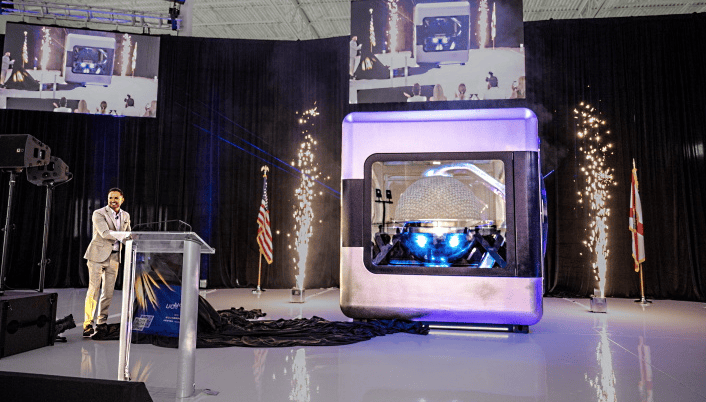
This 3D-printed nuclear reactor module integrates the core and pressure vessel, manufactured as a single piece using silicon carbide material. The core features a spherical monolithic rotary structure, produced via 3D printing technology, with a design life of up to 30 years without requiring refueling. Brian Matthews, founder and CEO of Ampera, stated: "This next-generation nuclear core and pressure vessel lay the foundation for factory-based, scalable nuclear energy production. Advanced technologies and additive manufacturing processes provide a clear pathway for new nuclear technologies to accelerate their entry into the commercial market."
The system will use TRISO thorium-based fuel, and its subcritical design offers inherent safety—the reactor cannot sustain a chain reaction on its own and relies on an external neutron generator to operate. Shutting down the generator immediately halts the reaction, fundamentally eliminating the risk of meltdown. Each module is expected to deliver up to 30 megawatts of electricity, with larger capacity configurations planned for the future.
Ampera's target markets include AI data centers, defense, industrial, and maritime sectors. In June, the company announced the establishment of a subsidiary in Australia to secure thorium resource supply. In February, Ampera submitted a pre-application filing to the U.S. Nuclear Regulatory Commission (NRC), initiating the licensing process for its factory-fabricated containerized microreactor. The module is planned to be licensed under the NRC's recently finalized 10 CFR Part 53 technology-inclusive regulatory framework.