
The longitudinal slope of the subway entrance passage reaches 30°, equivalent to a steep incline about six stories high—on such a slope, each prefabricated component weighing several tons is precisely assembled like "building blocks," with errors controlled to the millimeter level. On June 25, the D entrance of Hainan Road Station on Qingdao Metro Line 6 Phase II, constructed by China Railway No.8 Engineering Group, completed the assembly of its final prefabricated component, marking the successful completion of China's first 30° steep-slope prefabricated subway entrance. This signifies a breakthrough from "0 to 1" in the prefabricated construction of large-slope subway ancillary structures in China.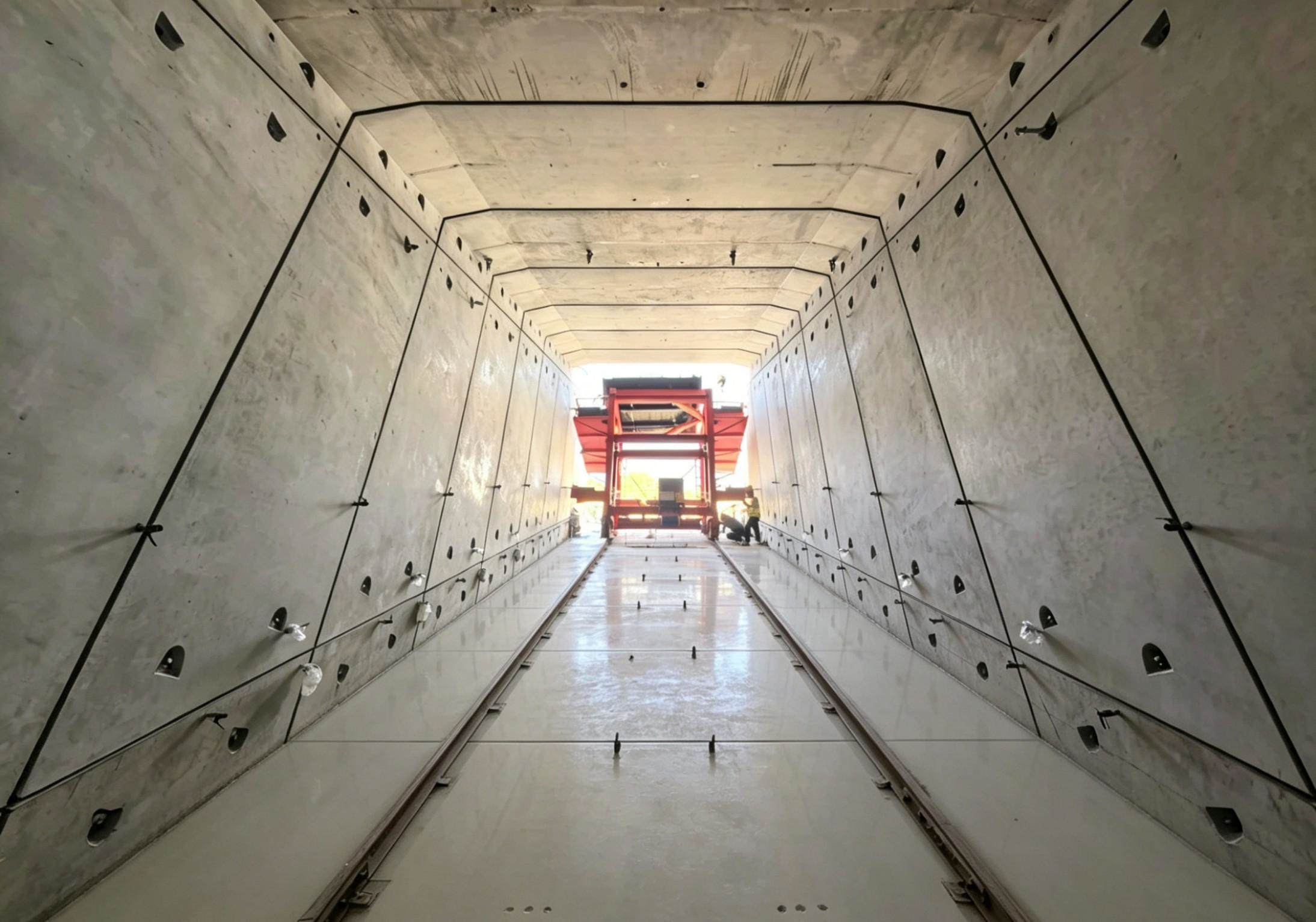
The "Slope Challenge" of Subway Entrances
Due to constraints from ground roads, surrounding buildings, and underground pipelines, subway station entrances often require passages with significant longitudinal slopes. In traditional cast-in-place construction, pouring concrete on slopes is difficult, formwork setup is complex, and waterproofing quality control is challenging. For a long time, the construction of large-slope subway entrances has heavily relied on on-site wet work, resulting in long construction periods, dense labor, and high quality variability—a tough nut to crack in improving the efficiency of rail transit engineering construction.
Although prefabricated construction has been applied in main station structures, extending it to large-slope entrance ancillary structures faces a series of new challenges. Prefabricated components assembled on steep slopes risk tipping, sliding, or misalignment with even slight errors; the waterproofing system at slope joints is far more complex than that of flat structures. How to achieve safe and precise "building block" assembly on a 30° steep slope has become a world-class challenge for builders.
Four Core Technological Breakthroughs
Facing the high risks and control difficulties of steep-slope assembly construction, the project team from China Railway No.8 Engineering Group, for the first time in the industry, integrated and applied a complete set of prefabricated construction technologies, including BIM full-process simulation and a dedicated slope assembly trolley.
"Test Before Build": BIM Full-Process Digital Twin Simulation
Before formal assembly, the team used Building Information Modeling (BIM) technology to conduct full-process digital simulation of the lifting path, posture adjustment, and placement sequence of each prefabricated component. This "test before build" digital twin strategy allowed potential spatial conflicts and process risks to be identified and resolved in the virtual space in advance, providing a precise "navigation map" for on-site construction.
"Dedicated for Slopes": Customized Assembly Trolley and Anti-Slip Limiting System
Conventional flat assembly trolleys cannot operate stably on steep slopes. The team independently developed a dedicated slope assembly trolley system, combined with a total station 3D real-time monitoring system and multiple anti-slip limiting protection devices, achieving integrated continuous operations for grabbing, rotating, and precisely placing prefabricated components on slopes. This is equivalent to laying exclusive "tracks" and "braking systems" for each component on the steep slope, ensuring construction safety at the equipment level.
"Triple Waterproofing": Solving Joint Leakage on Large Slopes
Joint waterproofing in prefabricated structures is a common industry challenge, especially under large-slope conditions. The project team independently developed a triple waterproofing system—combining precision tenon-and-groove positioning, prestressed tension locking, and double rubber water-stop sealing grouting to build a multi-level waterproof barrier. On July 7, a full-network observation activity organized by Qingdao Metro coincided with continuous rainfall, and the system's waterproof performance underwent comprehensive real-world testing, earning unanimous recognition from the observation group.
Full Prefabricated Modularization: Integrated Floor, Side Walls, Roof, and Stairs
All components of the D entrance at Hainan Road Station, including the floor, side walls, roof, and stairs, were standardized and prefabricated in a professional factory and assembled on-site. This "factory-made parts, on-site assembly" model shifted a large amount of high-altitude and confined-space work to ground-level factories, significantly reducing construction safety risks.
Construction Period Cut by 44%, Labor Reduced by 77%
Compared with traditional cast-in-place construction, the prefabricated construction model demonstrates significant comprehensive benefits:
| Comparison Dimension | Traditional Cast-in-Place | Prefabricated Construction | Improvement |
|---|---|---|---|
| Construction Period | 90 days | 50 days | Cut by 44% |
| Peak Construction Workers | 45 people | 10 people | Reduced by 77% |
| Assembly Precision | Relies on manual labor | Millimeter-level | Precisely controllable |
| Construction Mode | On-site wet work | Factory prefabrication + on-site assembly | Industrial upgrade |
Additionally, various specialized tooling and equipment can be reused, continuously reducing construction costs for subsequent projects. This technology has resulted in multiple independently developed tooling systems and proprietary construction techniques, with independent intellectual property rights, filling the domestic gap in prefabricated construction technology for large-slope subway ancillary structures.
Filling a Domestic Technical Gap, Setting an Industry Benchmark
This project is the first large-slope prefabricated subway entrance in China's rail transit industry, with its complete set of key construction technologies filling an industry gap. On July 7, Qingdao Metro Group organized a full-network observation and exchange activity on prefabricated entrance construction technology. Deputy General Manager Wang Shouhui led representatives from various construction branches, the third-phase planning and design institute, and all participating units across the network for on-site observation, fully verifying the feasibility, stability, and advancement of this technology.
Green and Low-Carbon, Supporting the "Dual Carbon" Goals
Prefabricated construction adopts a model of centralized factory prefabrication of components and on-site modular assembly, significantly reducing on-site wet work and material waste. This aligns with the green and low-carbon development concept, providing strong support for achieving China's "dual carbon" goals. Through factory-based batch prefabrication, it also improves entity quality, reduces structural defects, and enhances production efficiency.
Replicable and Scalable, Leading Industry Upgrades
This technology has formed a replicable and scalable practical model. Based on fully summarizing the design and construction experience of prefabricated stations on Line 6, Qingdao Metro has proposed and developed an integrated prefabricated construction system for rail transit. All 14 stations with suitable conditions on the third-phase planned lines will apply this technology. This complete set of large-slope prefabricated entrance construction technology provides an important demonstration for the deep integration of industrialization, informatization, and intelligence in national rail transit ancillary projects.
From "human-wave tactics" to "machine intelligence," from "on-site pouring" to "factory prefabrication"—the completion of China's first 30° steep-slope prefabricated subway entrance is not just a project success but marks a fundamental transformation in the construction model of China's rail transit ancillary structures.
As verified by the observation activity: when prefabricated components on a 30° steep slope achieve millimeter-level precision assembly, and when the triple waterproofing system withstands the real-world test of continuous rainfall, this technology, which fills a domestic gap, has moved from the "laboratory" to the "construction site," from "demonstration" to "promotion." In the future, as prefabricated construction technology is applied in more metro lines and steeper slope scenarios, China's rail transit construction will accelerate toward a more efficient, safer, and greener new phase.