
On July 9, the Diraq team published experimental results on an 8-qubit silicon spin array in *Nature Communications*. Researchers used a 300 mm SiMOS device fabricated by imec to achieve tuning, individual addressing, and coherent control of eight quantum dots. The device employs a wafer manufacturing process compatible with complementary metal-oxide-semiconductor (CMOS) technology, scaling from a previous 2-qubit unit to an 8-qubit linear array.
The experimental device consists of eight linearly arranged silicon quantum dots, with single-electron transistors integrated at both ends of the array to convert spin states into measurable charge signals. The quantum dots are built on isotopically purified silicon-28 material, with a residual silicon-29 concentration of approximately 400 ppm; the gate pitch is 90 nanometers, and the fabrication process combines optical lithography and electron-beam lithography to control the quantum dot gate structure, defect density, and device electrical noise. Every two adjacent quantum dots form a double-quantum-dot unit, and the eight qubits are tuned by four groups of double quantum dots respectively, thereby splitting the calibration process of the entire array into multiple locally controllable units.
All eight qubits underwent resonant control and coherence measurements. The array measured a maximum Ramsey dephasing time of 41 microseconds and a maximum Hahn echo coherence time of 1.31 milliseconds.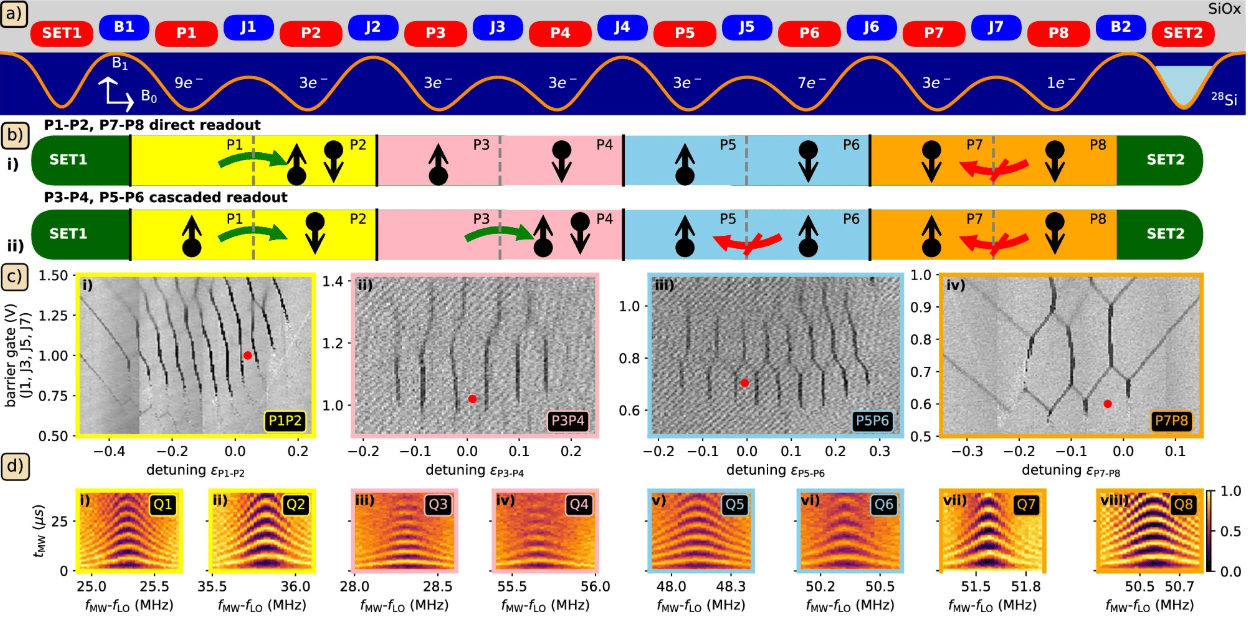
With an applied in-plane DC magnetic field of 0.5 Tesla, the electron spin energy levels produce a Zeeman splitting of approximately 14 GHz. Subtle differences in the electron g-factor among different qubits allow researchers to select target qubits using independent electron spin resonance microwave pulses. Single-qubit Xπ/2 gates are implemented via timed microwave pulses, while Zπ/2 gates are achieved through virtual phase shifts in the microwave source; the Heisenberg exchange interaction between adjacent qubits is controlled by barrier gate voltages and used to execute controlled-phase gates. The experiment also configured a real-time feedback program to continuously track the single-electron transistor operating voltage and qubit Larmor frequency, correcting parameter drift during operation.
The readout section employs a two-stage cascaded charge sensing scheme. The two groups of qubits at the ends of the array are read out directly via single-electron transistors, while the four qubits in the middle first trigger electron cascade movement in the outer quantum dots, and then the sensors at both ends detect the amplified charge changes. This method does not require an additional independent sensor next to each group of quantum dots to read the spin states of the qubits in the middle of the linear array.
The team also performed low-phase-noise two-qubit gate operations between adjacent qubits. The paper currently demonstrates two-qubit gate control for a pair of adjacent qubits, and has not yet completed unified calibration of all entanglement gates among the four groups of double quantum dots.
It should be noted that this paper did not announce a unified metric of "99% operational fidelity for the entire 8-qubit array." The over 99% single-qubit and two-qubit gate fidelities come from previous tests on a 2-qubit unit using the same 300 mm CMOS process; the main metrics reported in this 8-qubit experiment include the successful tuning and independent control of all eight quantum dots, maintained coherence times, cascaded readout of the central four qubits, and low-phase-noise two-qubit gate operations between adjacent qubits.