
Segment floating in tunnel construction has been a global challenge plaguing the engineering community for nearly a century in shield tunneling. Now, this problem has been successfully solved in the Northern Section of the Macau Light Rapid Transit (LRT) Eastern Line project—the world's first nano foam concrete shield grouting solution has been officially implemented, achieving "zero floating" of the tunnel, reducing segment buoyancy by 73.6%, and saving grouting costs by 44.8%.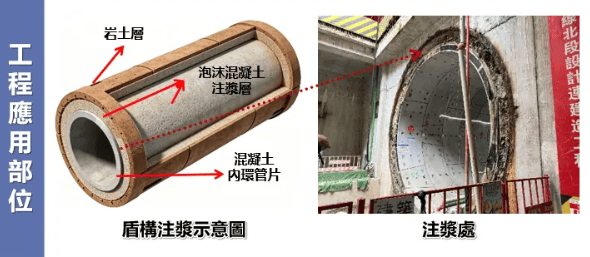
Why Do Tunnel Segments "Float"?
In shield tunneling, segments must be immediately grouted after assembly to fill the gap between the segments and the surrounding ground, ensuring tunnel stability and waterproofing. However, traditional grouting materials have high density and weight, generating significant buoyancy on the segments before the grout sets, causing displacement, deformation, or even cracking of the completed tunnel segments. This "segment floating" issue has long been one of the most critical quality and safety challenges in shield tunnel engineering.
According to statistics, segment floating-related tunnel quality incidents globally cause hundreds of millions of dollars in economic losses and project delays annually. Traditional solutions either sacrifice grout strength for lower density or employ complex anti-floating anchoring measures that increase project costs, with no ideal solution balancing "lightweight" and "high strength."
Nano-Particle Stabilized Foam Concrete Achieves "Lightweight and High Strength"
Recently, the world's first nano foam concrete shield grouting solution was successfully applied in the Northern Section of the Macau LRT Eastern Line project, jointly operated by China Civil Engineering Construction Corporation (CCECC), Nam Kwong (Group) Company Limited, and China Railway 16th Bureau Group Co., Ltd.
This technical solution is the core outcome of the "Research on Lightweight Anti-Floating Design and Durability of Synchronous Grouting Materials for Macau LRT Eastern Line Northern Section Tunnel Shield" project, funded by the Science and Technology Development Fund (FDCT) and collaboratively conducted by the University of Macau, CCECC, and the Macau Representative Office of China Railway 16th Bureau Group.
World's First Commercial Nano-Particle Stabilized Foam Concrete
The research team at the University of Macau previously developed the world's first commercial nano-particle stabilized foam concrete, achieving a 40% reduction in weight and material costs at equivalent strength, successfully applied in large-scale projects such as the approach bridge of the "Macau Bridge."
The core breakthrough of this technology lies in using nano-particles as foam stabilizers, replacing the large, unstable bubbles in traditional foam concrete. Nano-particles form a dense "armor" structure on the bubble surface, providing extremely high foam stability, allowing uniform distribution in the slurry without bursting or agglomeration over time.
Fundamentally Solving the Segment Floating Problem
This application of nano foam concrete for synchronous shield grouting in the test section of the EAP shaft on the Northern Section of the LRT Eastern Line marks the world's first use of nano-particle stabilized foam concrete in actual shield grouting engineering.
Under the premise of meeting grouting strength requirements, the solution innovatively adopts a lightweight anti-floating design, achieving three core breakthroughs:
Segment buoyancy reduced by 73.6%, fundamentally solving the industry's long-standing problem of segment floating caused by traditional high-density grouting materials
Achieving "zero floating" of the tunnel, with segment forming accuracy reaching unprecedented levels
Grouting cost savings of 44.8%, while significantly enhancing tunnel structural safety
On-site Verification by Over Ten Industry Organizations
On July 3, the Science and Technology Development Fund organized representatives from over ten industry organizations, including the Macau Public Works Bureau, Macau Development and Quality Research Institute, Macau Civil Engineering Laboratory, Macau Urban Renewal Limited, Macau Light Rapid Transit Corporation, Macau Association of Engineering Consultants, Macau Association of Building Developers, Macau Construction Association, Macau Construction Machinery and Engineering Association, and the University of Macau, to visit the project site. Representatives inspected the test section on-site and verified key performance indicators such as anti-floating effect and grouting density.
From Shield Tunnels to Broader Underground Engineering
"Standard Configuration" for Shield Tunnel Engineering
The successful application of this technology provides a new technical paradigm for global shield tunnel engineering. Particularly in scenarios with stringent requirements for segment floating control, such as submarine tunnels, river-crossing tunnels, and shield construction in dense urban areas, nano foam concrete grouting technology offers irreplaceable advantages.
With the continuous advancement of global infrastructure projects including urban rail transit, underground utility tunnels, and cross-sea passages, this technology is expected to become the "standard configuration" for shield tunnel construction.
From Macau to All of China and the World
China Civil Engineering Construction Corporation stated that it will continue to deepen technical collaboration with partners, accelerate the promotion and application of new technologies and processes, and solidify technical support for subsequent optimization, standard setting, large-scale application, and promotion.
The successful application of this technology marks China's leap from "following" to "leading" in the field of shield tunnel grouting materials. With the establishment of technical standards and large-scale application promotion, nano foam concrete shield grouting technology is expected to spread from Macau to the whole country and even globally.
"Technical Engine" for the Greater Bay Area Construction
The Macau LRT Eastern Line is a key component of the Guangdong-Hong Kong-Macao Greater Bay Area rail transit network. The successful application of this technology not only provides critical technical support for Macau's LRT construction but also contributes "Macau wisdom" and "China solutions" to underground engineering construction in the Greater Bay Area and beyond.
CCECC stated that this achievement will "write a new chapter for the company's high-quality development and support the construction of the Greater Bay Area."
From "Experience-Based Construction" to "Scientific Grouting"
The deeper value of this technology lies in elevating shield grouting from "experience-driven" to "science-driven." Traditional grouting solutions rely on engineering experience, often compromising one aspect for another. In contrast, nano foam concrete grouting technology achieves the unity of lightweight and high strength through material science innovation, fundamentally solving the segment floating problem that has plagued the industry for nearly a century.
Three Milestone Significances:
Technological First: World's first application of nano-particle stabilized foam concrete in actual shield grouting engineering
Remarkable Results: Segment buoyancy reduced by 73.6%, achieving "zero floating," with cost savings of 44.8%
Scalable and Replicable: Verified through actual engineering, ready for large-scale application
As the shield machine travels underground, segments no longer "drift," and tunnel forming accuracy reaches unprecedented levels—this is not only a triumph of material science but also another testament to China's world-class underground engineering capabilities.