
In the construction industry, where the pain points of "dangerous, complex, dirty, and heavy" tasks urgently need to be addressed, coating construction—one of the most labor-intensive and environmentally harsh stages of interior decoration—is undergoing a profound transformation driven by robots. On July 3, 2026, at the inaugural 2026 Construction Industry AI Development Conference held in Shenzhen, Fengtan Robot's fourth-generation P600 Max multifunctional coating construction robot made a significant debut as a groundbreaking innovation case in the field of construction robotics and was selected as a typical case in the "Construction Industry AI Development Report (2026)." Designed specifically for coating construction scenarios in buildings under 6 meters, this robot is the first to achieve full coverage of five major processes—putty spraying, scraping, sanding, dust collection, and paint spraying—with a single machine, reducing customer equipment procurement costs by two-thirds and increasing construction efficiency by 7 times compared to manual labor, marking a new era in building coating construction from "multi-machine collaboration" to "single-machine versatility."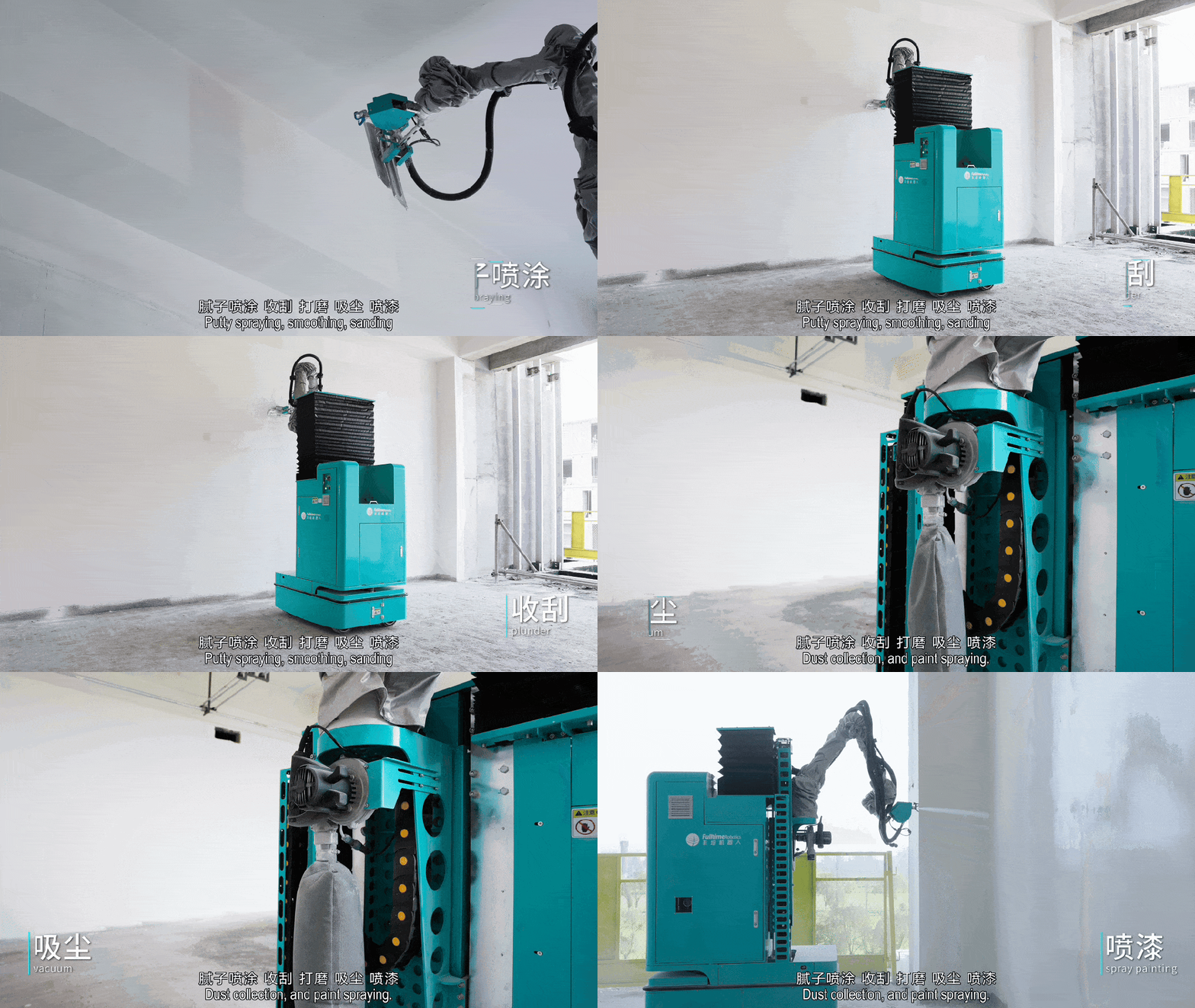
The "Human Wave" Dilemma of Coating Construction
Building coating construction has long been one of the most labor-intensive and environmentally harsh stages. The five processes—putty spraying, scraping, sanding, dust collection, and paint spraying—are interlinked. Under traditional construction methods, not only is a large amount of labor required, but there are also prominent issues such as severe dust pollution, high risks of working at heights, and inconsistent construction quality depending on the worker. As the construction industry faces a growing labor shortage and young people are reluctant to enter "dangerous, complex, dirty, and heavy" construction sites, the automation and intelligent upgrade of coating construction processes have become urgent.
Previous robot solutions in the industry mostly adopted a "multi-machine collaboration" model—putty sprayers, sanders, and paint sprayers operated independently, with 2 to 3 separate robots working together to complete multiple processes. This approach not only resulted in high equipment procurement costs but also faced practical challenges such as complex multi-machine coordination and low equipment utilization.
"Five-in-One" Execution Platform Rewrites Industry Rules
The P600 Max, developed over more than a year, features a core innovation: the self-developed "multi-modal integrated actuator." This actuator is equipped with a six-dimensional force sensor and a vision sensor, utilizing a force/position/velocity hybrid control algorithm combined with ten-axis simultaneous computing technology to dynamically adjust motion trajectories and contact forces in real time, fundamentally solving the industry challenge of "complex surface profiles."
The actuator achieves control precision with force accuracy of ±1N, position accuracy of 0.1mm, and speed accuracy error rate of 0.5%, with putty scraping flatness consistently within 0.5mm. The five end-effectors—putty spraying, scraping, sanding, dust collection, and paint spraying—are integrated into the same robot body via standardized interfaces, allowing for quick replacement of end-effectors within 5 minutes.
The disruptive nature of this "five-in-one" design lies in the fact that, compared to traditional industry solutions requiring 2 to 3 separate robots to complete multiple processes, the P600 Max can reduce customer equipment procurement costs by more than two-thirds. One machine for multiple uses significantly optimizes the project's input-output ratio.
"Spatial Brain": Enabling Robots to Operate Autonomously in Real Construction Sites
Another major technical highlight of the P600 Max is its integration of Fengtan's self-developed "Spatial Brain" intelligent system. The system achieves a complete technical chain including 3D scene reconstruction, object recognition, spatial semantic understanding, spatial perception and localization, task and path planning, and decision control.
Using AI visual semantic segmentation technology, the system can identify building components and attributes such as beams, columns, ceilings, walls, and door and window openings, call upon a spatial knowledge graph to match hundreds of process parameters, and autonomously plan optimal construction paths, enabling intelligent construction in open, unstructured scenes.
The core value of the "Spatial Brain's" first commercial application lies in solving the automation construction challenges of complex environments with interwoven beams, columns, walls, and ceilings in non-standard scenarios such as large public buildings, commercial buildings, and factories. It effectively liberates the traditional robot interaction method of manual mapping, allowing robots to truly perceive, decide, and operate autonomously in real, complex construction sites. This represents the real-world implementation of the 2026 physical AI era—where AI evolves from digital generation to action and interaction in the three-dimensional physical world.
Construction Efficiency Increased by 7 Times, Material Savings of Over 20%
The efficiency advantages of the P600 Max have been fully validated in real construction scenarios. According to measured data from Fengtan Robot's projects such as Baoding Chuangzhi Cloud Valley, using a combination of "1 robot + 1 operator + 1 assistant for mixing materials," the per-person daily work efficiency reaches 500 to 600 square meters, approximately 5 times higher than traditional construction efficiency. In larger-scale applications, putty construction efficiency can reach 1,000 to 1,200 square meters per day, 8 to 10 times that of manual labor; latex paint construction efficiency is about 3,000 square meters per day, twice that of handheld sprayers.
In terms of materials and costs, the robot can accurately adjust material usage and spray evenly, saving 20% to 25% of materials. Paired with an efficient dust collection system, it completely eliminates construction dust pollution, avoids occupational health risks, and reduces overall construction costs by 20% to 30%.
Overall, the P600 Max reduces customer equipment procurement costs by two-thirds and increases construction efficiency by 7 times compared to manual labor, achieving comprehensive optimization from equipment investment to construction efficiency, and from material savings to overall costs.
Restructuring Construction Organization Methods
The introduction of construction robots into construction sites is not merely a replacement of equipment but a restructuring of the core relationships among workers, tools, and work objects. In a keynote speech at the conference, Fengtan Robot proposed a "five-element" framework for the successful application of construction robots: selection of scenario applicability, tool adaptation to the scenario, reorganization of construction methods, clear definition of human-machine combinations, and capability training for new job roles.
The emergence of the P600 Max marks a new stage in building coating construction, transitioning from "multi-machine collaboration" to "single-machine versatility." When a single robot can independently complete all processes from putty to latex paint, when construction efficiency increases by 7 times while equipment costs decrease by two-thirds, the "dangerous, complex, dirty, and heavy" label of the construction industry is being peeled away one hardcore technology at a time. This coating construction revolution, driven by the "five-in-one" execution platform and the "Spatial Brain," is redefining the productivity boundaries of the construction industry.