
The Pacific Ocean floor holds approximately 3 billion tons of cobalt, 3,000 times the terrestrial reserves. In June 2024, the "Kaituo II," a deep-sea heavy-duty mining vehicle engineering prototype independently developed by Shanghai Jiao Tong University, landed at a depth of 4,102.8 meters in the western Pacific, successfully retrieving deep-sea polymetallic crusts and nodules, setting six records in China's deep-sea mining sector.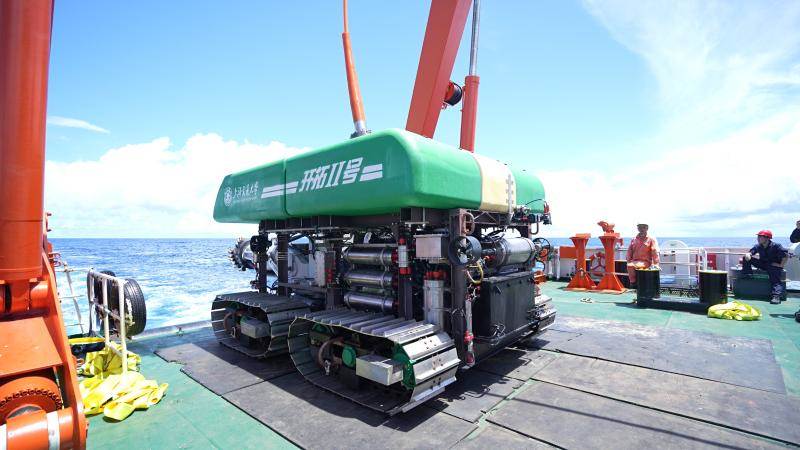
The "Blue Battle" for Deep-Sea Mining
The ocean floor is rich in mineral resources such as polymetallic nodules, cobalt-rich crusts, and polymetallic sulfides, containing key materials like copper, cobalt, nickel, and manganese with high application value. According to the International Energy Agency, global demand for cobalt could be 10 to even 25 times higher than current levels by 2030. The European Union, Japan, Canada, and other countries have been racing to develop key technologies and equipment for seabed mining.
China holds exclusive exploration rights and priority mining rights for five international seabed mining areas, covering an area equivalent to three Bohai Seas. However, exploration rights also have an "expiration date," making it crucial to master development technologies and build extraction capabilities as soon as possible. The innovative development of deep-sea mineral resource extraction equipment holds significant practical importance for leading marine high-tech development, forming future industries in deep-sea exploration and mining, and fostering new productive forces.
Six "Firsts" Forge the Deep-Sea "Mining Titan"
The "Kaituo II" measures 6 meters in length, 3 meters in width, 2.5 meters in height, weighs 14 tons, and is designed for an operating depth of 6,000 meters. During sea trials from June 22 to 26, the "Kaituo II" successfully completed five dives in the polymetallic crust and nodule mining area, reaching a maximum depth of 4,102.8 meters. Ultimately, the team brought back over 200 kilograms of various deep-sea mineral samples, including polymetallic crusts, polymetallic nodules, and seabed bedrock.
According to Professor Yang Jianmin, Chief Scientist of the sea trials and a professor at Shanghai Jiao Tong University's School of Naval Architecture, Ocean & Civil Engineering, deep-sea mining has long faced three major technical challenges internationally: first, the extremely complex seabed terrain in mining areas makes safe equipment travel difficult; second, the diverse forms and physical properties of deep-sea mineral deposits make efficient extraction and collection challenging; third, the safe deployment and recovery of heavy-duty deep-sea equipment under rough sea conditions is problematic. The "Kaituo II" has tackled these global challenges one by one with six "first-of-their-kind" technologies.
First: High-Mobility Travel Technology for Complex Deep-Sea Terrain. The "Kaituo II's" four independent tracks can autonomously adjust direction and posture in real-time based on the actual seabed terrain. Whether navigating steep seamounts with slopes exceeding 30 degrees or seabed "mudflats" formed by highly viscous, soft sediments, it can travel, climb, and rotate in place smoothly. The mining vehicle can autonomously perceive the mining environment without manual control, achieving centimeter-level positioning accuracy.
Second: Composite Drilling and Mining Technology for Multiple Deep-Sea Ore Types. Polymetallic crusts are tightly attached to sloping bedrock, while polymetallic nodules are semi-buried in soft seabed sediments. The "Kaituo II" can quickly separate crusts from bedrock and efficiently suck them into the collection box, while also excavating semi-buried nodules. A single set of equipment adapted to collect two different types of ore significantly improves the engineering efficiency and equipment utilization of deep-sea mining.
Third: Intelligent Fine Control Technology for Heavy-Duty Deep-Sea Operations. The mining vehicle possesses capabilities for intelligent path planning, tracking, and obstacle avoidance, achieving centimeter-level precise positioning even in the pitch-black deep-sea environment. Complex seabed mining operations resemble a more automated, programmed "underwater ballet."
Fourth: Deep-Sea Heavy-Duty Deployment and Recovery Technology Using Non-Metallic Cables. The "Kaituo II" is the first to use a photoelectric composite umbilical cable made of non-metallic aramid material, breaking the limitations of conventional steel cable deployment. In deep water, the self-weight of a steel cable far exceeds that of the equipment itself, making deployment at depths of 5,000 to 6,000 meters impossible. The non-metallic cable significantly reduces the equipment's self-weight, enabling the safe deployment and recovery of heavy-duty equipment at a depth of 4,100 meters.
Fifth: Deep-Sea Environmental Disturbance Monitoring and Assessment Technology. The mining vehicle is equipped with an environmental monitoring system to comprehensively monitor and assess environmental impacts such as the generation and diffusion of seabed plumes and underwater operational noise. While pursuing resource development, it simultaneously focuses on deep-sea ecological protection.
Sixth: First Time a Deep-Sea Heavy-Duty Mining Vehicle Has Surpassed the 4,000-Meter Depth Mark for Deployment Operations. This marks the first time a domestic deep-sea heavy-duty mining vehicle has conducted trial extraction of deep-sea mineral resources at depths exceeding 4,000 meters.
The Commercialization Path from 4,000 to 6,000 Meters
Strategic Resource Security. The crust and nodule samples obtained from this sea trial contain iron and manganese levels between 10% and 20%, and are rich in key metals such as titanium, nickel, cerium, and copper. Deep-sea mineral resource development is expected to achieve breakthroughs in the next 10 to 15 years, leading to commercial exploitation and utilization.
A Key Step Towards Commercial Mining. Professor Yang Jianmin stated that surpassing the 4,000-meter depth mark in this sea trial means the equipment can essentially reach the depths required for seabed mining—deep-sea mineral resources are generally found on the seabed at depths between 2,000 and 6,000 meters, with polymetallic crusts and sulfides mainly distributed within 4,000 meters. The "Kaituo II" has preliminarily demonstrated the capability for engineering and commercial extraction.
Continuing the Advance into Deeper Blue Waters. Experts including Lin Zhongqin and Li Jiabiao, academicians of the Chinese Academy of Engineering, and Li Maolin, Director of the State Key Laboratory of Deep-Sea Mineral Resources Development and Utilization Technology, commented that the successful sea trial of the "Kaituo II" marks that China will have stronger technical support and equipment guarantees in deep-sea scientific research, resource development, and environmental protection. Professor Yang Jianmin revealed that the team will continue to conduct in-depth scientific and technological research, continuously developing the next generation of "Kaituo" series deep-sea heavy-duty operation equipment, aiming for greater water depths, stronger operational capabilities, and higher levels of intelligence.
Starting from nearly zero foundation in 2013, to the "Kaituo I" achieving a 1,305-meter deep-sea test in 2021, and then the "Kaituo II" surpassing 4,102.8 meters in 2024—the Shanghai Jiao Tong University team, through over a decade of independent research, has propelled China into the world's top tier of deep-sea technology.