
A team led by Academician Li Yongfang and Researcher Meng Lei from the Institute of Chemistry, Chinese Academy of Sciences, has made new progress in perovskite-organic tandem solar cell technology. The device they developed achieved a steady-state photoelectric conversion efficiency of 28.04% as certified by a third party, setting a new world record for this type of device.
Traditional single-junction solar cells rely on only one light-absorbing material, making it difficult to efficiently utilize photons of different energies. The perovskite-organic tandem solar cell developed by this team stacks two photovoltaic materials, allowing layered absorption of sunlight and theoretically achieving higher photoelectric conversion efficiency. Additionally, this new type of cell is thin, lightweight, and flexible, and is expected to be applied in scenarios with high lightweight requirements, such as building-integrated photovoltaics, portable energy sources, wearable devices, drones, and space power supply.
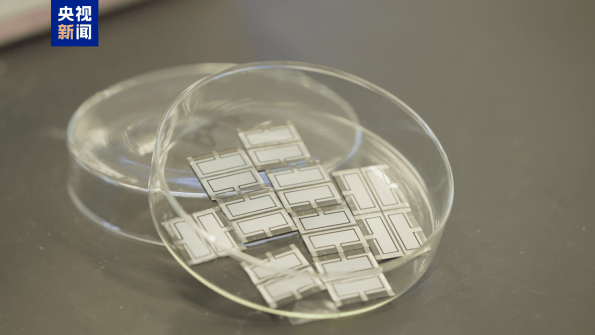
To address previous shortcomings of perovskite-organic tandem solar cells, such as performance degradation and insufficient stability, the research team introduced a novel additive molecule, TDB, achieving full-cycle regulation from preparation to operation. This provides an effective strategy for overcoming the technical limitations of such devices. The results were published in the international academic journal Nature on July 13.
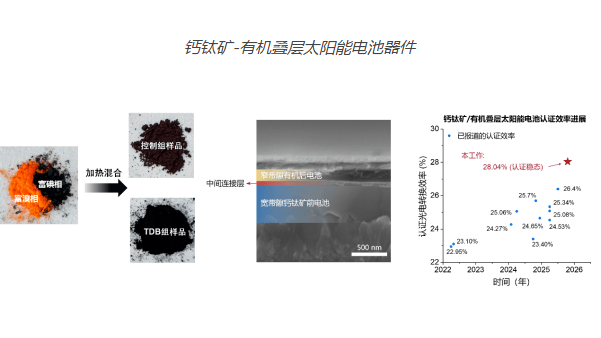
As certified by a third party, the perovskite-organic tandem solar cell fabricated using this technology achieved a steady-state photoelectric conversion efficiency of 28.04%, setting a new world record. The device also demonstrated excellent stability, retaining 90% of its initial photoelectric conversion efficiency after 625 hours of continuous light operation. In the future, this new type of solar cell is expected to provide energy support for ground-based buildings, transportation, smart wearable devices, and aerospace fields such as satellites.