
China Telecom, in collaboration with Beijing University of Posts and Telecommunications and Peng Cheng Laboratory, has completed a knowledge base-driven cross-modal semantic communication experiment for high-orbit satellites using the AsiaSat-9 satellite. The experiment combined a semantic knowledge base with joint source-channel coding technology. Under similar video quality conditions, the transmission efficiency of the satellite-to-ground link reached 5.5 times that of the traditional H.264 scheme and 3.5 times that of the H.265 scheme.
Traditional satellite video communication requires frame-by-frame compression and transmission of continuous images, resulting in large data volumes and susceptibility to satellite link bandwidth, latency, and channel fluctuations. In this experiment, instead of transmitting all video frames in full, the video content was split into key frames and non-key frames: key frames were directly transmitted via joint source-channel coding, while non-key frames were converted into text vectors from the knowledge base, replacing high-dimensional image data with low-dimensional semantic data.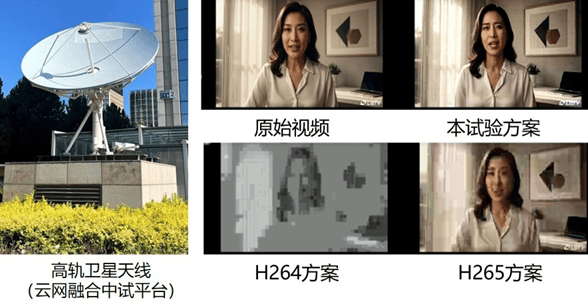
The experimental system compressed the proportion of key frames in the video to approximately 0.5%. For every 6-second video segment, only one key frame was selected for image transmission, while the remaining nearly 200 frames were mapped as text vectors. After receiving the key frame and semantic vectors, the receiving end reconstructed the video content using the knowledge base, thereby reducing the data volume that the satellite-to-ground link needed to carry.
Joint source-channel coding technology integrates the video compression and channel coding processes of traditional schemes, allowing the encoding system to directly optimize information representation and transmission based on satellite link conditions. When bandwidth is limited or channel quality fluctuates, the system prioritizes preserving scene subjects, action relationships, and key content, rather than recovering the original video data bit by bit.
Test results showed that when the Fréchet distance metric of the generated video was below 50 and image quality remained comparable, this scheme significantly reduced the data volume transmitted over the satellite-to-ground link compared to H.264 and H.265 encoding. The technical focus shifted from "transmitting complete pixels" to "transmitting key frames and semantic information," enabling high-orbit satellite links to complete video content expression with less data.
This experiment validated the combined application of knowledge bases, cross-modal mapping, and joint source-channel coding in high-orbit satellite communications. The related methods can subsequently be used for satellite video backhaul, remote monitoring, emergency communications, and multimodal information transmission in bandwidth-constrained environments.