
Dimension Network News, recently, the Massachusetts Institute of Technology (MIT) in the United States and the Samsung Advanced Institute of Technology in South Korea have developed an acrylic resin encapsulation method that significantly extends the operational lifespan of cadmium-free quantum dot light-emitting diodes. Among them, the lifespan of blue QD-LEDs, after conversion based on test conditions, has increased by more than 5,000 times. The research team also identified the key cause of device failure: hydrogen and oxygen active species generated and migrating during operation gradually alter the microstructure of the quantum dots and their adjacent functional layers. The related findings were published in Science Advances.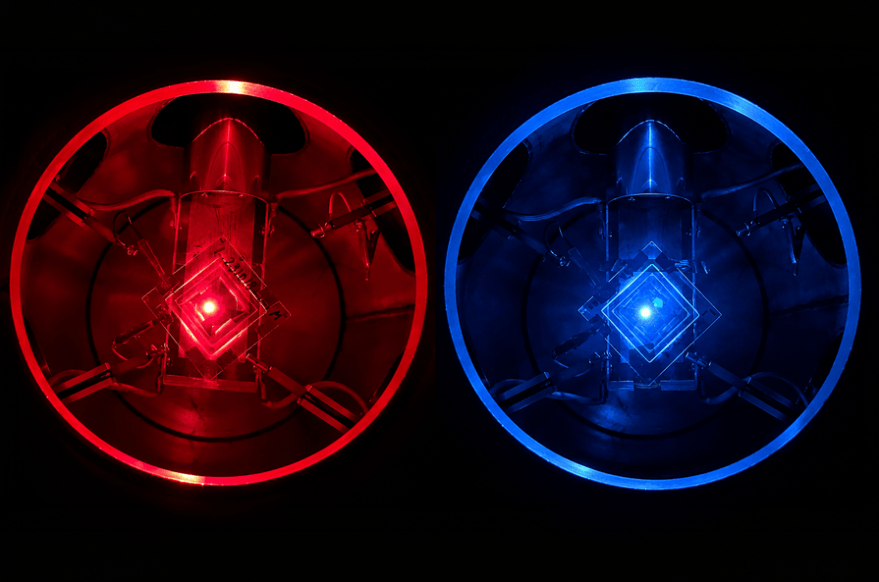
This research does not focus on the "quantum dot backlight screens" commonly seen in the current TV market. Some existing QLED TVs still use traditional LEDs for backlighting, with quantum dots primarily responsible for absorbing and converting light. In contrast, QD-LEDs directly inject electrons and holes into the quantum dot emitting layer, allowing the quantum dots themselves to generate red, green, and blue light. Their advantages include a narrower emission spectrum, higher color purity, a potentially simpler device structure, and suitability for flexible and large-area displays.
The real bottleneck for QD-LED commercialization is lifespan, especially for blue devices. Blue photons have higher energy than red and green photons, imposing stricter requirements on quantum dot materials, interface structures, and charge balance. MIT tests found that the stability of blue QD-LEDs is approximately 50 to 100 times lower than that of red and green devices. When used in full-color displays, blue sub-pixels may degrade first, causing color shifts and brightness reduction.
The devices fabricated by the research team consist of multiple layers of nanomaterials stacked together. The basic structure includes, in order, an indium tin oxide electrode, a hole injection layer, a hole transport layer, a quantum dot emitting layer, a magnesium zinc oxide nanoparticle electron transport layer, and an aluminum electrode. Red devices use InP/ZnSe/ZnS core-shell quantum dots, while blue devices use ZnTeSe/ZnSe/ZnS quantum dots. The entire emitting region is only nanometers thick, and any thinning, particle coalescence, or element migration in any layer can disrupt the balance of electron and hole injection.
To observe what happens inside the device, researchers used a focused ion beam to cut QD-LEDs into cross-sectional slices less than 200 nanometers thick, then compared fresh and aged devices using transmission electron microscopy. The results showed that after continuous operation, the electron transport layer, quantum dot emitting layer, and organic hole transport layer all became denser and thinner. Initially separate nanoparticles gradually coarsened and coalesced, with some quantum dots losing their original contours.
This degradation is not simply the material being "burned out." Elemental analysis revealed that hydrogen and oxygen active species are generated during device operation and diffuse between different functional layers, with oxygen accumulating at the interface between the aluminum electrode and the magnesium zinc oxide electron transport layer. In situ transmission electron microscopy experiments further confirmed that in the presence of hydrogen active species, the coarsening rate of magnesium zinc oxide nanoparticles accelerates. After the particle structure changes, the electron transport path and interface energy levels are altered, leading to an imbalance in the number of electrons and holes reaching the quantum dots, increased non-radiative recombination, and ultimately a decline in brightness and efficiency.
The role of the acrylic resin encapsulation is not to add a protective shell directly to the quantum dots themselves. Instead, after device fabrication, the resin is placed between the electrode and the encapsulation glass, altering the chemical environment inside the device. Experimental results indicate that the resin can inhibit the formation and migration of hydrogen and oxygen active species, reduce particle coarsening in the electron transport layer and quantum dot layer, and prevent the continuous thinning of the multilayer structure. The research team believes the resin may also suppress the formation of moisture from the internal gas environment of the device, as moisture is a key factor causing material degradation.
Lifespan testing used the LT50 metric, which is the operating time required for the device brightness to drop to 50% of its initial value. The LT50 of blue devices without resin encapsulation was only 0.2 hours, while after encapsulation it reached 115.5 hours, and the encapsulated devices were tested at a higher initial brightness. Using a brightness acceleration factor, the researchers converted the data from both groups to 100 candelas per square meter, yielding a lifespan improvement of over 5,000 times. For red devices, the LT50 increased from 22.1 hours to 189.9 hours, an improvement of about 8 times.
The "5,000-fold improvement" cannot be directly interpreted as the TV lifespan having been extended by 5,000 times. This figure comes from conversion results under specific current, brightness, and accelerated conditions for experimental devices. The current lifespan of blue devices still does not fully meet the requirements for large-scale consumer electronics. Resin encapsulation has not eliminated all degradation pathways, and the team is also researching the addition of other functional layers to further improve luminous efficiency and long-term stability.
The value of this technology lies in the relative simplicity of the encapsulation step, which does not require redesigning quantum dot materials or completely overhauling the QD-LED production process, making it potentially integrable into existing thin-film device manufacturing processes. If subsequent issues regarding long-term reliability, pixel uniformity, and large-area fabrication can be resolved, electroluminescent quantum dot technology could be used in flat-panel TVs, smartphones, AR/VR headsets, medical imaging, and large-area lighting, and may extend to sensors and lasers.