
In July 2026, a special report by CNR highlighted the breakthrough achievements of Liu Zetan, a young scientific research backbone at the Xianyang Ceramics Research Institute of China Building Materials Academy, and his team—successfully achieving one-piece molding of meter-scale and larger silicon carbide green bodies, advancing the manufacturing capability of advanced ceramic components from the "decimeter level" to a new height of the "meter level."
This breakthrough marks a critical step for China on the path to self-reliance in key high-end ceramic-based materials.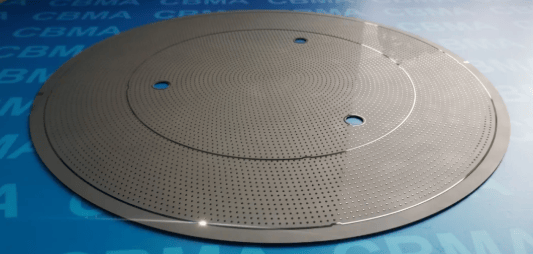
The "Size Curse" of Advanced Ceramics
Silicon carbide (SiC) advanced ceramics, renowned for their excellent properties such as high-temperature resistance, corrosion resistance, high hardness, and low density, are widely recognized as the "skeleton" and "armor" for next-generation high-end equipment. From hot-section components of aircraft engines and thermal protection structures of spacecraft, to core components of semiconductor manufacturing equipment and fuel cladding for nuclear reactors, large-sized, high-reliability silicon carbide ceramic components are indispensable strategic materials.
However, the manufacturing of advanced ceramics has long faced a "size curse": once dimensions exceed conventional limits, the difficulty increases exponentially. As the green body size scales up to the meter level, cracking induced by internal stress becomes extremely difficult to control—even the slightest flaw can render all previous efforts futile. For a long time, one-piece molding of meter-scale and larger silicon carbide green bodies was considered an "impossible task" within the industry.
This technical bottleneck has directly constrained China's ability to independently supply high-end ceramic components in strategic fields such as aerospace, semiconductors, and nuclear energy.
Deconstructing the "Impossible" with "First Principles"
Facing this industry-recognized challenge, the team at the Xianyang Ceramics Research Institute of China Building Materials Academy chose not to make patchwork improvements on existing processes but instead pursued a more fundamental path—breaking the deadlock using "first principles."
Returning to the Origins of Physical Chemistry to Re-understand "Cracking"
Liu Zetan and his team's approach was to reset empirical biases and return to the most basic physical and chemical theories. They "dismantled" the entire molding process, starting from the most fundamental mechanisms to re-examine and optimize every step.
During the transition to the aqueous gelcasting process, increasing the solid content of the slurry once hit a dead end. Instead of dwelling on surface-level frustration, the team returned to the most basic questions: What is the dispersion conformation of the dispersant in the solution? What are the deep interactions with the raw materials? What does every detail of the added reagents mean?
Through extensive literature review, repeated experiments, and team discussions, they not only broke through the technical bottleneck but also established a thinking model for deriving process problems from underlying principles.
Persisting with the Underlying Logic, Eliminating Risk Points Step by Step
In the process of conquering the molding of meter-scale large-sized green bodies, the team thoroughly "dismantled" the entire process flow, conducting theoretical derivation and experimental verification for each step. When necessary, they decisively broke away from traditional process routes.
From slurry preparation and mold casting to drying and sintering, every step was re-examined and optimized, gradually "eliminating" cracking risk points. Ultimately, the meter-scale large-sized green body was successfully achieved, pushing the comprehensive performance of the product to a new height.
"Headlight Philosophy": Breaking Down Grand Goals into Daily Concrete Actions
Liu Zetan summarized this methodology as the "headlight philosophy": "The pressure comes from the enormity of the overall goal and the anxiety of the unknown. It's like driving at night; the headlights can only illuminate 50 meters ahead, but that doesn't prevent you from reaching the destination."
He breaks down grand goals into daily concrete actions—optimizing one parameter today, verifying one formula tomorrow, and adjusting one heating curve the day after. It is this mindset of "turning obstacles into steps" that allowed the team to advance step by step towards the seemingly impossible task and ultimately reach the finish line.
From "Experience-Driven" to "Underlying Principle-Driven"
The deeper value of this breakthrough lies not only in manufacturing a large-sized silicon carbide green body but also in establishing a reproducible "underlying principle-driven" R&D paradigm.
Traditional ceramic process optimization often relies on accumulated experience and trial-and-error methods—adjust one parameter, observe the result, then adjust the next. This approach is highly inefficient and risky when dealing with the non-linearly amplified internal stress issues brought about by meter-scale dimensions.
In contrast, the approach of Liu Zetan's team was not to be satisfied with "knowing how to do it" but to ask "why do it this way." From the molecular conformation of the dispersant to the interaction forces between particles, from the rheological behavior of the slurry to the stress evolution during the drying process—every step was derived by returning to the most basic physical and chemical principles.
This methodology of "thoroughly mastering fundamental research" not only solved the immediate technical problem but also equipped the team with the ability to draw inferences and quickly conquer new challenges.
A Strategic Leap from "Bottleneck" to "Made in China"
Aerospace: Equipping "National Pillars" with Independent Ceramic Engines
Large-sized silicon carbide ceramic components are key materials for hot-section components of aircraft engines and thermal protection systems of spacecraft. Previously, limited by manufacturing capabilities, China had long relied on imports or was constrained by foreign technology blockades in related fields. The breakthrough in one-piece molding technology for meter-scale silicon carbide green bodies provides a material foundation for the self-reliance of key components in "national pillars" such as domestically produced large aircraft and new-generation launch vehicles.
Semiconductor Manufacturing: Breaking the "Bottleneck" of Core Equipment Components
In the semiconductor manufacturing field, silicon carbide is an indispensable component material for core equipment such as etchers and heat treatment systems. The ability to independently manufacture large-sized, high-purity silicon carbide components is directly related to the self-reliance and controllability of China's chip industry chain. This technological breakthrough is expected to break the passive situation where core ceramic components for semiconductor equipment have long relied on imports.
Nuclear Energy: Providing Reliable "Containers" for Advanced Reactors
Due to its excellent neutron economy and high-temperature stability, silicon carbide is widely studied for use in fuel cladding and structural materials for next-generation nuclear reactors. The one-piece molding technology for meter-scale large-sized green bodies offers a feasible manufacturing pathway to meet the demand for large ceramic structural components in the nuclear energy field.
Technology Spillover: Radiating Across the Entire Advanced Ceramics Industry Chain
The thinking model and methodology of "deriving process problems from underlying principles" established by this team can be radiated to other advanced ceramic systems such as oxide ceramics and nitride ceramics. This breakthrough is not only an advancement in the field of silicon carbide but will also drive the entire advanced ceramics industry from "empirical exploration" towards "scientific design."