
Without adding reducing agents, adsorbents, or catalysts, simply by moderately heating an oil-water system, microdroplets spontaneously generated at the interface can efficiently "extract" gold from waste liquid—a revolutionary green gold recovery technology is rewriting the traditional path of precious metal recycling.
In July 2026, this groundbreaking research, completed by a team led by Professor Cao Yingchang and Professor Yuan Guanghui from China University of Petroleum (East China) in collaboration with scholars from Stanford University, provides a new technical solution for the green recovery of precious metals like gold worldwide.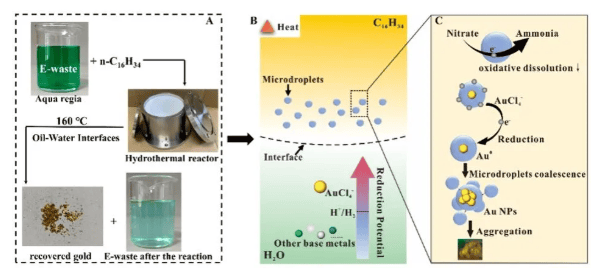
The "Three Mountains" of Gold Recovery from Complex Waste Liquids
Precious metals such as gold are vital strategic resources in fields like electronic information, advanced manufacturing, catalysis, and biomedicine. As high-grade gold ore resources gradually diminish and electronic waste rapidly increases, efficiently recovering precious metals like gold from complex aqueous systems such as industrial waste liquids and electronic waste leachates is crucial for ensuring the supply of key metal resources and promoting resource recycling.
However, such solutions typically feature strong acidity, low gold ion concentrations, and a variety of coexisting metals. Traditional recovery methods often require the addition of reducing agents, adsorbents, or catalytic materials, and face issues such as complex processes, insufficient selectivity, and secondary pollution. These technical bottlenecks have long constrained the efficiency and economic benefits of precious metal recovery.
An "Inspirational Leap" from Geological Fluids
During previous research on geological fluids, the team discovered a key phenomenon: at high temperatures, the oil-water interface can generate a large number of reactive microdroplets. Inspired by this, they boldly hypothesized—could these microdroplets alone, through their own chemical capabilities, selectively extract gold from complex waste liquids?
Core Innovation: Thermally Driven Microdroplets—"Microreactors" Without Chemicals
The team constructed a thermally driven oil-water interface reaction system. Under moderate heating, the oil-water interface continuously generates water microdroplets with diameters of 5–50 micrometers. These droplets act as microreactors with significant redox activity, continuously producing highly active species such as electrons, hydrogen radicals, and hydroxyl radicals. Without the need for added reducing agents, catalysts, or adsorbent materials, they reduce gold ions in the solution to elemental gold, which then aggregates and grows into millimeter-sized gold particles through the coalescence of water microdroplets.
Selectivity Mechanism: A Natural "Voltage Threshold" Enables Precise Screening
The study further reveals the chemical mechanism behind the selective recovery of gold by interfacial water microdroplets—the reduction of different metal ions is constrained by a "reduction potential window" defined by the hydrogen evolution reaction of the aqueous system, acting like a natural voltage threshold.
Gold ions, with their high reduction potential, can easily cross this threshold, preferentially accepting electrons generated by the interfacial water microdroplets to form elemental gold. In contrast, coexisting metal ions such as iron, zinc, magnesium, and calcium have generally low reduction potentials, making it difficult for them to gain electrons and be reduced. Even if a few metals are temporarily reduced, their low-valence states or elemental forms are unstable in strongly acidic solutions and will re-oxidize and dissolve back into the aqueous phase.
Professor Cao Yingchang further explains: "At the same time, the microdroplets can gradually reduce nitrate ions in the solution, diminishing the oxidative dissolution capability of aqua regia-type solutions towards newly formed elemental gold, thereby allowing the precipitated gold to be stably preserved." The synergistic effect of the preferential reduction of gold ions and the selective stabilization of the reduction products ensures efficient gold separation in complex solutions.
Key Performance Data: 98.5% Recovery Rate, 99.4% Purity
The experimental data is impressive:
| Performance Indicator | Measured Data |
|---|---|
| Gold Recovery Rate from Aqua Regia Waste Liquid | 98.5% |
| Gold Recovery Rate from Electronic Waste Leachate | 97.0% |
| Effect of Heating-Cooling Cycles | Further reduces recovery time |
| Recovery Efficiency with Recycled Oil Phase | Maintained above 90% |
| Gold Purity in Scale-Up Experiment | 99.4% |
In the scale-up experiment, processing 500 milliliters of gold-containing leachate yielded 0.5657 grams of solid product with a gold purity of 99.4%, fully demonstrating the immense application potential of this method for the green recovery of precious metals from complex acidic waste liquids.
From "Chemically Driven" to "Physicochemical Synergy"
The revolutionary nature of this technology lies in its complete elimination of reliance on chemical reagents. Traditional methods require the continuous consumption of reducing agents, adsorbents, or catalytic materials, which are not only costly but also generate secondary pollution. In contrast, the thermally driven microdroplet technology initiates the reaction simply through moderate heating, and the oil phase can be recycled, maintaining a recovery efficiency above 90%.
From a scientific principle perspective, this technology achieves synergy at three levels:
Interfacial Microenvironment Regulation: The oil-water interface creates a unique micro-reaction environment where microdroplets act as "natural reactors"
Reduction Potential Selectivity: Leveraging the differences in reduction potentials of various metal ions enables precise separation without the need for added chemicals
Stability Synergy: The reduction of nitrate ions by microdroplets protects the newly formed elemental gold from re-oxidation and dissolution
From Electronic Waste to Industrial Waste Liquid: A "Green Gold Mine"
Resource Utilization of Electronic Waste
With the accelerating upgrade of global electronic products, electronic waste has become an "urban mine." In traditional recovery processes, recovering gold from circuit board leachates often involves cumbersome steps and high costs. This technology can directly achieve efficient and selective recovery of gold from complex leachates, with a recovery rate of 97.0%, opening a new pathway for the green recovery of precious metals from electronic waste.
Comprehensive Treatment of Industrial Waste Liquids
Large quantities of gold-containing waste liquids generated by industries such as electroplating, chemicals, and metallurgy have long suffered from high treatment costs and severe resource waste. This technology enables efficient gold separation in complex systems characterized by strong acidity, low concentrations, and multiple coexisting metals, achieving a recovery rate of 98.5% and offering dual benefits of resource recovery and wastewater treatment.
Development of Low-Grade Gold Ore Resources
As high-grade gold ore resources dwindle, the development and utilization of low-grade ores and tailings are becoming increasingly urgent. This technology provides new possibilities for recovering gold from leachates of low-grade ores, potentially revitalizing a large number of marginal gold ore resources.
Technology Transferability
The core of this technology—selective reduction mediated by thermally driven oil-water interfacial microdroplets—is not only applicable to gold but also holds promise for the green recovery of other precious metals such as platinum, palladium, and rhodium, offering a novel approach for the entire field of precious metal recycling.
A Paradigm Shift from "High Energy, High Pollution" to "Green and Efficient"
The profound value of this breakthrough research lies in redefining the technical paradigm of precious metal recovery. Traditional recovery is a "chemically driven" consumptive process—adding reducing agents, consuming adsorbent materials, and generating secondary pollution. In contrast, the thermally driven microdroplet technology is a "physicochemical synergy" cyclic process—requiring only moderate heating, with a recyclable oil phase, making the entire process green and clean.
As the research team states, this method "shows immense application potential for the green recovery of precious metals from complex acidic waste liquids." As global precious metal resources become increasingly strained and environmental protection requirements grow stricter, this technological breakthrough, inspired by the study of geological fluids, provides a new tool for the green mining of "urban mines"—without needing to "touch stone," one can still "turn water into gold."