
In July 2026, the "ZhiZhu JingWei" well-opening robot, independently developed by China's State Grid Shanghai Municipal Electric Power Company, made its public debut at the 2026 World Artificial Intelligence Conference (WAIC 2026). This quadruped robot, specifically designed for high-risk deep well scenarios, can operate autonomously in extreme conditions such as water accumulation, humidity, oxygen deficiency, and dense equipment, marking the official end of the "manual well entry" era for urban underground cable network inspections and ushering in a new phase of unmanned, intelligent operations.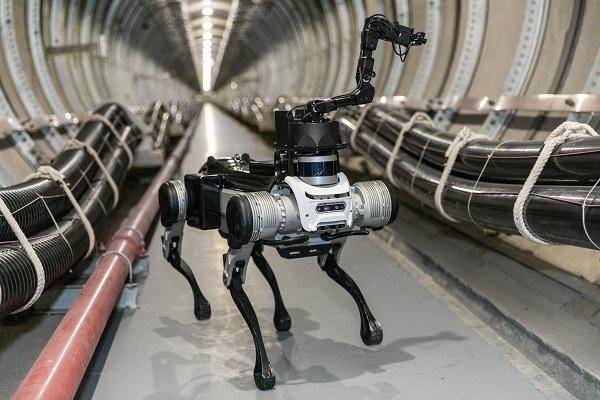
Deep Well Inspection: Why Is It Both "Indispensable for Humans" and "Impossible for Humans"?
Urban underground cable wells are the "capillaries" of the power grid, yet they are also the most dangerous "forbidden zones" for inspection operations. The underground space is confined, with thin air, severe water accumulation, densely arranged well walls and cable equipment, and a high risk of toxic and harmful gas accumulation. For a long time, this work has relied on manual well entry—workers carrying heavy equipment, crawling in cramped spaces, and approaching key parts such as cable joints and grounding boxes for detection. The operation risks are extremely high, efficiency is low, and achieving high-frequency, full-coverage inspections is difficult.
"Replacing manual inspection with machines and fundamentally avoiding the risk of manual well entry" has become a critical challenge to be addressed in the digital and intelligent transformation of urban power grids. "ZhiZhu JingWei" is State Grid Shanghai Electric Power's robust answer to this challenge.
A "Bionic Special Forces" Customized for Deep Well Inspection
Bionic Quadruped Configuration: "Passing Expert" for Complex Terrain
"ZhiZhu JingWei" adopts a quadruped bionic robot configuration, overcoming the mobility bottlenecks of wheeled and tracked robots in narrow, slippery, and obstacle-dense environments. The spider-inspired bionic design endows it with exceptional adaptability to complex terrain—whether climbing ramp entrances, vertical well walls, or navigating through gaps in equipment, it can autonomously complete the entire process, including ramp passage, wellhead parking, and close-proximity underground detection.
Adaptation to Harsh Conditions: Built for the "Underground Forbidden Zone"
The core competitiveness of "ZhiZhu JingWei" lies in its full-condition adaptability to extreme underground environments:
Waterproof and Moisture-Proof: Handles long-term water immersion in wells
Confined Space Survival: Operates independently in oxygen-deficient environments without external air supply
Dense Navigation: Flexibly moves through narrow spaces densely packed with cables, precisely approaching detection targets
Precise Detection and Real-Time Transmission: From "Blind Men Feeling an Elephant" to "X-Ray Inspection"
Equipped with a multimodal perception system, "ZhiZhu JingWei" can accurately identify hidden defects in underground pipelines and transmit on-site data in real-time to the command center via wireless networks. Maintenance personnel no longer need to enter the well; they can access first-hand data on underground cable conditions on screens, completely transforming the traditional passive inspection situation of "can't see clearly, can't measure accurately, can't transmit back."
"Vehicle-Robot-Well" Three-Dimensional Coordination: From Individual Operations to Systematic Operations
"ZhiZhu JingWei" does not operate alone. It deeply integrates with the "Boundless Ark" Superbrain Vehicle 2.0 to build a "vehicle-robot-well" three-dimensional coordinated maintenance system. The Superbrain Vehicle, equipped with an intelligent scheduling system, can autonomously generate drone patrol plans, achieving full-area coverage of "ground vehicle mobility + aerial drone surveillance + underground robot detection." This system has been piloted in areas such as Pudong and Jiading and was tested during the actual combat of Typhoon "Bavi"—completing inspections of nearly 6.5 kilometers of old residential area lines within one hour.
From Power Cables to the City's "Underground Lifeline"
Power Cable Network: From "Manual Well Entry" to "Unmanned Inspection"
This is the most direct application scenario for "ZhiZhu JingWei." As the scale of urban underground cables continues to expand, the contradiction between the demand for high-frequency, full-coverage inspections and limited manpower becomes increasingly prominent. "ZhiZhu JingWei" will fundamentally resolve this contradiction, completely freeing inspection personnel from dangerous and arduous underground work while significantly improving inspection frequency and data quality.
Urban Utility Tunnels: From "Periodic Patrols" to "Real-Time Sensing"
With the large-scale construction of urban underground utility tunnels, safety inspections inside the tunnels also face challenges such as narrow spaces and complex environments. The technical capabilities of "ZhiZhu JingWei" can be quickly transferred to tunnel inspection scenarios, enabling routine intelligent monitoring of tunnel structures, pipelines, and equipment.
Emergency Rescue and Post-Disaster Detection: From "Humans First" to "Machines First"
In disaster scenarios such as earthquakes, collapses, and floods, underground spaces are often "blind spots" and "danger zones" for rescue operations. The bionic obstacle-crossing ability and extreme environment adaptability of "ZhiZhu JingWei" make it an ideal "advance scout" for emergency rescue, capable of completing risk assessments and on-site detection before personnel enter, significantly reducing the risk of casualties among rescue workers.
Technology Spillover: Providing "Chinese Solutions" for More High-Risk Underground Operation Scenarios
The technological route represented by "ZhiZhu JingWei"—bionic robots + multimodal perception + autonomous decision-making—is highly replicable and scalable. From mine tunnels to municipal drainage networks, from tunnel engineering to underground civil air defense facilities, this technological system has the potential to become a "universal foundation" for the intelligent upgrade of various high-risk underground operation scenarios.
A Paradigm Revolution from "Human Wave Tactics" to "Machine Patrols"
The debut of "ZhiZhu JingWei" is not just the launch of a robot; it represents a profound transformation in the operation and maintenance model of urban underground infrastructure. It marks a critical step for China in the digital and intelligent transformation of urban power grids—moving from the "human defense" era, reliant on manual experience and judgment, to the "technical defense" era, centered on intelligent perception, autonomous decision-making, and real-time connectivity.
The moment "ZhiZhu JingWei" descends into a cable well, the history of manual well entry is being rewritten. What it represents is the grand narrative of China's urban construction transitioning from a "labor-intensive" model to an "intelligent equipment-driven" model.