
The China Institute of Atomic Energy (CIAE) recently announced significant progress in the development of an online monitoring device for the coolant of sodium-cooled fast reactors. Researchers at the institute have developed a principle prototype based on Laser-Induced Breakdown Spectroscopy (LIBS) technology and, for the first time globally, utilized this technology to quantitatively analyze trace concentrations of oxygen and iron—key control impurities in liquid sodium. This achievement represents a major breakthrough in the field of coolant quality control for sodium-cooled fast reactors, and the related paper has been published in the internationally renowned spectroscopy journal Journal of Analytical Atomic Spectrometry.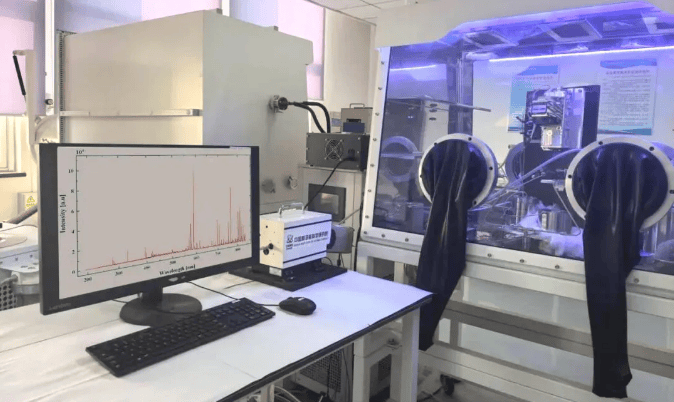
Sodium-cooled fast reactors are one of the key development directions for China's fourth-generation reactor technology. A critical task in ensuring their safe and efficient operation is the rapid and highly accurate monitoring of impurity levels in liquid sodium, which serves as the coolant.
Laser-Induced Breakdown Spectroscopy technology requires no sample pretreatment and can complete the sampling and measurement processes within the same system. Therefore, this technology offers significant advantages for continuous monitoring of sodium-cooled fast reactor coolants. However, quantitative analysis of trace impurities in high-temperature liquid sodium is a complex scientific and technical challenge. Factors such as the high chemical reactivity of liquid sodium, the generation of sodium aerosols, and melt splashing can significantly impact measurement accuracy.
To address these issues, researchers from the Reactor Engineering Research Division of the China Institute of Atomic Energy have developed an online monitoring system based on LIBS technology. The device design innovatively adopts a directional gas purging method for the first time, effectively eliminating the influence of sodium aerosols and melt splashing on measurement results.
Furthermore, utilizing laboratory resources accredited by the China National Accreditation Service for Conformity Assessment (CNAS), the researchers independently overcame one of the most challenging hurdles—the preparation technology for liquid sodium standard samples containing trace impurities. Consequently, for the first time globally, a calibration curve for determining the content of control impurities in liquid sodium using Laser-Induced Breakdown Spectroscopy was established. The next phase of the project will involve the development and testing of an engineering prototype. It is anticipated that this achievement will provide significant support for upgrading the coolant analysis and monitoring systems of liquid metal-cooled fast neutron reactors, and will reserve the necessary technical foundation for future projects such as the new generation of integrated sodium-cooled fast reactors.