
At 10:54 on July 22, the Gravity-1 (Yao-4) carrier rocket, developed by the company, ignited and lifted off from the East China Sea, successfully sending nine satellites into their predetermined orbits and simultaneously conducting one payload test, marking a complete success for the mission.
It is reported that the biggest breakthrough of this mission lies in the strategic expansion of the maritime launch footprint. This is the first time the Gravity-1 carrier rocket has performed an open-sea launch mission, and also the first time China has conducted a private commercial rocket sea launch in the East China Sea region of the Yangtze River Delta. The mission further validated the rocket's solid strap-on configuration's adaptability to complex sea conditions and its long-term standby capability in the fully assembled state.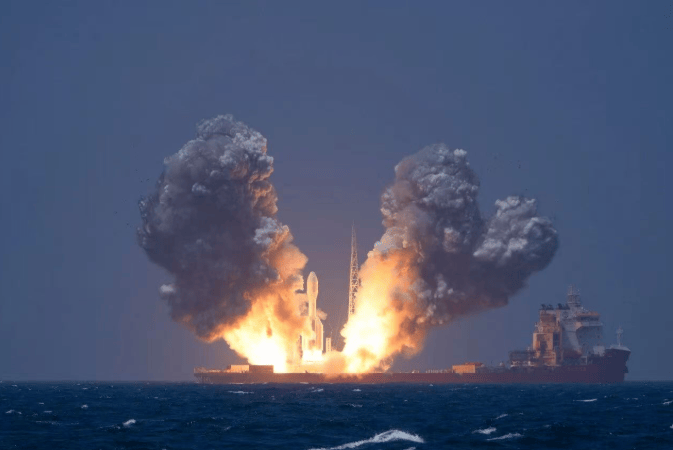
To date, Gravity-1 has completed three sea launch missions. Compared to the previous two launches near the coast of Haiyang, Yantai, Shandong Province, this rocket was carried by the "Eastern Aerospace Harbor" launch vessel to the East China Sea, approximately 170 kilometers east of Shanghai, for launch. Weather and sea conditions in the open sea can affect the stability of the launch platform, imposing stricter requirements on rocket attitude control; the prolonged exposure to high salt spray and humidity also demands higher protection for the rocket body and precision equipment.
The payload for this mission includes six "Dongpo" series satellites jointly developed by MinoSpace and Huantian Zhihui, comprising two optical satellites and four SAR (Synthetic Aperture Radar) satellites. After entering orbit, they will form a ten-satellite collaborative system with the four "Dongpo" satellites already in orbit, as part of the Huantian Constellation Phase II. This will enhance the constellation's data acquisition efficiency and spatial coverage capabilities, supporting remote sensing data application needs in diverse fields such as territorial surveying, emergency disaster relief, agriculture, forestry, and water resources in Southwest China, thereby accelerating the implementation of China's aerospace information industry.
Additionally, the mission carried the Xiguang-2 01 satellite and the Tianyi-49 satellite, positioned for "AI + Commercial Aerospace + Quantitative Remote Sensing," providing observation services for users in industries such as mining, agriculture, forestry, environmental monitoring, and urban planning. The Zijing-3 satellite will conduct technical experiments on ultra-flat integrated force-thermal platforms and new attitude control technologies. The Neptune test payload, based on a modular design, flexibly adapts to various specifications of flexible solar arrays.
Gravity-1 is a medium-lift carrier rocket independently developed by Orienspace and is currently the world's most powerful solid-fuel carrier rocket. It has a low Earth orbit (LEO) payload capacity of 6.5 tons and a 500-kilometer sun-synchronous orbit (SSO) payload capacity of 4.2 tons, meeting the requirements for multi-satellite launch missions for various small satellites. It is reported that the development of the reusable large liquid-fuel carrier rocket Gravity-2 is accelerating, with various intensive tests and verifications currently underway. Its LEO payload capacity is expected to reach 21.5 tons.