
The world's largest salt cavern compressed air energy storage station was fully commissioned in Jiangsu this year. Reporters learned that the successful implementation of this super grid "power bank" owes much to the hardcore technical support from the research team at Harbin Engineering University (HEU). Through digital simulation technology, they mitigated risks for core equipment and saved over 100 million yuan in testing costs.
The station uses natural salt caverns 1,500 meters underground as "energy storage warehouses": during low electricity demand periods, surplus power is used to compress air and store it in the caverns; during peak demand periods, the high-pressure air is released to drive generators for electricity production.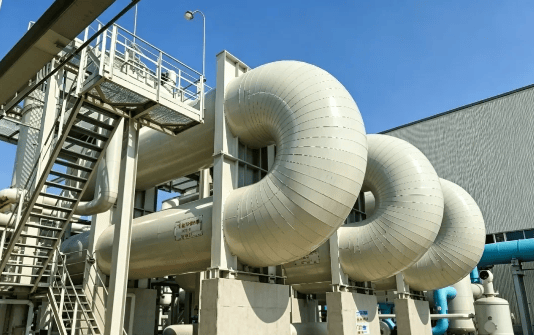
Within the entire energy storage system, the molten salt heat exchanger serves as the "core heart," controlling the entire energy transfer process and directly determining whether the station can operate safely, stably, and efficiently.
This giant "heart" is massive in size, measuring 16 meters in length and 6 meters in height, operating under extremely harsh conditions. It must withstand high temperatures and high pressures over long periods, while repeatedly enduring thermal cycling tests. With a single unit costing up to hundreds of millions of yuan, the tolerance for error in equipment design and operation is extremely low. Any malfunction could lead to incalculable losses.
To address this core challenge, the Reactor Engineering Research Team from HEU's College of Nuclear Science and Technology leveraged high-precision simulation technology to conduct a full-dimensional digital diagnosis and comprehensive virtual health check of the giant molten salt heat exchanger.
The oversized equipment required massive simulation calculations, and optimizing the complex structure was extremely challenging. To break through the computational bottleneck, the team innovatively optimized the fluid-thermal coupling simulation model while ensuring calculation accuracy, built a scaled-down model, and conducted repeated comparisons and calculations. They finalized the optimal "bottom inlet, top outlet" salt injection scheme, successfully reducing equipment pressure drop by 15%.
Additionally, through thermal-structural coupling simulation technology, they precisely identified high-stress risk areas such as U-shaped bends, providing accurate data support for equipment structural reinforcement and material selection. This fundamentally eliminated the risk of equipment failure under thermal cycling conditions.
This customized "digital prescription" not only enabled the giant heat exchanger to be developed in a single design iteration, perfectly matching operating conditions, directly avoiding hundreds of millions of yuan in trial-and-error losses, and significantly shortening the equipment development cycle, but also ensured stable operation of core equipment in harsh high-temperature and high-pressure environments, addressing "fatigue risks" in the equipment, and providing a dual safeguard for the station's long-term safe operation.