
Recently, a research team from the School of Integrated Circuits at Shanghai Jiao Tong University (SJTU), led by Professor He Zuyuan, Professor Fan Xinyu, and Assistant Professor Wan Yangyang, achieved a major breakthrough in the field of computational spectropolarimetry. The team proposed a novel computational spectropolarimetry method based on a resonant leaky-mode random medium, established a unified theoretical model for computational optical measurement systems, and developed a computational spectropolarimeter featuring ultra-high resolution (20 fm), wide measurement bandwidth (150 nm), and miniaturization. The relevant results were published in the top international journal Nature Communications under the title "Resonant microtaper leaky-mode computational spectropolarimetry with tens of femtometers spectral resolution and full Stokes measurement."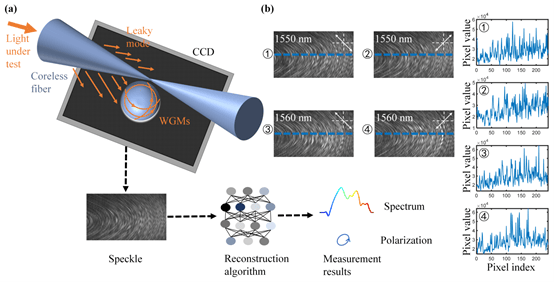
The spectral resolution reaches 20 femtometers (1 fm = 10⁻¹⁵ m), equivalent to resolving 7.5 million independent spectral channels within a 150 nm measurement bandwidth. This is the highest resolution publicly reported in the field of computational spectropolarimetry to date.
The Difficulty of Combining High Spectral Resolution with Miniaturization
Spectrum and polarization are the two most important dimensional information of light fields: spectrum can reflect the composition of substances and chemical reaction processes, while polarization can reveal surface texture, molecular chirality, and biological tissue structure. Spectropolarimetry technology, capable of simultaneously acquiring these two types of information, has irreplaceable application value in fields such as remote sensing, biomedicine, optical communication, industrial inspection, and astronomical observation.
Traditional spectropolarimeters rely on gratings, prisms, scanning devices, and complex polarization analysis modules, resulting in bulky systems with complex structures, making it difficult to meet the future demands of optical instruments for miniaturization, integration, and high performance.
In recent years, emerging computational spectrometers and polarimeters utilize random media to generate unique speckle patterns, achieving light field measurement through computational reconstruction. However, this field has long faced two key bottlenecks:
Lack of unified theoretical guidance: The performance of systems built with different random media varies greatly, and the mechanism determining resolution is unclear, making it difficult to guide structural design optimization;
Difficulty in balancing high performance and small size: Existing technologies cannot simultaneously achieve ultra-high spectral resolution, wide measurement bandwidth, and full polarization measurement capability.
From "Blind Men and the Elephant" to a "Unified Formula"
Unified Theoretical Model: Revealing the Essence of Resolution
The research team first established a unified theoretical model applicable to computational measurement systems using random media, such as computational spectrometers and polarimeters, solving the long-standing dilemma of "knowing what but not why."
Key Discovery: Regardless of whether the random medium originates from multimode transmission, multiple scattering, or multiple reflections, its measurement capability is ultimately determined by the maximum Optical Path Difference (OPD) that can be formed within the random medium. The theory proves that the minimum resolvable spectral change of the system is inversely proportional to the OPD, meaning a larger OPD leads to higher resolution. This provides a unified evaluation standard for computational measurement systems and clarifies the theoretical direction for the design and optimization of random media.
Resonant Leaky Mode Strategy: Creating "Kilometer-Level Optical Path" in Millimeter-Scale Space
Guided by the theory, the team proposed a novel Resonant Leaky Mode (RLM) computational spectropolarimeter architecture, with core innovations reflected in two aspects:
First Layer: Tapered Coreless Fiber Excites High-Order Leaky Modes
The study uses a tapered coreless fiber as the random medium instead of traditional multimode fiber. The light field in the tapered structure can excite a greater number of leaky modes with larger propagation constant differences, significantly increasing the optical path difference the system can generate.
Second Layer: Microsphere Whispering Gallery Mode Resonant Coupling
The team further introduced a high-quality-factor microsphere Whispering Gallery Mode (WGM) microcavity, which undergoes complex resonant coupling with the high-order leaky modes, further extending the light propagation path. This design significantly enhances the effective optical path difference within an extremely small device size, producing more complex speckle responses that are more sensitive to wavelength and polarization changes.
Physical Essence: Light repeatedly couples between the tapered leaky modes and the microsphere resonant modes, effectively achieving a "kilometer-level" effective optical path within a millimeter-scale physical space.
All Three Indicators Set International Best Records
Spectral Resolution: From 1.5 pm to 20 fm, a 75-fold Improvement
Experimental results show that after introducing the WGM microsphere resonance, the system's spectral resolution improved from the original 1.5 pm (picometers) to 20 fm (femtometers), an enhancement of approximately 75 times. A resolution of 20 femtometers means the instrument can distinguish two spectral signals with a wavelength difference of only two ten-millionths of a nanometer—the highest resolution publicly reported in the field of computational spectropolarimetry.
Polarization Measurement: Full Stokes Reconstruction with Mean Squared Error of Only 4.732×10⁻⁶
In terms of polarization measurement, the system achieved full Stokes polarization information reconstruction, with an overall mean squared error of only 4.732×10⁻⁶, reaching an internationally advanced level of polarization measurement accuracy. Experiments also verified the system's ability to simultaneously measure spectral and polarization information, achieving true multi-dimensional light field measurement.
Bandwidth/Resolution Ratio and Resolution-Size Product: Both Set New Records
Benefiting from the random medium optimization strategy guided by theory, the research team achieved internationally best levels for two key performance indicators:
| Performance Indicator | This Work's Result | Significance |
|---|---|---|
| Bandwidth/Resolution Ratio | 7.5×10⁶ | Achieves 7.5 million independent spectral channels within a 150 nm measurement bandwidth |
| Resolution-Size Product | Only 5 nm·μm² | Currently the best international level for this indicator, proving that miniaturization and high performance can coexist |
This result indicates that the proposed method effectively breaks the classic trade-off relationship among resolution, bandwidth, and size in traditional spectroscopy, opening a new path for the development of high-performance miniature spectropolarimeters.
Broad Space from Laboratory to Industrialization
Remote Sensing and Astronomical Observation
The ultra-high spectral resolution and full polarization measurement capability enable this technology to capture extremely subtle spectral features and polarization information from ground objects or celestial bodies. In fields such as atmospheric trace gas monitoring, vegetation ecological remote sensing, and stellar magnetic field measurement, the 20 femtometer-level resolution can provide unprecedented information dimensions.
Biomedicine and Clinical Detection
The miniaturized spectropolarimeter is expected to be integrated into endoscopes and portable diagnostic devices, enabling label-free histopathological analysis, early cancer screening, and continuous blood glucose monitoring. Full Stokes polarization measurement can reveal structural information, such as collagen arrangement and cell morphology changes, that is difficult to obtain with traditional spectroscopy.
Optical Communication and Industrial Inspection
In dense wavelength division multiplexing optical communication systems, 20 fm-level resolution can precisely monitor the wavelength drift of each channel. In industrial scenarios such as semiconductor manufacturing, thin-film thickness measurement, and chemical process monitoring, this technology can provide high-precision, real-time, online multi-dimensional light field analysis capabilities.
Chip-Scale Spectropolarimeter
The resolution-size product of 5 nm·μm² achieved by the team means this technology has the potential to be further integrated into chip-scale optical sensors, providing platforms like smartphones, wearable devices, and drones with spectropolarimetric analysis capabilities previously only achievable by large instruments.
Chinese Team Leads a New Paradigm in Computational Optical Measurement
The core value of this research lies in establishing a complete innovation chain of "theoretical model—medium design—system integration—performance breakthrough":
Theoretically, it established a unified model for the first time, revealing that OPD is the fundamental physical quantity determining system resolution;
Methodologically, it proposed the novel resonant leaky-mode random medium strategy, breaking the curse of the traditional trade-off between high performance and miniaturization;
In terms of performance, the 20 fm resolution, 7.5×10⁶ bandwidth/resolution ratio, and 5 nm·μm² resolution-size product are all at the internationally leading level.
This achievement not only provides a new technical route for computational spectropolarimetry but also lays an important foundation for the future development of miniaturized, high-performance optical instruments, marking China's entry into the international forefront of the field of computational optical measurement.