
Concrete is the most widely used building material on Earth, with its production process contributing approximately 8% of global carbon dioxide emissions. 3D-printed concrete is seen as a crucial path to reducing carbon emissions, but computer-generated optimal designs often cannot be realized due to the physical limitations of printers. A team at the Massachusetts Institute of Technology (MIT) has developed a design framework that directly incorporates the actual manufacturing constraints of printers into topology optimization, successfully designing and printing a 2.3-meter-long concrete bridge. The bridge took about 30 minutes to print and can withstand loads exceeding 900 kilograms. The study found that the current bottleneck limiting structural lightweighting lies in the printing hardware, not the concrete itself—reducing the nozzle diameter from 4 centimeters to 1 centimeter can decrease material usage by up to 76%.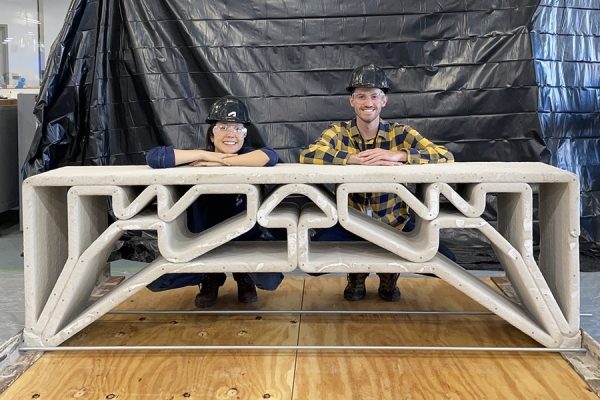
The Gap Between Topology Optimization's 'Ideal' and the Printer's 'Reality'
Concrete is the second most consumed substance on Earth after water, with its production process accounting for 7%-8% of global carbon emissions. 3D-printed concrete is considered a key pathway to address this dilemma—it eliminates the complex formwork required for traditional casting, extruding material layer by layer like a giant frosting robot, precisely placing it only where the structure needs it.
However, a fundamental contradiction has long plagued this field. Engineers use topology optimization to find mathematically optimal designs that use the least material while being structurally strongest, but these designs often take on intricate, spiderweb-like forms with sharp corners, slender branches, and discontinuous paths—large concrete printers, constrained by thick nozzles, limited turning radii, and the requirement for continuous single-line printing, simply cannot build these 'paper-optimal' structures.
"We found many gaps in the process of translating hyper-optimized designs into manufacturable ones," said Hajin Kim-Tackowiak, a postdoctoral fellow in MIT's Department of Civil and Environmental Engineering and co-first author of the paper. "Those gaps were like chasms."
Mixed-Integer Optimization: Generating 'Printable Optimal Solutions' in Two Minutes
The MIT team's research was published in the journal Additive Manufacturing, in a paper titled "Effect of fabrication restrictions on topology optimized 3D printed concrete structures." The computational framework they developed is the first to directly 'bake' the real manufacturing constraints of printers into the mathematical rules of optimization.
Mathematical Translation of Three Core Physical Constraints
Through participation in a research residency program at Autodesk's Boston Technology Center, the team worked closely with operators of large printers to translate three core constraints into mathematical language:
Extrusion width: The minimum thickness of each printed line (currently typically 40mm)
Turning radius: The minimum steering angle achievable by the nozzle
Path continuity: Must print in a continuous single line without interruption
"They pointed to some sharp corners in our designs and said, 'I don't feel safe printing this,'" Kim-Tackowiak recalled.
Mixed-Integer Nonlinear Programming: From 'Days' to 'Two Minutes'
The traditional design workflow involves first optimizing the shape and then performing extensive post-processing, a process that takes days. The MIT team's framework uses Mixed-Integer Nonlinear Programming (MINLP) to generate fully printable designs on a laptop in about two minutes.
When the team needed to slightly reduce the bridge's size on the day of printing, they simply reran the optimization program and obtained an updated design within five to ten minutes.
"Achieving this speed is itself a breakthrough in recent years," said Zane Schemmer, a PhD student in MIT's Department of Civil and Environmental Engineering and co-first author of the paper. "Going back five or ten years, even three years ago, the solvers we used couldn't handle these problems. This area has been avoided because everyone thought it was a dead end. But with new algorithms and new resources, we're starting to be able to use it to formulate problems."
900-Pound Bridge Withstands 2000-Pound Load, Yet Reveals 'Overdesign' Truth
30-Minute Print, Load Test Highly Accurate
The team printed a 2.3-meter-long concrete bridge at Autodesk's facility using commercially available mortar. "The bridge took about 30 minutes to complete," said Josephine Carstensen, Gilbert W. Winslow Career Development Professor of Civil Engineering at MIT and corresponding author of the paper.
In load testing, the structure, weighing approximately 900 pounds (408 kilograms), withstood a uniformly distributed load of over 2000 pounds (907 kilograms) with almost no measurable bending deformation, closely matching simulation results.
Key Finding: Constraint Lies in Hardware, Not Material
But the tests also revealed the study's biggest surprise: the structure was severely overdesigned.
"From zero to 200,000 pounds, the design is entirely dominated by the constraint of 'can it be built.' Only beyond 200,000 pounds do you need to consider physical performance," Kim-Tackowiak said.
In other words, the limitation on structural lightweighting is the current printing technology, not the strength of the concrete. If printer hardware improves, the same structure could achieve equivalent strength with far less material than currently used.
Quantified Roadmap: Nozzle Reduction of 76%, Material Usage Cut by 76%
Because the framework can find mathematically global optimal solutions, researchers were able to precisely measure the impact of each hardware constraint on material usage.
The most critical lever is extrusion width:
Current typical nozzle diameter is 40mm
If reduced to 10mm, material usage can be decreased by 76.1%
Eliminating the continuous path constraint could achieve an additional 28.6% material savings. In contrast, reducing the turning radius has the smallest impact.
"Through mixed-integer optimization, we can find the global optimal solution—the best solution, not just a good one," Carstensen said. "Since we know we can find the optimal solution, we can quantify: if we had a machine capable of other tasks, how would material consumption be affected?"
From Rapid Post-Disaster Reconstruction to Next-Generation Green Buildings
Rapid Deployment of Emergency Infrastructure After Disasters
Printing a bridge capable of supporting nearly a ton of load in 30 minutes—this speed holds immeasurable value in emergency rescue scenarios following natural disasters. No formwork, no complex equipment, just a printer and commercially available mortar, allowing for rapid restoration of critical transportation nodes.
Significant Reduction in Building Carbon Footprint
Compared to traditional cast-in-place concrete alternatives, structures designed with this framework already achieve a 14% material savings. With continued improvements in printing hardware (finer nozzles, more flexible path planning), this figure has the potential to increase significantly to over 76%.
Against the backdrop of approximately 14 billion tons of concrete consumed globally each year, the carbon reduction potential of this technological pathway could reach hundreds of millions of tons.
Providing Precise Direction for Printer Hardware Upgrades
This research is not just a design tool; it provides a quantified technical roadmap for printer manufacturers. It clearly indicates that reducing nozzle diameter is the single most effective path to improving material efficiency, followed by breaking the continuous path constraint. This points to the priority for the development of next-generation 3D concrete printers.
Moving from Plain Concrete to Reinforced Concrete
The team has already defined the next step: integrating steel reinforcement into the continuous additive manufacturing process. While plain concrete structures can withstand compressive loads, most structures in practical engineering require reinforcement to resist tensile forces. How to embed steel reinforcement without interrupting continuous printing is the next technical challenge the team is tackling.
"Plain concrete structures are not necessarily the optimal solution; we are more focused on the real world—that is, reinforced concrete," Kim-Tackowiak said.
A Paradigm Shift from 'Design Then Adapt' to 'Manufacturing Is Design'
The deeper value of this research lies in completely reversing the logical sequence of architectural design. The traditional path is 'design → optimize → post-process to adapt for manufacturing'; the MIT team's framework is 'manufacturing constraints → optimize → directly printable design'—writing the physical limits of the printer into the design equation from the very beginning.
"We guarantee that every piece of concrete is in a state of compression—no part is being stretched," Schemmer said. This precise control over the mechanical properties of materials is the essence of topology optimization.
When Building Information Modeling (BIM) is deeply integrated with additive manufacturing constraint optimization, when every bridge and every building 'knows' from the outset what a printer can and cannot do—the construction industry will move from 'being poured' to 'being grown,' from 'labor-intensive' to 'algorithm-driven.'