
On July 20, it was learned from Chuanqing Drilling Engineering Company that China's first fully autonomous and controllable intelligent drilling system—the Qineng·IDOS Intelligent Drilling System—has been successfully put into use in Sichuan. By "brain-swapping" and upgrading 12 traditional drilling rigs, it has significantly improved drilling efficiency.
As a pioneer in intelligent drilling for PetroChina, Chuanqing Drilling took the lead in the industry by launching the "332 Project," which involves selecting 30 well sites for pilot promotion of the intelligent drilling system, aiming to achieve a 20% increase in single-well drilling speed. This self-developed system features intelligent drilling, intelligent reaming, one-key well shut-in, and remote duty monitoring, enhancing efficiency while ensuring construction safety.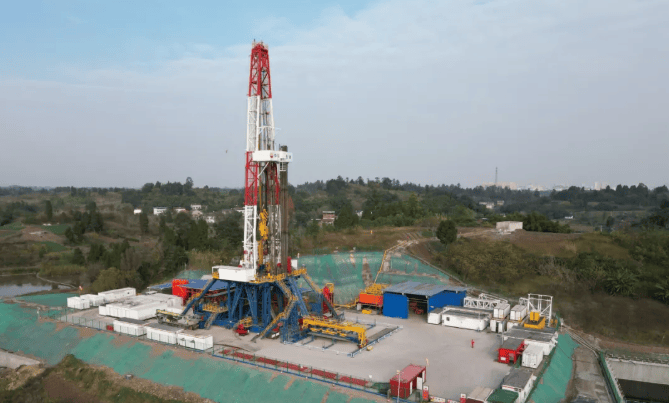
In terms of personnel optimization, the system integrates intelligent agents and job positions. Employees in roles such as mud workers, economic managers, and living administrators, after training, are transferred to newly established positions like equipment inspection and remote monitoring, or reassigned to other understaffed drilling teams, revitalizing human resources.
At the digital and intelligent command center for drilling and completion operations, located 100 meters outside the well site, reporter saw Xu Bolang, a duty monitoring worker, staring at the screen monitoring the circulation tank level. "In the past, working on the tank meant sweating in summer and freezing in winter. Now, with remote duty monitoring, I just click the mouse, and my clothes stay clean for a week." From exposure to wind and sun to a clean and bright environment, "blue-collar" workers have truly become "white-collar" workers.
In terms of operational efficiency, the system acts like a "smart brain" for the drilling rig. In the driller's cabin of Team 70346, driller Luo Qiaoran lightly tapped the screen, and the rig automatically began drilling operations. "In the past, finding the optimal construction parameters required repeated exploration for tens of minutes. Now, the system automatically controls the equipment and completes it in five to six minutes, increasing drilling speed by up to 20%." The system's intelligent directional function is deeply compatible with mainstream domestic and international MWD/LWD data interfaces, covering two core processes: sliding drilling and rotary steering.
The system's one-key tripping function, integrated with real-time algorithms, increases the average number of stands completed per trip from 15-18 to 19-21, equivalent to pulling out 3 to 9 additional drill pipes, improving overall efficiency by 20%. Based on this, the test well set a record for the shortest construction cycle in the block, reducing it by 8.7% compared to the optimal indicator.
Safety is another barrier for intelligent drilling. On the driller's navigator, reporter saw that as soon as the drill bit contacts a formation prone to sticking, the intelligent reaming function automatically adjusts torque and friction in milliseconds, firmly controlling the risk of "over-pulling and over-releasing." The red "one-key shut-in" button on the driller's panel is particularly eye-catching. In the event of emergencies such as overflow, the system can issue a second-level warning and automatically execute the shut-in.
Yu Jiansheng, General Manager of the Science and Technology Information Department of Chuanqing Drilling, explained that the system is similar to L2 to L3 autonomous driving in automobiles, with routine operations running automatically and abnormal conditions requiring manual intervention, both liberating productivity and maintaining safety bottom lines.
"The goal is to reduce the burden on drilling teams and improve production efficiency," said Yang Jie, Deputy Chief Engineer of Chuanqing Drilling's East Sichuan Drilling Company. According to the plan, from 2026 to 2027, Chuanqing Drilling will complete the intelligent upgrade of 30 drilling rigs, gradually achieving full-chain intelligence.