
At 10:54 on July 22, the Taiyuan Satellite Launch Center used the Gravity-1 Y4 carrier rocket in the eastern waters of Shanghai to successfully send the first satellite of the Global University Satellite Alliance constellation, "Lilac-3 (Kaiyun-2)", into its predetermined orbit, marking the complete success of the flight test mission.
This launch signifies the official start of the constellation network construction led by Kaiyun Aerospace for the Global University Satellite Alliance. As a key addition to the Star Plan's integrated space-ground observation network, the successful orbit insertion of the Lilac-3 (Kaiyun-2) university satellite alliance satellite will continue to conduct space situational awareness star sensor technology verification tests, refine the technical system, achieve performance iteration and optimization, strengthen China's AOE space data foundation, and inject new momentum into space traffic management and the integrated development of global commercial aerospace industry, academia, and research.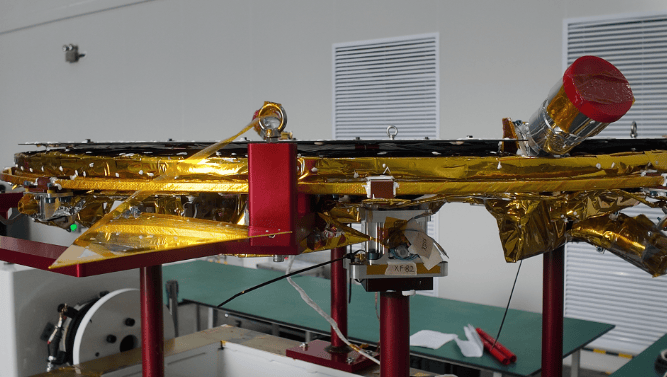
Lilac-3 (Kaiyun-2) is China's first disc-shaped satellite, featuring ultra-thin, flat, lightweight, and highly integrated characteristics compared to traditional CubeSats. Its onboard high-performance star sensor serves as both the "eye" for satellite attitude control and the core data source for building space situational awareness capabilities.
The Global University Satellite Alliance constellation was officially announced by Kaiyun Aerospace on "China Space Day" 2026. It is China's first space science experimental constellation project focused on university collaborative innovation and open sharing globally. The project plans a six-year construction period, deploying 300 university science experiment satellites in phases. These satellites are equipped with space situational awareness star sensors, enabling comprehensive monitoring of near-space and low-Earth orbit environments, continuously expanding the AOE space data foundation. The constellation will connect global universities and young scientific innovation forces, building a shared, co-constructed, and co-governed space innovation ecosystem, promoting the safe and high-quality development of the global commercial aerospace industry.