
At 7:33 a.m. on July 24, China successfully launched five satellites, including the first satellite of the Gande Constellation Phase I, "Gande-1 01," using a Lijian-1 Y15 carrier rocket from the Dongfeng Commercial Aerospace Innovation Experimental Zone. The satellites entered their predetermined orbits smoothly.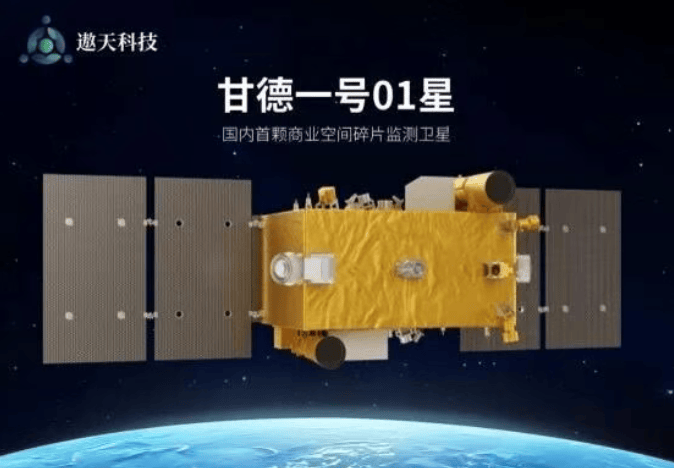
The Gande Constellation, built by Aotian Technology (Beijing) Co., Ltd. (hereinafter referred to as "Aotian Technology"), is China's first commercial space debris monitoring constellation. It plans to deploy a total of 120 satellites, using a hybrid configuration of low Earth orbit (LEO) and geostationary orbit (GEO), to be deployed in three phases, with completion targeted before 2030.
The Gande Constellation Phase I, "Gande-1" (LX630), consists of 14 satellites, jointly built by Liangxi Aerospace Technology Group and Aotian Technology. It adopts a hybrid configuration of sun-synchronous and low-inclination orbits, equipped with a "precision-general synergy" detection camera combination to achieve all-sky, high-timeliness detection and cataloging of space targets, supporting comprehensive monitoring of targets in high, medium, and low orbits.
"Gande-1 01" is China's first commercial space debris monitoring satellite. It is equipped with a high-magnitude target detection camera, enabling all-domain detection of space targets in low, medium, and high orbits, precisely locking onto small space debris, and supporting the establishment of a dynamically updated centimeter-level space debris catalog.
Notably, the AI computer onboard "Gande-1 01" will endow the satellite with the ability to "think autonomously." Leveraging intelligent algorithms, the satellite can flexibly perform routine patrols, emergency responses, and rapid tracking tasks without frequent ground intervention.
Paired with multiple new propulsion systems independently developed by Aotian Technology, this satellite will also possess flexible "space maneuvering" capabilities, enabling cross-orbit movement to complete complex on-orbit tasks such as close-range observations.