
Extreme weather has become a core challenge to the safe and stable operation of new-type power systems. Meteorological disasters such as gales, torrential rain, blizzards, and line icing can easily trigger violent fluctuations in renewable energy output, placing grid dispatch under constant pressure. For a long time, domestic electric power meteorological forecasting has been constrained by three core bottlenecks: security risks in overseas computing power, insufficient scenario adaptability of general-purpose large models, and lagging accuracy of traditional forecasting models. The industry's intelligent and self-reliant transformation urgently calls for breakthrough solutions.
Recently, "Jiheng," the industry's first electric power meteorological large model with full-chain domestic development covering training, inference, and business deployment, was officially launched for routine operation. It was jointly developed by the China Electric Power Research Institute (hereinafter referred to as "CEPRI"), the University of Science and Technology of China, and Hygon Information Technology Co., Ltd. (hereinafter referred to as "Hygon"). The model precisely addresses three major industry challenges—low efficiency of traditional numerical forecasting, poor adaptability of general-purpose AI, and constraints of underlying computing power—improving the power prediction accuracy of over 70% of renewable energy stations, and establishing a replicable and scalable industry-academia-research collaboration benchmark for independent innovation in vertical energy large models.
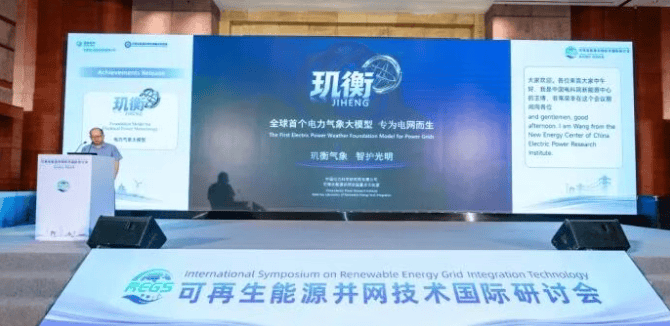
Launch of "Jiheng," the industry's first electric power meteorological large model
Three Technical Bottlenecks Restricting the Intelligent Upgrade of Electric Power Meteorology
The "15th Five-Year Plan for Renewable Energy Development" has defined the direction of intelligent, refined, and self-reliant development for new-type power systems, making independent controllability the core course for industry advancement.
As China's renewable energy installed capacity continues to expand, the depth and breadth of extreme weather impacts on all segments of the power system—generation, grid, and load—are steadily increasing. Meteorological disturbances have shifted from occasional risks to key variables affecting the balance of power supply and demand. Even minor deviations in electric power meteorological forecasting are amplified at every level; a wind speed error of just 1 meter per second can trigger power imbalances on the scale of tens of gigawatts, intensifying the contradiction between power supply security and renewable energy integration. Traditional general-purpose meteorological service models are ill-suited to meet the micro-scale, high-precision, and full-chain dispatch decision-making needs of the grid, making it imperative to build a professional, customized, and self-reliant electric power meteorological support system.
At present, China's traditional electric power meteorological system suffers from three prominent shortcomings that severely constrain high-quality industry development.
First, traditional forecasting models lack timeliness and precision.
New-type power systems impose stringent requirements on forecasting extreme weather events such as typhoons, cold waves, severe convection, and line icing. However, traditional numerical weather prediction (NWP) involves long computation times, high resource and energy consumption, and low update frequency, making it unable to support minute-level and station-level refined grid dispatch, or to capture rapid changes in localized micro-meteorology, thereby continuously aggravating the pressure on grid peak and frequency regulation.
Second, general-purpose large models lack dedicated adaptation capabilities for the electric power sector.
"There is a gap between public meteorological services and the actual needs of electric power production," said Huang Yuehui, Chief Engineer of the New Energy Research Institute at CEPRI. He noted that such models have insufficient observational representativeness for the locations of power equipment, fail to meet the timed, fixed-point, and quantitative requirements of power production, and lack key meteorological elements needed for power generation.
In simple terms, general-purpose models exhibit notable shortcomings in scenario adaptation: they lack dedicated datasets for transmission lines and renewable energy stations, fall short in spatial resolution, distort high-impact power-related disasters such as icing, severe convection, and typhoons, and their outputs cannot be directly integrated with grid dispatch platforms, making it difficult to support differentiated and refined station-level applications. This is akin to off-the-rack garments failing to fit individualized body shapes.
Third, the underlying core computing power is highly dependent on overseas supply, harboring unavoidable security risks hidden within the industry chain.
Industry experts point out that the future development of intelligent electric power meteorological forecasting should focus on three core directions: building differentiated forecasting systems, advancing full-lifecycle technology development, and standardizing industry implementation, while comprehensively promoting self-reliant and intelligent upgrades.
Tripartite Collaborative Efforts Build a "Scenario + Algorithm + Computing Power" Domestic Innovation System
Rooted in the imperative needs of new-type power system construction, the "Jiheng" electric power meteorological large model has emerged. The model's name is derived from the ancient astronomical observation instrument "Xuanji Yuheng" (armillary sphere), symbolizing precise measurement of weather changes with independent computing power and safeguarding grid safety and stability with core hard technologies, serving as a vital pillar for technological self-reliance in the energy meteorology sector.
The project has established a tripartite industry-academia-research system involving CEPRI, the University of Science and Technology of China, and Hygon, forming a complete innovation loop of "industry scenario traction, frontier algorithm breakthroughs, and domestic computing power foundation," and connecting the entire chain from business needs and technology R&D to practical application. The three parties each play their roles in deep coupling, jointly tackling multiple core industry technology challenges.
As the lead organization, CEPRI has been deeply engaged in the electric power meteorology field for decades, accumulating profound industry expertise and practical experience. The team has integrated measured data from thousands of renewable energy stations nationwide, meteorological monitoring data from transmission lines, and historical meteorological disaster cases, defined business standards and validation specifications across the full chain of grid dispatch, equipment inspection, and renewable energy grid integration, led model R&D and iterative optimization, precisely corrected deviations between algorithms and actual grid operations, and thoroughly resolved the industry pain point of disconnection between AI technology and electric power industry scenarios.
The University of Science and Technology of China leverages its interdisciplinary strengths in mathematics, physics, and artificial intelligence to optimize model architecture and algorithms. The team pioneered a "global–national–provincial" three-level nested forecasting architecture, which, through progressive transfer of "knowledge–structure–parameters," elevates the spatial resolution of provincial models to 3×3 kilometers, achieving station-level precise meteorological forecasting.
Meanwhile, targeted optimizations were made to attention mechanisms and multi-objective loss functions, with self-developed multi-source data assimilation algorithms that fuse multi-dimensional observational data from ground stations and station sensors, achieving key breakthroughs in refined output prediction and precise identification of extreme weather. The loss function adapted to electric power scenarios effectively resolves the common shortcomings of general-purpose models—"convergent forecasts and inaccurate extremes"—enabling AI meteorological prediction to deeply align with grid operation logic and enhancing early warning and forecasting capabilities for over 10 categories of high-impact grid weather events.
Hygon provides the full-process domestic computing power foundation for the model, solidifying the foundation of independent controllability. The project relies on the domestic DCU-3G AI computing platform to fully support domestic operations across data preprocessing, data assimilation, model training, and online inference. The R&D team optimized the storage-compute-communication collaborative architecture for the high-resolution grid computing characteristics of meteorology, deeply adapted and custom-tuned mainstream deep learning frameworks, achieving a hundredfold leap in forecasting computation efficiency, completely eliminating dependence on overseas computing power, and truly realizing full-chain independent controllability of the electric power meteorological large model.
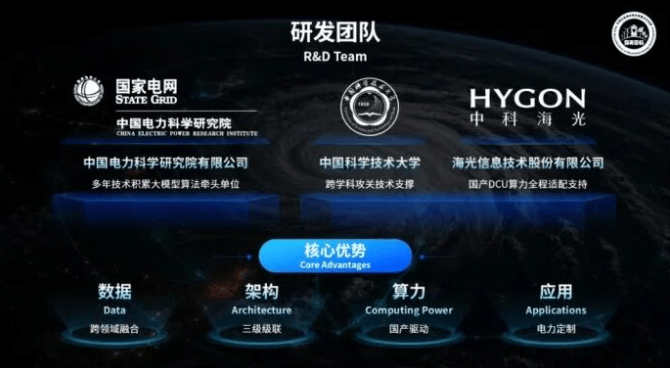
"Jiheng" electric power meteorological large model R&D team and core advantages
The Hygon DCU-3G is fully compatible with mainstream frameworks such as PyTorch and TensorFlow, significantly lowering the barrier to R&D and deployment. Leveraging its high-density computing power and operator-level optimization capabilities, a single DCU card can complete global meteorological forecasting for the next 10 days within 1 minute, improving efficiency a hundredfold over traditional numerical models and providing robust computing support for high-frequency, high-precision grid meteorological forecasting.
Outstanding Real-World Results Set a Benchmark for Domestic Vertical AI Innovation
Built on the tripartite collaborative innovation matrix, "Jiheng" has completed the full closed loop of "demand-driven R&D—dual iteration of data and computing—field validation," evolving from a laboratory technology achievement into a meteorological sentinel guarding the grid day and night.
The deployment results of "Jiheng" validate the success of the tripartite collaboration model of "business traction—algorithm breakthroughs—computing foundation." In terms of forecasting performance, its 10-day wind speed forecast errors are essentially on par with internationally mainstream models, and its near-surface temperature forecasts rank the best among all evaluated models.
Real-world tests across multiple regional grids nationwide confirm that the model's comprehensive forecasting accuracy rivals top international meteorological AI models, with several segmented scenario indicators taking the lead. Power generation prediction accuracy has significantly improved at over 70% of renewable energy stations, enabling early identification of severe convection, blizzards, line icing, and other disasters, reserving ample buffer windows for grid load adjustment, equipment maintenance, and emergency response. The model has now been integrated into multiple provincial power dispatch platforms for 7×24-hour routine operation, with the complete technical solution, hardware configuration, and operational processes mature and comprehensive, fully ready for nationwide large-scale deployment.
Continuous Iteration and Upgrades Empower High-Quality Energy Industry Development
Against the backdrop of new-type power system construction and energy technology self-reliance, the three parties will continue to deepen long-term industry-academia-research collaboration, iteratively optimize the functions and performance of the "Jiheng" model, and continuously refine its intelligent observation, forecasting, and early warning capabilities for electric power meteorology.
The routine deployment of "Jiheng," a full-chain domestic electric power meteorological large model, represents both a key breakthrough in the intelligent transformation of the electric power meteorology sector and a typical example of independent innovation in China's vertical energy AI track driven by industry-academia-research collaboration. Its innovative "scenario + algorithm + computing power" integrated deployment paradigm successfully breaks through overseas technology barriers and the dilemma of general-purpose model deployment, opening the complete pathway from independent R&D and practical application to large-scale promotion for vertical industry large models.
Looking ahead, as technology continues to iterate, application scenarios expand, and innovative models are replicated and promoted, "Jiheng" will continue to unleash the value of domestic AI technology, consolidate the solid foundation for the safe, efficient, and intelligent operation of new-type power systems, support the green transformation and upgrading of China's energy industry and the in-depth implementation of the "dual carbon" goals, and comprehensively empower the overarching landscape of technological self-reliance and high-quality development in the energy sector.