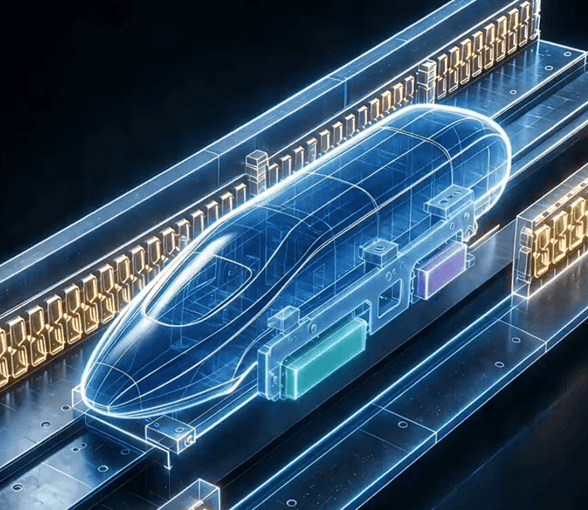
Dimension News, August 10 — At the 1-kilometer high-speed maglev test track at the Hubei East Lake Laboratory, a domestically produced ton-class high-speed rail model achieved a major technological breakthrough:
The test vehicle, weighing 1,110 kilograms, accelerated from a standstill to 800 km/h (close to the cruising speed of some commercial airliners) in just 5.3 seconds, and was able to come to a safe stop within a short distance. This marks the third time in six months that the platform has set a new world record for maglev acceleration of its kind.
The entire test simultaneously addressed acceleration, levitation, positioning, and emergency braking, achieving millimeter-level positioning accuracy at high speeds. After reaching top speed, the test vehicle required only about 200 meters to brake smoothly to a full stop.
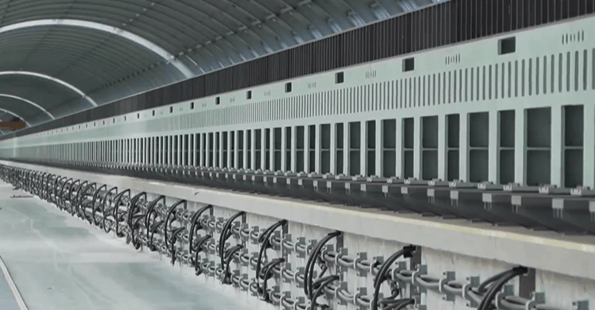
Reviewing the three record-breaking milestones: in June 2025, the test track conducted its first public trial, propelling the test vehicle to 650 km/h in 7.1 seconds, securing the first world record; in July of the same year, the team iterated again, raising the speed to 700 km/h; and in November, they completed the key test of accelerating to 800 km/h in 5.3 seconds, successively rewriting the global record for short-distance maglev acceleration.
The system is driven by electromagnetic propulsion, generating thrust through alternating magnetic fields in the coils. The vehicle operates in full levitation throughout, eliminating wheel-rail friction losses. The propulsion technology has a wide range of applications, with horizontal expansion leading to ultra-high-speed maglev transportation; additionally, it can be used in aerospace electromagnetic launch, maglev elevators, industrial levitation conveying equipment, and other fields.
Industry insiders stated that setting new records three times in a row validates China's strength in underlying technologies such as high-power electromagnetic propulsion, transient power supply, and high-speed levitation control, laying an important experimental foundation for future vacuum-tube ultra-high-speed transportation.
However, it should be made clear that this is a laboratory model vehicle test, not a real vehicle ready for passenger operation. There remains a long engineering cycle before commercial passenger routes can be realized, requiring solutions to practical challenges such as energy consumption, vehicle engineering, and track construction costs.