
American scientists published a research finding in the journal Nature Machine Intelligence on the 10th: a rolling robot named "Tribar" can withstand extremely high-impact landings after falling from a record height and continue to move across complex terrain. This dual breakthrough in engineering and robotics is expected to advance the development of robots suitable for hazardous and remote environments such as planetary surfaces and disaster zones.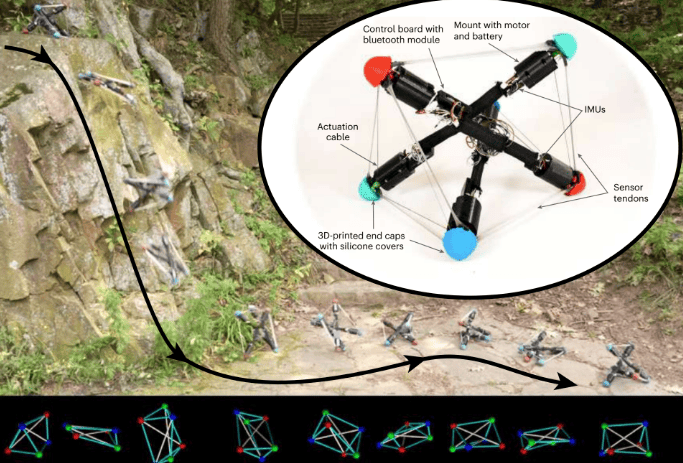
Tribar is a tensegrity robot. This type of robot originates from the "tensegrity" structural concept proposed by architect Buckminster Fuller in the mid-20th century, which maintains structural stability through continuous tension elements and discontinuous compression elements. When this concept was applied to robotics, the robot's body is composed of a network of elastic cables and rigid rods, making the structure flexible and lightweight, capable of absorbing significant external loads like a spring, and resistant to damage even upon impact.
For this reason, researchers have long envisioned using tensegrity robots as future planetary rovers or disaster response platforms. However, maintaining autonomous control and mobility after withstanding severe impacts has always been a key challenge limiting the practical application of such robots.
This time, the Tribar developed by the Yale University team in the United States is a three-rod tensegrity robot specifically designed to balance impact resistance with autonomous control. It is equipped with stretchable sensor "tendons" and onboard motion sensors that enable real-time estimation of its own shape and orientation. The research team tested Tribar in multiple scenarios: it moved stably across grass, ice, gravel, and sand; it could climb slopes of up to 28 degrees; and it could walk along straight, curved, and triangular paths.
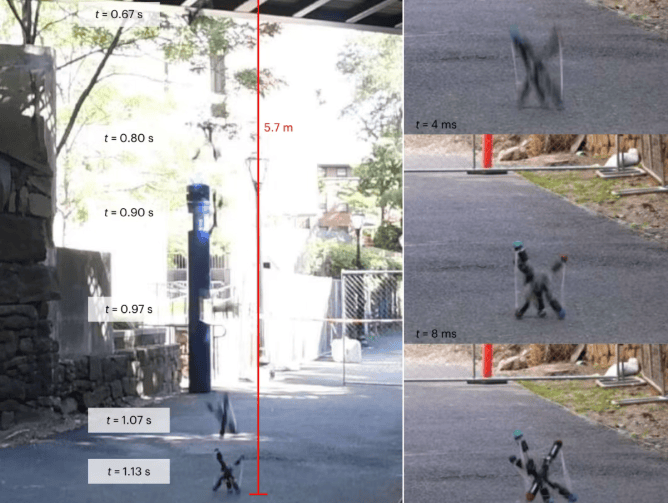
Most notably, Tribar continued moving forward after falling 5.7 meters from a bridge onto an asphalt surface. This is reportedly the highest fall record for a tensegrity robot to date.
The research team noted that combining impact resistance with sensing and control capabilities will help future robots perform tasks in environments that are difficult for traditional robots to access, such as cliffs, craters, or disaster-stricken areas. They stated that this design can serve as a foundational framework for further developing robot systems with high survivability.