
An international team of astronomers led by scientists from the Max Planck Institute for Extraterrestrial Physics in Germany and the University of Cambridge in the UK, using data provided by the James Webb Space Telescope, has discovered three supermassive black holes actively accreting surrounding matter in the galaxy J0148-4214. This marks the first time scientists have found three active black holes in a single galaxy. The related paper was published in the latest issue of the journal Astronomy & Astrophysics.
When observing very distant celestial objects, astronomers find that their spectra shift toward the red end, a phenomenon known as "redshift." Astronomer Edwin Hubble, while observing distant objects, revealed the relationship between redshift and distance: the greater the redshift, the farther the object is from us. Using redshift, scientists have determined that the galaxy J0148-4214 is more than 12.5 billion light-years away from Earth.
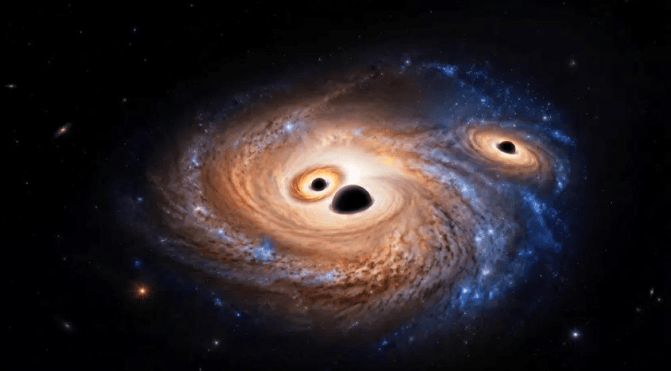
The team confirmed the existence of these black holes through spectral fingerprint identification, specifically the characteristic of hydrogen atoms moving at high speeds within the gravitational influence of the black holes. Two of the black holes have masses of 80 million and 600,000 times that of the Sun, respectively. They are located at the center of the galaxy, separated by only 620 light-years. The third black hole, with a mass of approximately 2 million times that of the Sun, is situated in the outer region of the galaxy, about 5,500 light-years from the center.
The team stated that the data provided by the James Webb Space Telescope not only helped them identify these three black holes but also enabled them to estimate the black holes' masses, accretion rates, and the galaxy's stellar mass. The study shows that the galaxy's total stellar mass is approximately 1.3 billion times that of the Sun, with the black holes accounting for a considerable proportion of it.
The pair of black holes at the galaxy's center is expected to merge within the next few hundred million years. The third black hole, located at the galaxy's edge, may be the remnant of a previous black hole merger.