
On August 17, at a depth of 80 meters beneath the seabed on the Ningbo side of the Jintang Subsea Tunnel on the Yongzhou Railway, constructed by China Railway 14th Bureau Group, China's first shield saturation hyperbaric intervention system, the "Deep-Sea Space Station," completed inspection and replacement of 104 cutter tools under a water pressure of 7.8 bar, setting a new national record for the highest pressure for hyperbaric intervention in shield tunneling.
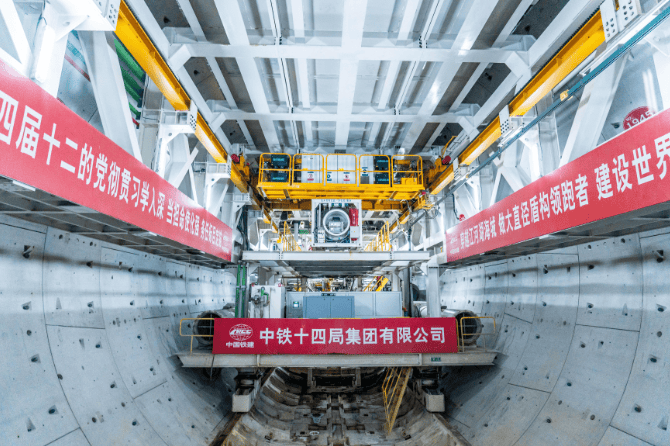
The Jintang Subsea Tunnel is a critical control project of the entire Yongzhou Railway, spanning the Jintang Waterway between Ningbo and Zhoushan. With a total length of 16.18 kilometers, including an 11.21-kilometer subsea shield section, it is the world's longest subsea high-speed railway tunnel. The "Yongzhou" shield machine is responsible for the 4,940-meter boring task on the Ningbo side, requiring 24 crossings through alternating soft and hard strata. Hard rock and uneven soft-hard formations account for nearly 70% of the route, with rock strength reaching up to 191 megapascals. The lowest point of the tunnel lies 92 meters below sea level, with extreme water and soil pressure reaching 8.5 bar, and the high-water-pressure zone exceeding 6 bar extends for 2,000 meters.
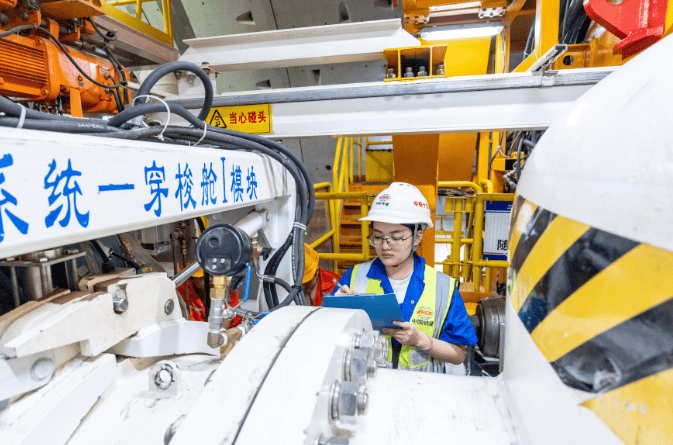
Under these geological conditions, the cutter tools of the "Yongzhou" shield machine wear out rapidly, requiring multiple stoppages for tool changes during excavation. To address the challenge of high-pressure tool changes beneath the seabed, China Railway 14th Bureau Group, in collaboration with the Shanghai Salvage Bureau of the Ministry of Transport, spent three years developing China's first domestically produced shield saturation hyperbaric intervention system, the "Deep-Sea Space Station." The system comprises a full set of autonomous functional modules, including the Ninghai (living) chamber, the Tanhai (shuttle) chamber, and the Zhenhai (control) chamber, with a maximum designed operating depth of 100 meters.
"Compared to other hyperbaric intervention methods that require repeated pressurization and decompression cycles, the saturation hyperbaric intervention technique uses a scientifically formulated gas mixture to pressurize personnel in a single step to the same high-pressure environment as the tunnel face. Once the inert gases in their bodies reach a saturated state, they can remain in the Ninghai chamber for extended periods," explained Hu Hao, project manager of the Jintang Subsea Tunnel on the Yongzhou Railway under China Railway 14th Bureau Group.
The "Deep-Sea Space Station" had previously completed its first practical application, with nine operators stationed at a depth of 75 meters for 22 days, replacing a total of 46 cutter tools. Compared to the initial operation, this tool change presented comprehensively greater challenges, with the environmental depth reaching 80 meters. With the tool replacement work fully completed, all operators have returned to the Ninghai living chamber and entered a three-day gradual decompression procedure.
Currently, the "Yongzhou" shield machine has advanced 3,936 meters, completing nearly 80% of its boring task. In the next phase, the project team will systematically summarize construction data, develop a standardized safety management system, and promote the standardization and replicability of this technology, building indigenous core capabilities for China's deep-sea crossings and deep underground space development.