
On August 19, 2026, the Zhuque-3 Y2 carrier rocket lifted off from the Dongfeng Commercial Aerospace Innovation Test Area, and its first stage successfully completed a land recovery as scheduled, marking a complete success for the mission.
This mission marks China's first successful recovery of a reusable carrier rocket's first stage using landing legs, signifying a major breakthrough in China's reusable rocket technology.
Reusable Rockets Boost Low-Orbit Constellation Deployment
The Zhuque-3 carrier rocket is a new-generation low-cost, high-capacity, high-frequency, reusable liquid oxygen-methane carrier rocket model approved by the China National Space Administration. This rocket adopts a single-core, two-stage tandem configuration, with a total length of 66.1 meters, a first and second stage diameter of 4.5 meters, and a payload fairing diameter of 5.2 meters.
According to the head of the model's development team, the rocket's main structure uses stainless steel materials, with an overall layout of "fuel tank on top, oxygen tank on bottom" to optimize the flight center of mass.
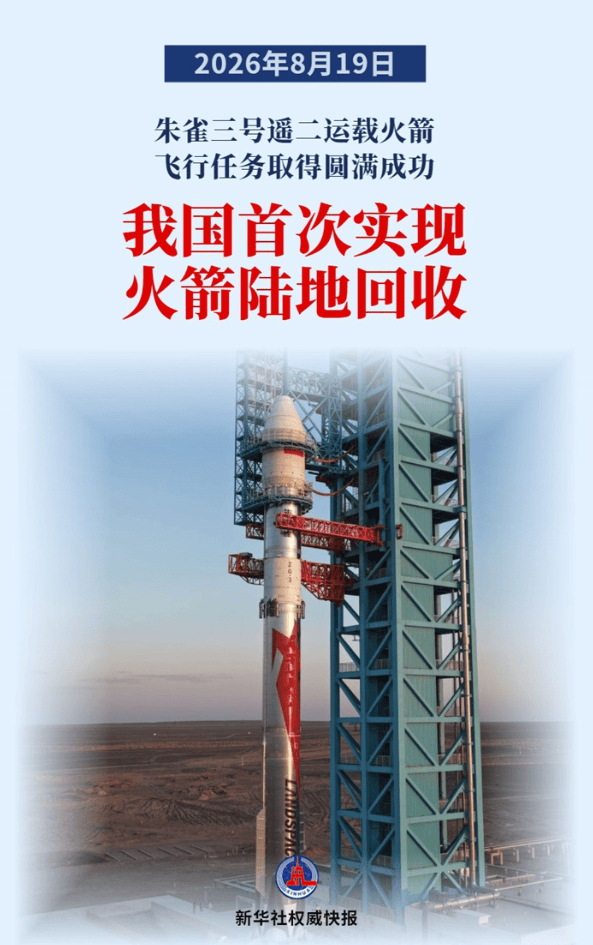
The rocket's first stage is equipped with nine Tianque-12A liquid oxygen-methane engines, with a propulsion system adjustable between 40% and 110% thrust, enabling vertical recovery and reuse after completing orbital launches.
In April 2026, China deployed plans to strengthen the construction of "six networks," including a new-generation communication network.
At the outset of the 15th Five-Year Plan period, new space-based productive forces represented by satellite internet and new space-based "transport capacity" represented by reusable rockets serve as a crucial "foundation" for achieving integrated space-air-ground-sea connectivity and the fusion of communication, sensing, computing, and intelligence.
Industry experts believe that the successful validation of the Zhuque-3's "liquid oxygen-methane propellant + stainless steel rocket body + vertical recovery" technical route is expected to accelerate the deployment of China's low-orbit constellation.
Not Just "Getting Up" but Also "Coming Back and Landing Accurately"
The difficulty of reusable rockets lies not only in "getting up" but also in "coming back and landing accurately."
Simplifying the landing propulsion scheme, reducing the number of ignition engines, and lowering system complexity; upgrading safety control strategies, adding predicted landing point safety control functions, and improving recovery safety; increasing the second-stage engine nozzle expansion ratio to effectively unlock payload potential... The Zhuque-3 achieved multiple technological breakthroughs in this mission.
In terms of satellite separation, the rocket tested a self-developed stacked compression-release device, exploring a dual-redundancy design to ensure reliable multi-satellite separation.
From the approval of the Zhuque-3 project in August 2023 to the successful orbital insertion of the second stage and successful recovery of the first stage in August 2026, the world has witnessed the "China speed" of commercial aerospace breaking through the soil and pursuing innovation.
The More Times a Rocket Is Reused, the Lower the Launch Cost
"Under normal circumstances, liquid oxygen-methane fuel costs account for 1% to 3% of launch costs, while the first stage accounts for approximately 70% of the total rocket cost. The more times a rocket is reused, the lower the launch cost," said the head of the model's development team.
According to reports, LandSpace plans to implement reuse missions for the recovered rocket body as soon as possible, accelerating the establishment of a closed-loop "launch-recovery-inspection-reuse" system to lay the foundation for future high-frequency, low-cost commercial operations.
In the next step, the China National Space Administration will continue to advance the engineering application of China's reusable carrier rockets, effectively enhancing China's capability for high-capacity, low-cost, and high-frequency access to space.