
On August 12, a research team from the University of Illinois Urbana-Champaign in the United States developed a new type of molecule with a permanent charge that uses electricity to drive a liquid-liquid extraction process, selectively recovering gold from electronic waste leachate. Experimental results show that this method can reduce chemical usage in the separation step by one to two orders of magnitude, equivalent to a reduction of approximately 90% to 99%.
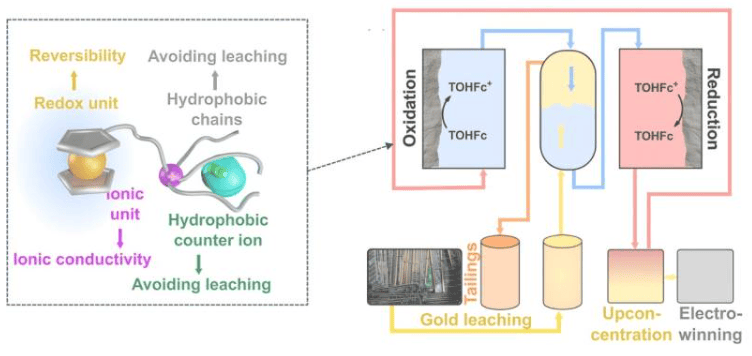
Traditional liquid-liquid extraction transfers and separates metal ions using two immiscible liquids, typically requiring large amounts of acids, bases, and intermediate chemical reagents. The research team's previously developed electrochemical liquid-liquid extraction process was already able to recover gold and platinum group metals using redox reactions, but still required the addition of auxiliary reagents to complete the metal extraction and release cycle.
The new molecule simultaneously possesses metal-selective binding, a permanent charge, and solubility in the organic phase. Its built-in charge can serve as an electrolyte, allowing the extraction solution to conduct electricity. When electricity is applied, the molecule's redox state changes and it binds with gold ions, transferring them to the organic phase; after adjusting the electrical signal, the molecule releases the gold and re-enters the next separation cycle, thereby eliminating the need for intermediate chemical reagents.
The research team has completed laboratory validation using electronic waste leachate. Valuable metals from electronic waste first enter the leachate, and the new molecule then selectively captures the gold within it. This study primarily validates the molecular design and electrochemical extraction mechanism, and has not yet published data on the processing scale, gold recovery rate, or unit energy consumption of a continuous industrial unit.
By adjusting the chemical structure of the extraction molecules, this electrochemical platform can also be used to recover platinum group metals from spent automotive catalysts, as well as other critical metals from mine tailings and industrial waste streams. The main structure of the separation platform can remain unchanged, requiring only modifications to the binding sites and redox properties of the extractant based on the target metal.
The research findings have been published in ACS Energy Letters, with funding support from the Basic Energy Sciences program of the U.S. Department of Energy's Office of Science. The team's next steps include advancing process scale-up and industrial application research, as well as using computational simulation and artificial intelligence to accelerate the design of extraction molecules for different metals.