
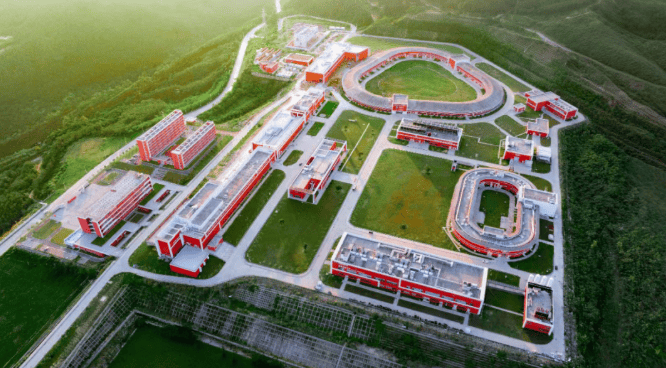
On the Renzhen Peninsula in Huizhou, Guangdong, several red buildings have risen from the ground, two of which are particularly eye-catching: one shaped like a rounded triangle, the other resembling a giant running track. Thirteen meters underground, a two-kilometer-long tunnel lies hidden. What is housed here is none other than the national major scientific and technological infrastructure—the High Intensity heavy-ion Accelerator Facility (HIAF).
On July 21, HIAF successfully passed its process acceptance review. The expert review panel unanimously concluded that HIAF's comprehensive performance has reached a leading level among similar international facilities, marking a leapfrog development in China's high-intensity heavy-ion accelerator technology. With this, all construction components of the project have been completed, and the facility has officially entered trial operation, opening its doors to scientific research.
"HIAF is the world's first advanced heavy-ion research facility that integrates a superconducting linear accelerator, a synchrotron, and storage rings into one system," said Yang Jiancheng, Deputy Director of the Institute of Modern Physics, Chinese Academy of Sciences, and Chief Engineer of the High Intensity heavy-ion Accelerator Facility. It provides the highest pulsed beam intensity of heavy-ion beams currently available internationally, equipped with the highest-precision nuclear mass ring spectrometer, offering a first-class research platform for cutting-edge nuclear science and major heavy-ion applications.
Innovative proposal of a new six-dimensional phase space painting scheme
What exactly is HIAF? Yang Jiancheng drew an analogy: it is both a "super microscope" and an "ion cannon."
In simple terms, a heavy-ion accelerator uses artificial methods to create high-speed ion beams that precisely bombard target materials, producing a large number of particle fragments. Scientists then analyze these fragments to peel away the microscopic structure of matter layer by layer.
As early as the 1980s, China built its first large-scale heavy-ion accelerator—the Heavy Ion Research Facility in Lanzhou (HIRFL). Why build HIAF as well? Yang Jiancheng said with a smile: "As scientific research delves deeper into the microscopic world and pushes toward extreme conditions, building a high-performance, high-intensity heavy-ion accelerator has become an urgent need to advance the frontiers of nuclear science."
The Institute of Modern Physics, Chinese Academy of Sciences, proposed the concept of building HIAF in 2009. In December 2018, construction of HIAF officially began in Huizhou, and the facility successfully produced its first beam in October 2025.
The starting point of the entire facility lies 13 meters underground, where a superconducting ion source is installed. Its job is to strip away some of the electrons from atoms, turning them into charged ions and providing them with initial energy.
The core indicator of a new-generation accelerator is "high beam intensity." How to enable the ion source to produce stronger beams is also a current focus of international research. "This is the world's first fourth-generation superconducting electron cyclotron resonance (ECR) ion source developed in-house by our team," Shen Guodong, head of the Accelerator Division at the Accelerator Technology Center, told reporters, pointing to a large white machine. "The team increased the microwave frequency to 45 gigahertz, setting a world record for the highest beam intensity of an ECR ion source."
The ion source operates in pulsed beam mode, using precise timing control to achieve instantaneous beam extraction under optimal conditions. "This process is like precisely regulating the throttle and ignition timing of an engine, allowing the ion beam to reach its optimal working state at the moment of 'launch,'" Shen Guodong said.
Innovation goes far beyond this. To accumulate a large number of particles to ultra-high beam intensity, they must also be kept orderly and aligned—a world-class challenge that has seen no major breakthroughs internationally for over 20 years. The team's proposed new method of "six-dimensional phase space painting + independent clock stacking" not only extends the injection method previously confined to two-dimensional space to six dimensions but also breaks the circumference ratio limitation.
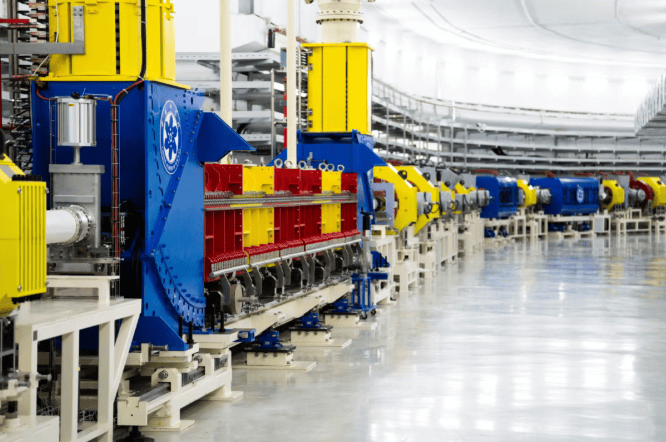
"This is like first choreographing a formation drill for billions of 'ion bullets,' spreading them evenly in phase space, and then using an independent clock to precisely command the ions to be injected into the main accelerator in batches and staggered sequences," Yang Jiancheng explained vividly. "This achieves millisecond-level synchronization without interference, ultimately accumulating the high-intensity, high-quality ion beams required for experiments."
It is precisely this breakthrough that has increased HIAF's beam intensity accumulation gain by 10 times compared to the highest international level, while reducing beam loss by an order of magnitude.
Breaking the international record for pulsed heavy-ion beam intensity
"The core equipment of HIAF has achieved full domestic production," Yang Jiancheng said proudly. "We have built the heavy-ion accelerator with the highest pulsed beam intensity in the world!"
This confidence stems from the team's unwavering dedication over sixteen years and their determination to tackle the toughest challenges.
To ensure unimpeded heavy-ion beam transport, the team first had to lay a "highway"—the vacuum pipeline. "Heavy ions travel hundreds of thousands of laps per second. This intense process tolerates not a single speck of dust, otherwise the beam would collide with gas molecules and 'crash,'" said Jiao Jiqiang, an engineer from the Vacuum Technology Division at the Accelerator Technology Center, revealing their unique expertise: the world's first skeleton-lined ultra-thin-wall extreme high vacuum chamber.
The skin of this vacuum chamber is as thin as a cicada's wing, measuring only 0.3 millimeters—equivalent to the thickness of three sheets of A4 paper stacked together. Inside, it is supported by a 3D-printed titanium alloy skeleton with a thickness of just 4 millimeters. The vacuum level inside is even higher than that on the lunar surface. Moreover, this design is not only sturdy and produces low eddy currents but also significantly reduces construction costs.
Running fast is not enough; it must also run steadily. In HIAF's power supply system, the booster dipole magnet pulsed power supply plays the role of a "precise helmsman" for beam operation. The team developed the world's first non-resonant pre-excitation full-energy storage fast-cycle pulsed power supply, solving the challenge of extremely rapid current changes and high-precision control during pulsed operation.
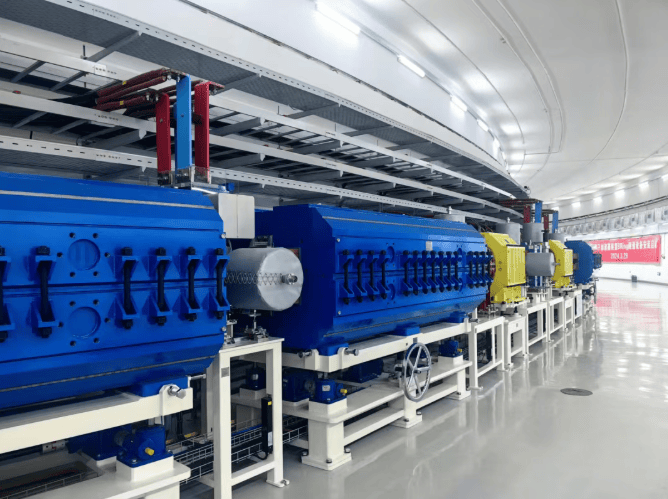
This power supply achieves the world's fastest current ramp rate of 38,000 amperes per second, with a tracking error of less than 0.2 amperes. "This is equivalent to a super race car traveling at approximately 140,000 kilometers per hour on a highway from Beijing to Shanghai, deviating from its lane by no more than 20 centimeters throughout the entire journey," said Wang Xiaojun, Deputy Director of the Power Supply Technology Division at the Accelerator Technology Center.
For the beam to keep "running," it requires a continuous source of power. Accelerating heavy-ion beams to high energies depends on the beam's "super engine"—the radio frequency (RF) system. However, the core component of this system, the "large-size oil-cooled magnetic alloy ring," had faced strict foreign embargoes and technology blockades.
"When the facility officially broke ground, this component had not yet been developed, and the pressure on everyone was immense," recalled Cong Yan, Director of the RF Technology Division at the Accelerator Technology Center. At the time, collaboration with multiple domestic manufacturers progressed slowly, and samples struggled to meet requirements. They conducted repeated experiments starting from the raw materials and ultimately succeeded in developing a domestically produced high-performance magnetic alloy ring, with core performance parameters surpassing international counterparts by more than 60%.
Thanks to full-chain independent innovation, HIAF achieved full beamline commissioning across its 2-kilometer line in 16 hours, setting a new record for beam commissioning speed among similar international facilities. HIAF's typical oxygen ion beam and bismuth ion beam intensities both broke international records, increasing the previous highest international standards by 3 times and 7.5 times, respectively. Many experiments that previously required months or even years to accumulate data could now potentially be completed in days or even hours.
Expected to synthesize China's own new elements
HIAF's beamline spans a total length of 2 kilometers, equipped with 6,000 large-scale devices, over 5 million components, and 1.5 million meters of process pipelines. For such a large-scale, highly complex scientific facility, international projects typically require two to three years for installation. However, the HIAF team built a full-system digital twin collaborative platform, compressing the construction period to just 8 months. This technology has already been extended to the construction of several other major scientific facilities, including the Hefei Advanced Light Source and the Advanced Attosecond Laser Facility.
As the world's first "superconducting linac + fast-cycling synchrotron + cascaded storage ring" accelerator major scientific facility, HIAF's unique "three-in-one" configuration brings two core advantages: first, full ion species coverage, enabling it to meet research needs across multiple disciplines; second, ultra-high beam intensity, meaning it can provide richer experimental data and produce more new nuclides that were previously difficult to generate, helping researchers discover new physical phenomena.
Yang Jiancheng said with great anticipation: "With this major scientific facility, Chinese scientists are expected to synthesize China's own new elements and plant the five-star red flag on the periodic table." Currently, the periodic table has 118 elements, and the seventh period has been fully filled. The United States, Russia, Germany, Japan, and other countries have successfully synthesized 15 new elements, naming them after their respective countries or locations. Exploring the synthesis of new elements 119 and 120 is one of HIAF's key scientific goals.
Beyond exploring the limits of atomic nuclei, once the facility is operational, it will also focus on revealing nuclear astrophysical processes, advancing nuclear energy development, and multidisciplinary applications. For example, HIAF can be used for radiation resistance testing of spacecraft, promoting nuclear energy development and functional materials research, and will play a significant role in people's livelihoods, such as advancing heavy-ion cancer therapy and the development of medical isotope drugs, as well as applications in crop breeding and food preservation. Currently, a new generation of affordable heavy-ion radiotherapy devices based on HIAF's advanced technology has been deployed at Huizhou Central People's Hospital.
It is worth noting that the team has also kept a card up their sleeve for the future. "The superconducting linear accelerator tunnel is nearly 400 meters long, with over 100 meters currently installed. The remaining 200-plus meters are reserved for future upgrades and iterations," Shen Guodong said. This forward-looking design allows the major scientific facility to adapt smoothly to evolving research needs in the future.
"From nothing to something, from following to leading, we have carved China's solution into the world's technology landscape and built a 'national heavy weapon' that leads the frontiers of nuclear science and major applications," Yang Jiancheng stated. "At this new starting point, we look forward to providing users with high-performance, high-quality beams and contributing to major scientific achievements."